
By
Noel A. Ihebuzor
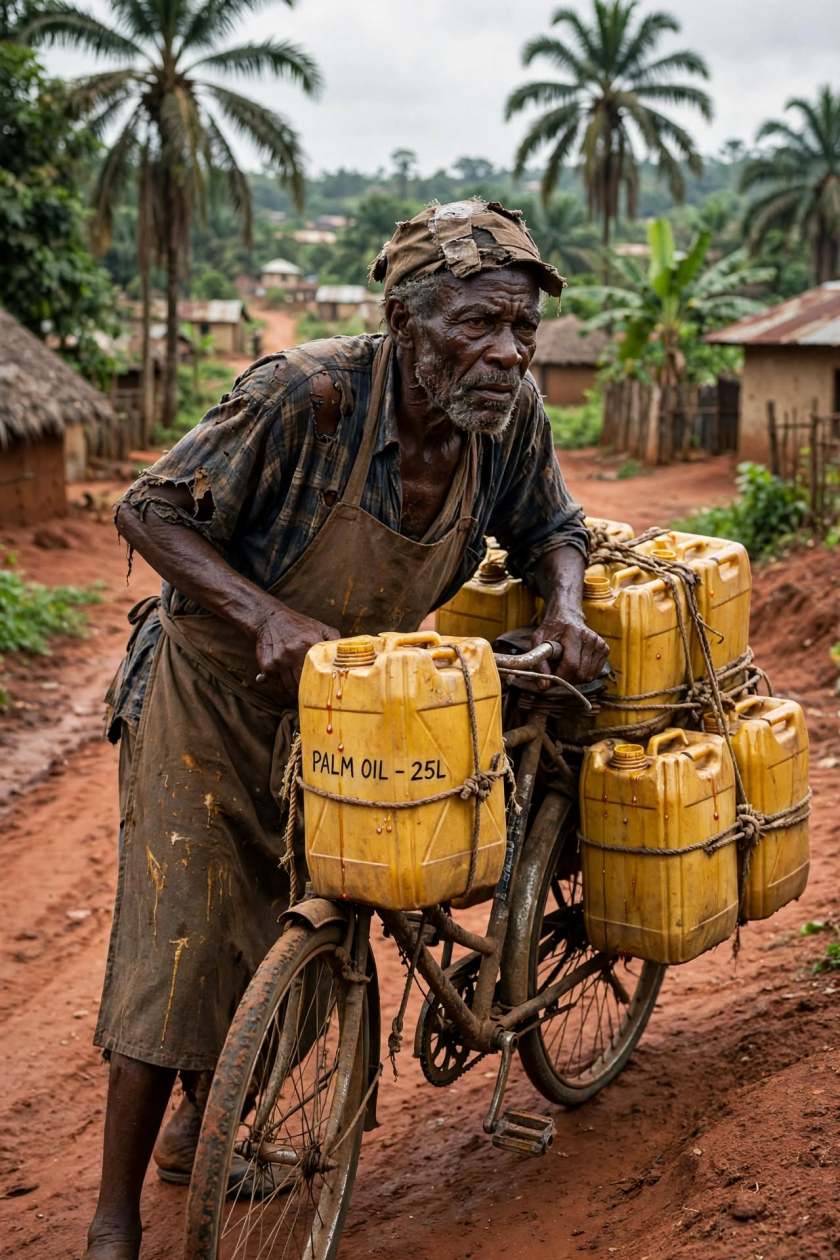
John Munonye’s The Oil Man of Obange invites a reconsideration of what constitutes tragedy and, more importantly, whose suffering is considered worthy of tragic representation. In the classical conception of tragedy, particularly as inherited from Greek drama, the tragic protagonist is frequently a person of elevated social standing whose fall from fortune is associated with error, misjudgment, or hamartia. Tragedy derives part of its force from the distance between the protagonist’s former stature and his eventual ruin. Munonye radically alters this configuration. His protagonist, Jeri, has no great height from which to fall. He is an ordinary palm-oil trader struggling to sustain himself and his family in a precarious colonial economy. His tragedy lies not in falling from greatness but in the exhausting struggle to achieve even a modest degree of security.
It is precisely this ordinariness that gives The Oil Man of Obange its distinctive tragic power. Munonye relocates tragedy from the palace to the marketplace, from the exceptional individual to the economically vulnerable household. Jeri is neither king nor warrior, neither statesman nor aristocrat. His aspirations are correspondingly modest: to work, provide for his family, educate his children, preserve his dignity and gradually improve his material circumstances. Yet the novel demonstrates how even these modest ambitions can become heroic when pursued under conditions of persistent deprivation and insecurity.
Jeri may therefore be understood as the protagonist of a modern social tragedy—a tragedy in which vulnerability, rather than hamartia, assumes explanatory importance. His suffering does not arise primarily from a fatal defect of character. Indeed, many of the qualities traditionally regarded as virtues—industry, perseverance, responsibility, thrift and devotion to family—are strongly present in him. The tragic irony is that these virtues prove insufficient. Munonye presents a social environment in which personal virtue cannot always compensate for structural disadvantage.
Adversity and the Architecture of Tragedy
Munonye constructs Jeri’s tragedy cumulatively. Adversity does not arrive as a single catastrophic event. Instead, the novel subjects him to a succession of pressures whose combined effects gradually diminish his capacity to recover. Taxation, financial insecurity, family obligations, bereavement, educational expenses, accident and the premature assumption of adult responsibilities by his daughter form part of an expanding field of misfortune.
This accumulation is crucial to the novel’s tragic method. A relatively prosperous individual may absorb an isolated shock; a poor household often cannot. The significance of adversity therefore depends not simply on the severity of the event itself but also on the resources available to the person experiencing it. Jeri’s vulnerability lies precisely in the narrowness of his margin for error. He possesses few reserves with which to absorb misfortune.
Munonye reinforces this vulnerability through the physical representation of his protagonist. Jeri’s scarred hands and his clothing—including the memorable oversized black shorts—locate him firmly within the world of manual labour and material scarcity. His body becomes, in a sense, an archive of hardship. The marks of labour upon him remind the reader that poverty in the novel is not an abstraction. It is lived physically, socially and psychologically.
This representational strategy generates pathos without requiring Jeri to be conventionally heroic. The reader’s sympathy derives from witnessing the disproportion between his efforts and his rewards. He works, saves, sacrifices and persists, yet every modest gain remains exposed to destruction by another unforeseen event.
Resilience and Its Limits
One of Jeri’s defining characteristics is resilience. Each encounter with adversity produces an effort at recovery. He refuses to surrender easily to despair, and Munonye repeatedly allows him to reconstitute his hopes after they have been damaged. In contemporary psychological language, one might describe Jeri as possessing considerable self-efficacy: he continues to believe that purposeful action can improve his circumstances.
Yet The Oil Man of Obange complicates any simplistic celebration of resilience. Jeri’s persistence does not guarantee success. This is one of the novel’s most important insights. Resilience is valuable, but resilience without resources has limits.
The distinction is critical. Popular narratives of success often suggest that perseverance eventually triumphs over adversity. Munonye offers a more disturbing proposition: perseverance may be necessary for survival while remaining insufficient for escape from poverty. Jeri can recover psychologically from one setback, but each recovery consumes resources—money, property, labour, social standing and emotional strength. Resilience itself therefore becomes progressively more expensive.
This is particularly evident when financial pressures force Jeri into increasingly desperate coping strategies. Funeral expenses, school fees, accident and other demands erode the small economic base upon which his aspirations depend. His eventual willingness to surrender land is especially significant. Land represents more than an immediately disposable economic asset. In the social world represented by the novel, it carries implications of security, continuity and belonging. To relinquish it is therefore to mortgage part of the future in order to survive the present.
Munonye thus exposes what might be called the paradox of poverty: the poor frequently survive today’s crisis by sacrificing resources needed to protect themselves against tomorrow’s.
Deferred Gratification and the Collapse of the Future
Jeri’s economic behaviour may also be interpreted through the concept of deferred gratification. He repeatedly accepts present hardship in anticipation of future improvement. His labour, savings and sacrifices are investments in a future that he imagines will be better than the present. Education, family advancement and economic security constitute different versions of this deferred future.
In conventional economic reasoning, postponing immediate consumption may permit accumulation and eventual improvement in welfare. But Munonye introduces a crucial qualification: deferred gratification works only where the present and its structures are sufficiently secure for sacrifice to yield its expected return in the future. Jeri inhabits no such secure environment.
Every attempt at accumulation remains vulnerable to illness, death, taxation, family emergency, and accident. Consequently, the future continually consumes the resources accumulated for it before it can arrive. The irony is devastating. Jeri sacrifices the present for the future, but repeated crises compel him to spend the future merely to survive the present.
The novel therefore transforms deferred gratification from a straightforward economic virtue into a tragic mechanism. Prudence cannot guarantee prosperity when individuals are exposed to risks against which they possess little protection.
The Death of Marcelina and the Social Production of Tragedy
The death of Jeri’s wife, Marcelina, is particularly revealing. Her death from tetanus carries significance beyond personal bereavement. It directs attention towards the inadequacy of the social and medical environment within which the family exists. What is experienced privately as devastating grief may simultaneously be understood as evidence of wider institutional deprivation.
This is an important feature of Munonye’s tragic vision. Misfortune appears personal because individuals experience its consequences, yet its origins and severity are often social. Illness becomes catastrophic where healthcare is inaccessible or inadequate. Bereavement becomes economically ruinous where households lack insurance or meaningful social protection. Educational aspiration becomes fragile where school costs must compete with subsistence. An accident becomes an existential economic threat where savings are negligible.
Munonye thereby blurs the distinction between private tragedy and public failure.
The circumstances surrounding Jeri’s daughter deepen this critique. Her pregnancy at thirteen and her decision to leave school in order to assist the family represent more than an individual misfortune. Childhood itself becomes a casualty of household vulnerability. The pressures generated by poverty travel across generations: the crisis experienced by the parents reshapes the possibilities available to the children.
The tragedy is therefore not Jeri’s alone. His vulnerability becomes familial and potentially intergenerational.
Community Without a Safety Net
Another striking feature of the novel is the contrast between communal recognition and effective communal assistance. Jeri may attract sympathy and even admiration, but sympathy does not necessarily translate into material protection.
This distinction deserves attention because it complicates romantic assumptions about traditional communal solidarity. Community can provide identity, companionship and moral recognition while remaining incapable of absorbing severe economic shocks. The people around Jeri may recognise his suffering, yet recognition cannot pay school fees, replace lost income, provide medical treatment or restore depleted assets.
Munonye therefore presents a society in which social relationships exist but an adequate social safety net does not. Jeri remains surrounded by people and yet, at crucial moments, structurally alone.
His vulnerability is consequently not simply the condition of being poor. It is the condition of possessing insufficient alternatives. Poverty narrows the range of possible responses to adversity. The wealthy confront crises with buffers; the poor confront them with choices between necessities.
Jeri’s predicament illustrates this distinction with painful clarity.
From Hamartia to Vulnerability
It is here that Munonye’s contribution to the idea of tragedy becomes most apparent. Classical tragedy often encourages the question: what flaw or error brought the protagonist to this end? The Oil Man of Obange encourages a different question: what resources did the protagonist possess with which to prevent this end?
The shift is profound.
Jeri’s tragedy is not convincingly explained by identifying a single fatal character flaw. His problem is not an excess of ambition comparable to that of certain classical tragic figures, nor an overwhelming pride that blinds him to reality. His aspirations are modest and socially recognisable. He wants security for himself and his family.
The source of tragedy therefore migrates from character towards condition.
This does not mean that Jeri lacks agency or that every decision he makes must be regarded as correct. Rather, it means that his decisions occur within severely restricted circumstances. Agency exists, but it is constrained agency. Choice exists, but the available choices are often between competing forms of loss.
From this perspective, vulnerability performs some of the narrative work traditionally assigned to hamartia. It exposes Jeri repeatedly to consequences from which more privileged individuals might recover. His poverty magnifies ordinary misfortunes into existential threats.
The tragedy of Jeri is thus not that a great man falls. It is that an ordinary man is given so little room in which to remain standing.
The Ethics of Munonye’s Tragic Method
The relentless accumulation of adversity inevitably raises an aesthetic and ethical question: does Munonye subject Jeri to too much suffering? At what point does the accumulation of calamities risk appearing authorially contrived?
The question is legitimate because tragedy depends upon plausibility. If suffering appears arbitrarily imposed merely to manipulate the reader’s emotions, pathos can deteriorate into sentimentality.
Yet the cumulative structure of Jeri’s suffering can be defended on precisely sociological grounds. Vulnerability tends to be cumulative. One shock depletes the resources needed to withstand the next. Illness produces expenditure; expenditure consumes savings; depleted savings increase exposure to subsequent crises; crisis may require the sale of productive assets; loss of assets then increases future vulnerability. What may appear, from a position of security, to be an improbable succession of disasters may represent the lived logic of chronic poverty.
Munonye’s apparent excess therefore has a deeper realism. Jeri is not merely unlucky again and again. He is progressively less protected against being unlucky.
This distinction is essential to understanding the novel.
Conclusion: A Tragedy Without Kings
The Oil Man of Obange ultimately enlarges the moral territory of tragedy. Munonye demonstrates that tragic dignity need not depend upon social rank and that catastrophic suffering need not begin with an extraordinary flaw. The life of an ordinary palm-oil trader can carry tragic weight because the fundamental materials of tragedy—hope, striving, attachment, loss, endurance and defeat—are not the exclusive possessions of kings.
Jeri emerges as a compelling tragic protagonist precisely because his aspirations are so recognisably human. He asks comparatively little of life: the opportunity to work, support his family, educate his children and achieve some measure of security. Yet the social and economic environment continually raises the cost of these modest aspirations.
His resilience intensifies rather than diminishes the tragedy. Had Jeri surrendered immediately, his fate might merely evoke pity. Because he repeatedly rises, struggles and attempts to rebuild, each subsequent reversal acquires greater emotional force. Munonye makes us witnesses not simply to suffering but to the gradual exhaustion of the resources with which suffering can be resisted.
The novel consequently proposes a powerful revision of the tragic form. In place of the classical movement from greatness to ruin, Munonye gives us the struggle from vulnerability towards security—and the repeated interruption of that struggle by forces larger than the individual’s capacity to absorb them. In place of hamartia, he gives us precarity; in place of the palace, the poor household; in place of the fallen great man, the ordinary working man attempting to preserve his dignity.
The most disturbing question raised by Jeri’s experience is therefore not whether he possessed sufficient resilience. He plainly did. The more important question is how much resilience society can reasonably demand from a human being before the celebration of endurance becomes an excuse for the absence of protection.
Munonye’s achievement lies in making that question tragic. Jeri’s defeat is moving not because he is extraordinary, but because he is ordinary—and because the forces that overwhelm him are precisely the kinds of forces to which ordinary lives remain most exposed. The Oil Man of Obange thus makes a persuasive case for a tragedy of the vulnerable: a modern tragic form in which the measure of the protagonist is not the height from which he falls, but the courage with which he struggles, again and again, to rise.


