Posted in Creative writing, hope, disappointment,, Literature, Aesthetics, power

The Tragedy of the Ordinary Man: Vulnerability, Resilience and Adversity in John Munonye’s The Oil Man of Obangi

By

Noel A. Ihebuzor

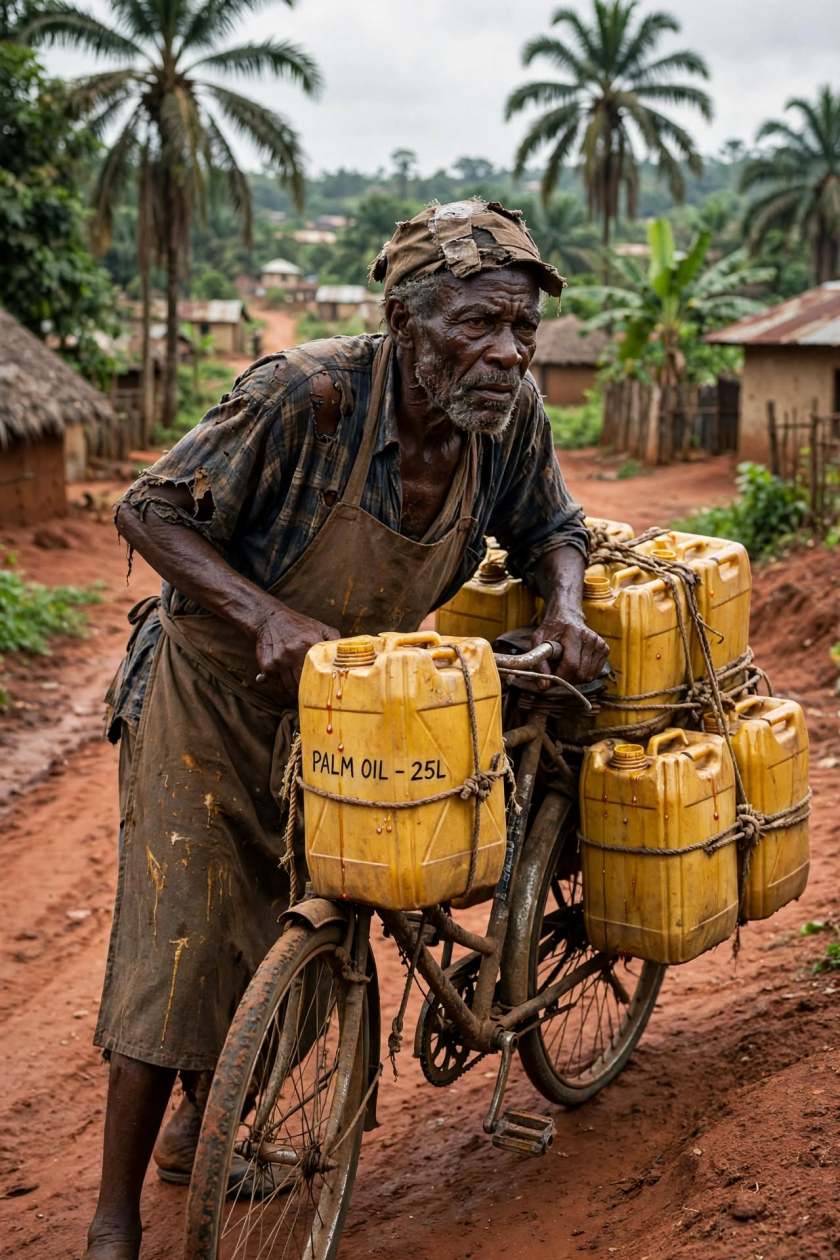
John Munonye’s The Oil Man of Obange invites a reconsideration of what constitutes tragedy and, more importantly, whose suffering is considered worthy of tragic representation. In the classical conception of tragedy, particularly as inherited from Greek drama, the tragic protagonist is frequently a person of elevated social standing whose fall from fortune is associated with error, misjudgment, or hamartia. Tragedy derives part of its force from the distance between the protagonist’s former stature and his eventual ruin. Munonye radically alters this configuration. His protagonist, Jeri, has no great height from which to fall. He is an ordinary palm-oil trader struggling to sustain himself and his family in a precarious colonial economy. His tragedy lies not in falling from greatness but in the exhausting struggle to achieve even a modest degree of security.

It is precisely this ordinariness that gives The Oil Man of Obange its distinctive tragic power. Munonye relocates tragedy from the palace to the marketplace, from the exceptional individual to the economically vulnerable household. Jeri is neither king nor warrior, neither statesman nor aristocrat. His aspirations are correspondingly modest: to work, provide for his family, educate his children, preserve his dignity and gradually improve his material circumstances. Yet the novel demonstrates how even these modest ambitions can become heroic when pursued under conditions of persistent deprivation and insecurity.

Jeri may therefore be understood as the protagonist of a modern social tragedy—a tragedy in which vulnerability, rather than hamartia, assumes explanatory importance. His suffering does not arise primarily from a fatal defect of character. Indeed, many of the qualities traditionally regarded as virtues—industry, perseverance, responsibility, thrift and devotion to family—are strongly present in him. The tragic irony is that these virtues prove insufficient. Munonye presents a social environment in which personal virtue cannot always compensate for structural disadvantage.

Adversity and the Architecture of Tragedy

Munonye constructs Jeri’s tragedy cumulatively. Adversity does not arrive as a single catastrophic event. Instead, the novel subjects him to a succession of pressures whose combined effects gradually diminish his capacity to recover. Taxation, financial insecurity, family obligations, bereavement, educational expenses, accident and the premature assumption of adult responsibilities by his daughter form part of an expanding field of misfortune.

This accumulation is crucial to the novel’s tragic method. A relatively prosperous individual may absorb an isolated shock; a poor household often cannot. The significance of adversity therefore depends not simply on the severity of the event itself but also on the resources available to the person experiencing it. Jeri’s vulnerability lies precisely in the narrowness of his margin for error. He possesses few reserves with which to absorb misfortune.

Munonye reinforces this vulnerability through the physical representation of his protagonist. Jeri’s scarred hands and his clothing—including the memorable oversized black shorts—locate him firmly within the world of manual labour and material scarcity. His body becomes, in a sense, an archive of hardship. The marks of labour upon him remind the reader that poverty in the novel is not an abstraction. It is lived physically, socially and psychologically.

This representational strategy generates pathos without requiring Jeri to be conventionally heroic. The reader’s sympathy derives from witnessing the disproportion between his efforts and his rewards. He works, saves, sacrifices and persists, yet every modest gain remains exposed to destruction by another unforeseen event.

Resilience and Its Limits

One of Jeri’s defining characteristics is resilience. Each encounter with adversity produces an effort at recovery. He refuses to surrender easily to despair, and Munonye repeatedly allows him to reconstitute his hopes after they have been damaged. In contemporary psychological language, one might describe Jeri as possessing considerable self-efficacy: he continues to believe that purposeful action can improve his circumstances.

Yet The Oil Man of Obange complicates any simplistic celebration of resilience. Jeri’s persistence does not guarantee success. This is one of the novel’s most important insights. Resilience is valuable, but resilience without resources has limits.

The distinction is critical. Popular narratives of success often suggest that perseverance eventually triumphs over adversity. Munonye offers a more disturbing proposition: perseverance may be necessary for survival while remaining insufficient for escape from poverty. Jeri can recover psychologically from one setback, but each recovery consumes resources—money, property, labour, social standing and emotional strength. Resilience itself therefore becomes progressively more expensive.

This is particularly evident when financial pressures force Jeri into increasingly desperate coping strategies. Funeral expenses, school fees, accident and other demands erode the small economic base upon which his aspirations depend. His eventual willingness to surrender land is especially significant. Land represents more than an immediately disposable economic asset. In the social world represented by the novel, it carries implications of security, continuity and belonging. To relinquish it is therefore to mortgage part of the future in order to survive the present.

Munonye thus exposes what might be called the paradox of poverty: the poor frequently survive today’s crisis by sacrificing resources needed to protect themselves against tomorrow’s.

Deferred Gratification and the Collapse of the Future

Jeri’s economic behaviour may also be interpreted through the concept of deferred gratification. He repeatedly accepts present hardship in anticipation of future improvement. His labour, savings and sacrifices are investments in a future that he imagines will be better than the present. Education, family advancement and economic security constitute different versions of this deferred future.

In conventional economic reasoning, postponing immediate consumption may permit accumulation and eventual improvement in welfare. But Munonye introduces a crucial qualification: deferred gratification works only where the present and its structures are sufficiently secure for sacrifice to yield its expected return in the future. Jeri inhabits no such secure environment.

Every attempt at accumulation remains vulnerable to illness, death, taxation, family emergency, and accident. Consequently, the future continually consumes the resources accumulated for it before it can arrive. The irony is devastating. Jeri sacrifices the present for the future, but repeated crises compel him to spend the future merely to survive the present.

The novel therefore transforms deferred gratification from a straightforward economic virtue into a tragic mechanism. Prudence cannot guarantee prosperity when individuals are exposed to risks against which they possess little protection.

The Death of Marcelina and the Social Production of Tragedy

The death of Jeri’s wife, Marcelina, is particularly revealing. Her death from tetanus carries significance beyond personal bereavement. It directs attention towards the inadequacy of the social and medical environment within which the family exists. What is experienced privately as devastating grief may simultaneously be understood as evidence of wider institutional deprivation.

This is an important feature of Munonye’s tragic vision. Misfortune appears personal because individuals experience its consequences, yet its origins and severity are often social. Illness becomes catastrophic where healthcare is inaccessible or inadequate. Bereavement becomes economically ruinous where households lack insurance or meaningful social protection. Educational aspiration becomes fragile where school costs must compete with subsistence. An accident becomes an existential economic threat where savings are negligible.

Munonye thereby blurs the distinction between private tragedy and public failure.

The circumstances surrounding Jeri’s daughter deepen this critique. Her pregnancy at thirteen and her decision to leave school in order to assist the family represent more than an individual misfortune. Childhood itself becomes a casualty of household vulnerability. The pressures generated by poverty travel across generations: the crisis experienced by the parents reshapes the possibilities available to the children.

The tragedy is therefore not Jeri’s alone. His vulnerability becomes familial and potentially intergenerational.

Community Without a Safety Net

Another striking feature of the novel is the contrast between communal recognition and effective communal assistance. Jeri may attract sympathy and even admiration, but sympathy does not necessarily translate into material protection.

This distinction deserves attention because it complicates romantic assumptions about traditional communal solidarity. Community can provide identity, companionship and moral recognition while remaining incapable of absorbing severe economic shocks. The people around Jeri may recognise his suffering, yet recognition cannot pay school fees, replace lost income, provide medical treatment or restore depleted assets.

Munonye therefore presents a society in which social relationships exist but an adequate social safety net does not. Jeri remains surrounded by people and yet, at crucial moments, structurally alone.

His vulnerability is consequently not simply the condition of being poor. It is the condition of possessing insufficient alternatives. Poverty narrows the range of possible responses to adversity. The wealthy confront crises with buffers; the poor confront them with choices between necessities.

Jeri’s predicament illustrates this distinction with painful clarity.

From Hamartia to Vulnerability

It is here that Munonye’s contribution to the idea of tragedy becomes most apparent. Classical tragedy often encourages the question: what flaw or error brought the protagonist to this end? The Oil Man of Obange encourages a different question: what resources did the protagonist possess with which to prevent this end?

The shift is profound.

Jeri’s tragedy is not convincingly explained by identifying a single fatal character flaw. His problem is not an excess of ambition comparable to that of certain classical tragic figures, nor an overwhelming pride that blinds him to reality. His aspirations are modest and socially recognisable. He wants security for himself and his family.

The source of tragedy therefore migrates from character towards condition.

This does not mean that Jeri lacks agency or that every decision he makes must be regarded as correct. Rather, it means that his decisions occur within severely restricted circumstances. Agency exists, but it is constrained agency. Choice exists, but the available choices are often between competing forms of loss.

From this perspective, vulnerability performs some of the narrative work traditionally assigned to hamartia. It exposes Jeri repeatedly to consequences from which more privileged individuals might recover. His poverty magnifies ordinary misfortunes into existential threats.

The tragedy of Jeri is thus not that a great man falls. It is that an ordinary man is given so little room in which to remain standing.

The Ethics of Munonye’s Tragic Method

The relentless accumulation of adversity inevitably raises an aesthetic and ethical question: does Munonye subject Jeri to too much suffering? At what point does the accumulation of calamities risk appearing authorially contrived?

The question is legitimate because tragedy depends upon plausibility. If suffering appears arbitrarily imposed merely to manipulate the reader’s emotions, pathos can deteriorate into sentimentality.

Yet the cumulative structure of Jeri’s suffering can be defended on precisely sociological grounds. Vulnerability tends to be cumulative. One shock depletes the resources needed to withstand the next. Illness produces expenditure; expenditure consumes savings; depleted savings increase exposure to subsequent crises; crisis may require the sale of productive assets; loss of assets then increases future vulnerability. What may appear, from a position of security, to be an improbable succession of disasters may represent the lived logic of chronic poverty.

Munonye’s apparent excess therefore has a deeper realism. Jeri is not merely unlucky again and again. He is progressively less protected against being unlucky.

This distinction is essential to understanding the novel.

Conclusion: A Tragedy Without Kings

The Oil Man of Obange ultimately enlarges the moral territory of tragedy. Munonye demonstrates that tragic dignity need not depend upon social rank and that catastrophic suffering need not begin with an extraordinary flaw. The life of an ordinary palm-oil trader can carry tragic weight because the fundamental materials of tragedy—hope, striving, attachment, loss, endurance and defeat—are not the exclusive possessions of kings.

Jeri emerges as a compelling tragic protagonist precisely because his aspirations are so recognisably human. He asks comparatively little of life: the opportunity to work, support his family, educate his children and achieve some measure of security. Yet the social and economic environment continually raises the cost of these modest aspirations.

His resilience intensifies rather than diminishes the tragedy. Had Jeri surrendered immediately, his fate might merely evoke pity. Because he repeatedly rises, struggles and attempts to rebuild, each subsequent reversal acquires greater emotional force. Munonye makes us witnesses not simply to suffering but to the gradual exhaustion of the resources with which suffering can be resisted.

The novel consequently proposes a powerful revision of the tragic form. In place of the classical movement from greatness to ruin, Munonye gives us the struggle from vulnerability towards security—and the repeated interruption of that struggle by forces larger than the individual’s capacity to absorb them. In place of hamartia, he gives us precarity; in place of the palace, the poor household; in place of the fallen great man, the ordinary working man attempting to preserve his dignity.

The most disturbing question raised by Jeri’s experience is therefore not whether he possessed sufficient resilience. He plainly did. The more important question is how much resilience society can reasonably demand from a human being before the celebration of endurance becomes an excuse for the absence of protection.

Munonye’s achievement lies in making that question tragic. Jeri’s defeat is moving not because he is extraordinary, but because he is ordinary—and because the forces that overwhelm him are precisely the kinds of forces to which ordinary lives remain most exposed. The Oil Man of Obange thus makes a persuasive case for a tragedy of the vulnerable: a modern tragic form in which the measure of the protagonist is not the height from which he falls, but the courage with which he struggles, again and again, to rise.
Posted in Colonialism, Creative writing, faith, hope, disappointment,, Politics, power, Prose, The Christian life

Reading and chatting with myself and a keyboard – my reactions to three novels – by three Igbo authors : “Arrow of God,” (Achebe) “Purple Hibiscus,” (Adichie)  and  “The Oil Man of Obange” (Munonye).

Noel A. Ihebuzor

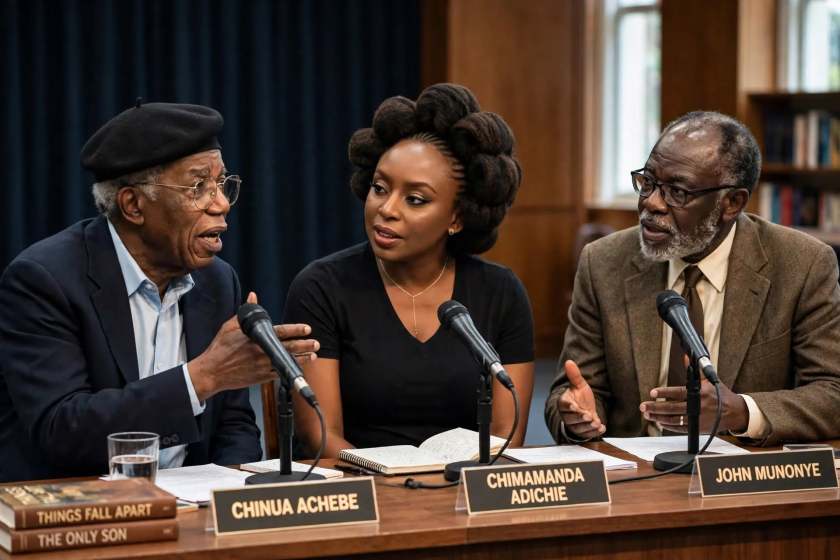
Reading three novels together—or reflecting on them in relation to one another, even when read them at different times—can reveal unexpected connections, allowing each work to cast new light on the others. This has been my experience with Chinua Achebe’s Arrow of God, Chimamanda Ngozi Adichie’s Purple Hibiscus, and John Munonye’s The Oil Man of Obange. Written by three Igbo authors whose works span different generations and historical moments, these novels invite a comparative exploration of how tragedy takes shape. Viewed alongside Arrow of God and Purple Hibiscus, The Oil Man of Obange brings into focus three distinct architectures of tragedy, each shaped by a different relationship to power: Achebe explores power hardened by inflexibility; Adichie examines its oppressive exercise within the family; and Munonye reveals the vulnerability of those who possess too little of it.

Join me as we plunge further into this challenging adventure of discovery.

Ezeulu, Eugene and Jeri as tragic figures

In Arrow of God, Ezeulu comes closest to the classical tragic protagonist. He is already a man of stature: Chief Priest of Ulu, intellectually formidable, proud, politically important and conscious of his authority. His tragedy develops through an interaction between character and historical circumstance. Colonial intervention destabilizes the traditional political and religious order, but Ezeulu’s pride, rigidity and increasingly uncompromising understanding of his own authority contribute significantly to the catastrophe.

The crucial point is that Ezeulu possesses power. His tragedy concerns, among other things, how he understands and exercises it. When his conflict with his community culminates in his refusal to announce the New Yam Festival before the ritual conditions have been fulfilled, religious authority becomes entangled with personal conflict. The resulting crisis threatens the community’s harvest and helps create the conditions in which Christianity gains converts.

Achebe’s tragic structure therefore retains something recognizably Aristotelian: a distinguished protagonist, exceptional qualities, consequential choices, reversal and catastrophic loss. Yet Achebe complicates the classical model because Ezeulu’s downfall cannot simply be attributed to hamartia. Colonialism has entered the political system and altered the field upon which Ezeulu acts.

Jeri, in “The Oil Man of Obange”, occupies almost the opposite position.

He possesses very little institutional, economic or social power. He is not destroyed because he exercises power unwisely; he is destroyed partly because he lacks sufficient power to protect himself and his family from adversity. This represents a second configuration of tragedy.

The situation is not so in the Purple Hibiscus: Here tragedy originates within and moves inside the household.

This offers a third configuration. Eugene Achike possesses considerable power—economic, patriarchal, religious and social. Publicly, he is generous, courageous and respected. Privately, however, his absolutist Catholicism becomes inseparable from authoritarian control and horrific violence against his family.

The resulting tragedy is profoundly paradoxical. Eugene possesses qualities that ought to make him admirable: generosity, courage, religious commitment and resistance to political oppression. Yet those virtues coexist with fanaticism and brutality. He can resist tyranny in public while reproducing tyranny in his own home.

His tragedy therefore contains something much closer to hamartia than Jeri’s does. Eugene’s inability to accommodate ambiguity—his absolutism, religious rigidity and desire for control—contributes directly to the destruction of the family he believes he is protecting.

There is an intriguing parallel here with Ezeulu. Both men possess authority; both are convinced of the legitimacy of that authority; both become increasingly rigid; and both ultimately lose what their authority was supposed to preserve.

But there is an important difference. Ezeulu’s rigidity occurs within a struggle involving traditional religious authority, community and colonial power. Eugene’s operates within religion, patriarchy and the intimate space of the family.

Jeri, by contrast, commands almost nothing.

Three relationships between agency and tragedy

This produces a useful continuum:

Ezeulu — Arrow of GodEugene — Purple HibiscusJeri — The Oil Man of Obange
Social positionPowerful religious leaderWealthy patriarch/businessmanPoor palm-oil trader
Primary arenaCommunity/politics/religionFamily/religionHousehold/economy
Source of tragedyCharacter + colonial disruptionAuthoritarianism + religious absolutismPoverty + accumulated adversity
Relationship to powerPossesses and contests powerPossesses and abuses powerLacks protective power
Role of personal agencyVery highVery highLimited
Approximation to hamartiaPride, rigidity, inflexibilityAbsolutism, fanaticism, controlMuch less obvious
Central vulnerabilityAuthority under historical assaultFamily subjected to patriarchal dominationEconomic and social precarity
Tragic movementPower → isolation → collapseControl → violence → family catastropheStriving → repeated shocks → depletion
What is destroyed?Religious/social authority and familial continuityFamily cohesion and eventually Eugene himselfEconomic security, family aspirations and hope

The comparison suggests a broader historical movement in Nigerian fiction: from the tragedy of the powerful individual towards the tragedy produced by systems and structures.

That proposition needs qualification, but it is potentially a strong journal argument.

The importance of hamartia

With Ezeulu, we can plausibly ask: What did he do that contributed to his downfall?

With Eugene, the question becomes even sharper: How did the very convictions by which he defined goodness become instruments of destruction?

But Jeri forces us to ask something different:

What exactly is his tragic flaw?

Working too hard? Loving his family too much? Hoping that sacrifice will improve his children’s future? Attempting to save and accumulate?

None adequately explains his suffering.

That is why Jeri may represent the most radical departure from classical tragedy of the three. Munonye shifts the causal centre of tragedy away from defective agency and towards vulnerability.

Jeri suffers not principally because he chooses wrongly but because he possesses too few resources with which to survive the consequences of things he did not choose.

Resilience also means something different

The concept of resilience becomes especially productive here.

Ezeulu is certainly strong, but his strength gradually becomes indistinguishable from inflexibility. His refusal to bend contributes to his destruction. In his case, therefore:

resilience can harden into rigidity.

Eugene is also extraordinarily strong-willed. But perseverance in his convictions becomes dangerous because the convictions themselves have become absolutist. His psychological certainty prevents self-correction.

Jeri’s resilience is fundamentally different. His persistence is not directed towards dominating others or defending authority. It is directed towards survival.

He absorbs one shock and gets up. Another arrives and he adjusts. Another consumes some of his resources. He begins again.

And this leads to Munonye’s cruelest irony: Jeri possesses the psychological resource of resilience but lacks the material resources that would allow resilience to succeed.

This observation on the links between the needs for the existence of adequate quantities of social and material resources for the full instantiation of resilience is a much more sophisticated proposition than saying simply that Jeri lacks resilience.

The three novels also locate tragedy at different social scales

Achebe’s tragedy is substantially communal and historical. Ezeulu’s crisis affects Ulu and unfolds against colonial transformation.

Adichie’s tragedy is primarily domestic and psychological, although military dictatorship, colonial religious inheritance and postcolonial social structures remain crucial contexts. The nation enters the home, but the family is the principal theatre in which tragedy is experienced.

Munonye’s tragedy is primarily socioeconomic. The central questions concern livelihood, family survival, illness, education, property and the household’s capacity to absorb shocks.

We could therefore express their tragic geographies almost schematically:

Achebe: community → colonial disruption → tragic collapse

Adichie: family → authoritarian control → tragic violence

Munonye: poverty → vulnerability → repeated shocks → depletion

And yet all three ultimately converge upon the family. Ezeulu’s tragedy damages his household. Eugene’s tragedy destroys the emotional integrity of his household. Jeri’s tragedy progressively consumes the resources upon which his household depends.

The Nigerian family becomes, in all three novels, the place where larger religious, political and economic forces acquire human consequences.

One further distinction: Jeri may produce greater pathos precisely because he is ordinary

Ezeulu and Eugene can provoke morally complicated responses. We can admire them and condemn them almost simultaneously. Their suffering is partly entangled with the suffering they cause others.

Jeri’s relationship with the reader is different. If your interpretation of Munonye is correct, the reader increasingly recognizes a disproportion between what Jeri deserves and what Jeri endures.

That disproportion produces pathos.

And here I think that the question—“Was Munonye fair to Jeri?”—becomes considerably more interesting when placed beside Achebe and Adichie.

We can reasonably say that Ezeulu helps make his tragedy.

We can say even more strongly that Eugene helps make his tragedy and that of his family.

But can we say the same of Jeri?

If the answer is largely no, then Munonye has constructed a fundamentally different tragic protagonist – a character who is a complete victim of circumstances. Since these overwhelming circumstances were created by the author, can we say that thebrotagonist is the victim of his creator?

Conclusion

Where Achebe’s Arrow of God locates tragedy in the collision between authority, character and historical disruption, and Adichie’s Purple Hibiscus locates it in the pathological exercise of patriarchal and religious power, Munonye’s The Oil Man of Obange relocates tragedy among the socially vulnerable. Jeri’s catastrophe proceeds less from hamartia than from precarity: he is not a powerful man destroyed partly by the manner in which he exercises agency, but an ordinary man whose agency is progressively overwhelmed by accumulated adversity. Munonye thereby transforms the Nigerian tragic protagonist from the bearer of consequential power into the bearer of consequential vulnerability.

Ezeulu, Eugene and Jeri can be read as three configurations of power in modern Nigerian tragedy: the man who has power and will not bend, the man who has power and uses it destructively, and the man who lacks enough power to protect himself from catastrophe.

The particularly powerful conclusion would be that Munonye does not abolish the tragic hero; he democratizes him. Tragic stature no longer comes from office, priesthood, wealth or authority. Jeri acquires tragic stature through endurance itself. In that sense, The Oil Man of Obange makes perhaps the most radical claim of the three novels: an ordinary person’s struggle to keep a family alive can possess as much tragic magnitude as the fall of a chief priest or the destruction of a powerful patriarch.

Posted in corruption, Creative writing, hope, disappointment,, Literature, Aesthetics, Politics, Prose, Religion

Purple Hibiscus – a critique of patriarchy and misguided religiosity

By Noel Ihebuzor

Purple hibiscus is a tragic tale of lives and family destroyed by the effects of extreme religiosity, a religiosity that strays quite frequently into the irrational and the psychotic. It is also a tale on the dangers of patriarchy, of domestic violence (spousal and GBV) and what could happen when the battered acquiesce for too long in their systematic humiliation. I also see it as a critique of crude and arrogant Catholicism of the type practised in some parishes in Nigeria. The author of the novel, Chimamanda Adichie has certainly amplified that criticism in her recent address to the council of Nigeria’s, and thereby called out the church and its leaders on a public platform.

But let us go back to the story and see what it tells us – simply this – a fanatical father infected with extremes of religious belief engages in behaviors which systematically estrange from his family, his own father and his sister. In the end, he is poisoned by his wife who sees murder as the only route to end his reign of terror and her suffering.

Let us look at the characters – Papa, a Catholic and publisher of a newspaper, mama, his subdued wife who he humiliates at will, their two children, Kambili and Jaja, whom Papa terrorises and who live in total fear of his fits of temper and excesses, Aunty Ifeoma, Papa’s sister, a lecturer and a beacon of liberalism and radicalism, her two children and finally Papa Nnukwu, Papa’s dad and the children’s grandfather. Papa Nnukwu practices traditional religion and this reality creates a permanent tension between him and his son. The tension is such as that it stands permanently in the way of any demonstration of any bond of filial loyalty from our super Christian pater familias to his father.

Interwoven in this sad tale and in the lives of the characters are snippets of the social ills of Nigeria, including that of corruption, poor governance, abuse of office, wrong and aggressive policing, the corrupting and corrosive effects of a poorly examined religious life and what could happen when a young girl either falls in love with or fantasizes over her priest. The tension is intense and eventually leads to the tragic ending of the novel. The title of the novel ” Purple Hibiscus” is thus at variance with its content.

In the end papa dies from the effects of sustained poisoning by his wife but Jaja takes the rap for his mum. A family is destroyed because of the misguided religiosity of a domineering and aggressive father.

This is a troubling and troubled novel told with sensitivity and tact. One sees in it also the early signs of the author’s feminism, a feminism that has since blossomed as can seen in her positions and speeches on several social media platforms. But some questions persist. One of these is this – is papa a rounded character or a flat character? Does his characterization lean towards a single story approach? Remember that Adichie comes against single stories in one of her now famous lectures? What does the reader think?

Posted in hope, disappointment,, Poetry

Song in December for Decembers gone

By Noel Ihebuzor

December is here. It caught me in a hotel room in Monrovia. It sent me on a time travel to those dry cold days when naked trees stood mournfully by haze draped roads & tall grass cackled and swayed all the way from Abaji to Okene to Ewu as bushmeat raiders commenced their hunt

Why do the trees not run away after sacrificing their leaves to the gods of time? Why wait for the yearly cremation when hot flames will lick their thighs and arms and frightened rabbits and bushmeat become easy meat for lovers of lean meat? I still can hear December sing.

December’s songs still sing slowly and soulful but not like before. They sing and sound different. I hear them with my eyes, I hear them with my nose and I feel their painful taps on my tympanum. The laughter of children has now been stolen by our toothy Grinches full of grouses

December, a time of plenty is now a time of penury. Mr Grinch has stolen the jingle bells. Child suffering soars, hunger hooks children’s thin necks like tight bow tie, tummies are naked as the naked trees that used to announce harmattan….and I sit in Monrovia mourning incompetence

The road to Abaji is in mourning, the Ewu junction wails, the road past Uromi is red with grief and the bridgehead has lost its swag…I hear it singing that there was a Christmas but not any more.

NAI

Monrovia, 01/12/21

Posted in corruption, hope, disappointment,, Politics, Uncategorized

Same PMB APC Administration – Two verdicts!

Social media often presents us in very succinct terms divergent views on the same phenomenon. Take the APC administration, for example. Since the 29th May, 2018, media has been swamped with claims and confutations of its successes and of its failures. This morning on Twitter, I came across two very diametrically opposed appraisals of its performance in the last three years – two views, two verdicts of its performance using broadly identical criteria and indicators! Certainly, the two views cannot be right at the same time. So, which is the correct view? Which is the more balanced appraisal?

I present both appraisals with apologies for any unintended violations of copyright to their authors!

Is it this ?

or this?

Choose your choice and state your reasons


Posted in hope, disappointment,, Politics

On the border of two years

By

Noel Ihebuzor

We will soon be bidding goodbye to 2016.
I am in my village in Naze. We tell ourselves in my village that this is the original Nazareth, the place where Christ was born. Nazareth! We lost the “reth” portion of the name when Ireti seceded and moved to the other side of Owerri town. “The loss is their’s”, we tell ourselves, “after all, the traces of the manger where the savior lay are still here by Umuoparaugo compound for all sinless ones to see”. Personally, I cannot remember when last I saw those traces but Naze is still Nazareth for us and will remain so.
You can now understand why we take the celebration of Xmas with a certain level of seriousness in my village — a child is born in my tiny village, and soon, the world will be at his feet and his fame will enlarge to fill the minds of most humans. So it has been celebrations “Ahoy” though rice and stew have been declining in quality and quantity lately. Last time things were this bad was in the 83/85 period.
But back to my story. All the towns around us have their own Christmas days, depending on their market days – Eke, Orie, Afo or Nkwo. On these market days, the spirits of the land come out of tiny ant holes in the ground to become huge masquerades that walk the streets of the town in huge beautiful dance steps. Far from us is that spirit of religious intolerance – animists, traditionalists and christians of shades and colors troop out to celebrate. Any AK 47s you see are toys that Rambo looking and aping security officials flash around as they make a mockery of the act of protecting politicians from the same persons who were supposed to have elected them. The whole thing is so childish that I find it best to see it as part of the celebrations, as a well conceived play within a play.
So, it is all celebrations, and in the process, we get up caught up by forgetfulness and the new year creeps in on us, as it is doing as I struggle to rush-write this mail where I wish to do two things – to wish you well and rejoice with you that you survived 2016 and to wish you Health, Wealth, Wisdom, Success, Love of God and neighbor, Peace, Prosperity and Progress in 2017.
2016 has not been an easy year for Nigerians – everything got “Mbuhari” – got thrown out of place and out of skew. Things fell apart, things have fallen apart and there are no indication that they will stop falling apart. Promises made to the electorate were not kept by government, the naira crashed, herdsmen became expert death squads, security forces appeared powerless to stop them, oil prices slumped, and being largely a one product economy the economy also slumped, recession, so ably described as a term in economics, hit us when our supposed experts were looking and padding found its place in our budgeting process. Instead of solutions, we toured other countries, we established dual and triple rates for naira exchange and chose the most inconvenient of moments to remind the world of what we thought of feminism in the now acclaimed and patented “za oda room” prescription. Scapegoatism, diversionary antics and finger pointing which may have been appropriate as electioneering tactics were stepped up by government to the discomfiture of its former supporters and the amusement of the scattered opposition. Surprise and arrest became a typical pattern till it turned out to very boring and repetitive to the public. Devoid of any forward looking economic policy and without a stimulus package that could halt the slide of the economy and the naira, recession dug deeper. Even the government anti-corruption flagship was badly managed and soon came to be perceived as a selective exercise and one targeted at persons with “wrong” political affiliations – those with the right political affiliations have nothing to fear. By thus being seen to be protecting its associates, the government was inadvertently giving a new breath of life to corruption and strangely enough was also crying loudest that corruption was fighting back. It found it convenient to ignore that selective targeting incentivizes corruption. Unemployment continues to rise and the promised social safety nets programmes have been slow in taking off. Government’s area of distinction appears to be in the blaming of its predecessor but the discerning public is beginning to see through this. Ditto for security. Ditto for energy, ditto for our roads where death stalks and steal souls every day and security agents sent out to protect the traveler look for every excuse to extort money from you. Protectors and providers have now turned exploiters and expropriators. Some state governments went one step further to creatively deepen kleptocracy by stealing the pensions of retired teachers. In 2016, Nigeria was not country for old men.
On the foreign scene, human ability to create, watch and report suffering and cruelty continues to outpace our capacity to build peace and be our brothers’ and sisters’ keepers. Religious and sectarian intolerance rose and intercultural dialogue/harmony appear to be expressions coined by passing martians on a short visit to planet earth. As I write, horrific and horrible images and footages from the wars in Iraq and Syria harass my mind, pictures of cruelty and devastating destructions are all around for us to see. Africans, Arabs, Asians and even Europeans “invaded” portions of Europe – initially, they came by sea, and then they swarmed overland. The “jungles of Calais”, in the end, are merely a visible projection of the inner jungle in the human heart. We have managed to outdo Kurtz, Joseph Conrad’s anti-hero in our propensity for savagery and imbecility. Short-termist economist thinking is being fanned and is desiccating human capacity for empathy. Populists and right wing politicians and demagogues in Europe and America have latched unto people’s fears of an imagined demographic make over to push xenophobia and exaggerated accusations as the best vote catching strategies. The American elections showed indeed that America remains the land of opportunities and that locker room talk does not dent any opportunity. I refuse to tear any green card or to eat my hat but the results shook me up completely. I am still struggling to work out how this magic was worked, how the polls could have been so wrong and how so many women – educated, middle class, non-educated etc could have voted the way they did. Over time, someone will come up with a study that could reveal the effect of those results on the feminist position and feminist consensus – for the moment, all appears allowed – bum pitching, groping and locker room talk for some persons!
Slowly 2016 limps out and 2017 walks in.
Looking forward to meeting you all on the other side of the new year, and soon, insha allah.
Posted in hope, disappointment,, Politics

Random Tweets on a random day

by

Noel Ihebuzor


On my way back from Lagos this morning, I ran into a friend who 20 months ago used to swear by GMB. Today, he was swearing at the man! TIME!

Disillusionment – “when you find yourself now beginning to swear AT the person you used to swear BY a few month’s ago”

Mental liberation – when the scales fall off your eyes and you begin to see clearly again, free from the manipulation of “influencers”

The arrogance of the ignorant is baffling, the ignorance of the arrogant more so, and the arrogance of the ignorant arrogant most so!

The tragedy of Nigeria is that she has always had elected persons who put the pursuit of personal interests ahead of institution building.

Bad leadership is characterized by excessive short-termism in vision and thinking.

Bad leadership is characterized by ignorance, arrogance and an unwillingness to recognize and remedy its fundamental ignorance!

Blaming one’s predecessor for one’s vision & strategic leadership failures is the best admission of & the lamest excuse for incompetence.

Best way a non-performer can hold on to power? Use the instruments of state power to intimidate and scatter potential opponents!

Does he/she seeking elected office possess functional competences in Economics & Public Policy? Does he/she believe in lifelong learning? Question for 2019!