Posted in Creative writing, hope, disappointment,, Literature, Aesthetics, power

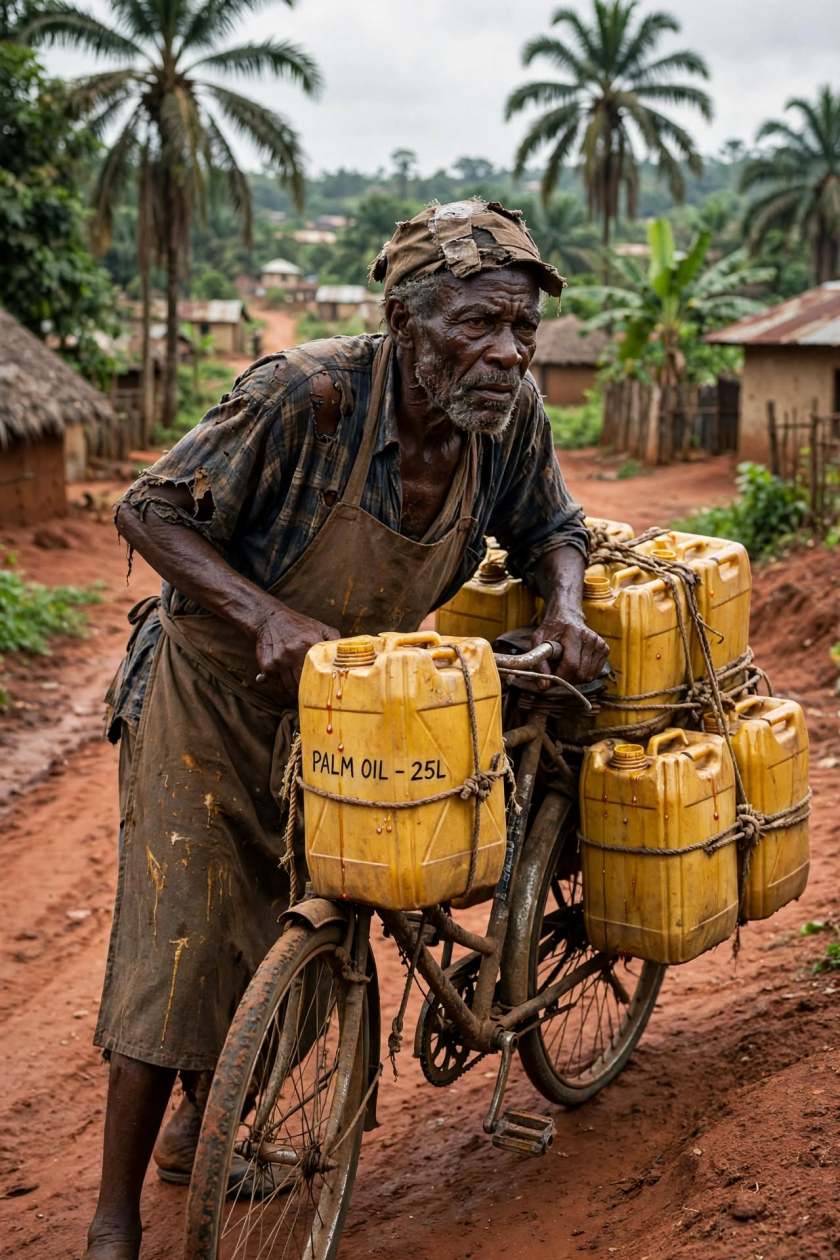
The Tragedy of the Ordinary Man: Vulnerability, Resilience and Adversity in John Munonye’s The Oil Man of Obangi

By

Noel A. Ihebuzor

John Munonye’s The Oil Man of Obange invites a reconsideration of what constitutes tragedy and, more importantly, whose suffering is considered worthy of tragic representation. In the classical conception of tragedy, particularly as inherited from Greek drama, the tragic protagonist is frequently a person of elevated social standing whose fall from fortune is associated with error, misjudgment, or hamartia. Tragedy derives part of its force from the distance between the protagonist’s former stature and his eventual ruin. Munonye radically alters this configuration. His protagonist, Jeri, has no great height from which to fall. He is an ordinary palm-oil trader struggling to sustain himself and his family in a precarious colonial economy. His tragedy lies not in falling from greatness but in the exhausting struggle to achieve even a modest degree of security.

It is precisely this ordinariness that gives The Oil Man of Obange its distinctive tragic power. Munonye relocates tragedy from the palace to the marketplace, from the exceptional individual to the economically vulnerable household. Jeri is neither king nor warrior, neither statesman nor aristocrat. His aspirations are correspondingly modest: to work, provide for his family, educate his children, preserve his dignity and gradually improve his material circumstances. Yet the novel demonstrates how even these modest ambitions can become heroic when pursued under conditions of persistent deprivation and insecurity.

Jeri may therefore be understood as the protagonist of a modern social tragedy—a tragedy in which vulnerability, rather than hamartia, assumes explanatory importance. His suffering does not arise primarily from a fatal defect of character. Indeed, many of the qualities traditionally regarded as virtues—industry, perseverance, responsibility, thrift and devotion to family—are strongly present in him. The tragic irony is that these virtues prove insufficient. Munonye presents a social environment in which personal virtue cannot always compensate for structural disadvantage.

Adversity and the Architecture of Tragedy

Munonye constructs Jeri’s tragedy cumulatively. Adversity does not arrive as a single catastrophic event. Instead, the novel subjects him to a succession of pressures whose combined effects gradually diminish his capacity to recover. Taxation, financial insecurity, family obligations, bereavement, educational expenses, accident and the premature assumption of adult responsibilities by his daughter form part of an expanding field of misfortune.

This accumulation is crucial to the novel’s tragic method. A relatively prosperous individual may absorb an isolated shock; a poor household often cannot. The significance of adversity therefore depends not simply on the severity of the event itself but also on the resources available to the person experiencing it. Jeri’s vulnerability lies precisely in the narrowness of his margin for error. He possesses few reserves with which to absorb misfortune.

Munonye reinforces this vulnerability through the physical representation of his protagonist. Jeri’s scarred hands and his clothing—including the memorable oversized black shorts—locate him firmly within the world of manual labour and material scarcity. His body becomes, in a sense, an archive of hardship. The marks of labour upon him remind the reader that poverty in the novel is not an abstraction. It is lived physically, socially and psychologically.

This representational strategy generates pathos without requiring Jeri to be conventionally heroic. The reader’s sympathy derives from witnessing the disproportion between his efforts and his rewards. He works, saves, sacrifices and persists, yet every modest gain remains exposed to destruction by another unforeseen event.

Resilience and Its Limits

One of Jeri’s defining characteristics is resilience. Each encounter with adversity produces an effort at recovery. He refuses to surrender easily to despair, and Munonye repeatedly allows him to reconstitute his hopes after they have been damaged. In contemporary psychological language, one might describe Jeri as possessing considerable self-efficacy: he continues to believe that purposeful action can improve his circumstances.

Yet The Oil Man of Obange complicates any simplistic celebration of resilience. Jeri’s persistence does not guarantee success. This is one of the novel’s most important insights. Resilience is valuable, but resilience without resources has limits.

The distinction is critical. Popular narratives of success often suggest that perseverance eventually triumphs over adversity. Munonye offers a more disturbing proposition: perseverance may be necessary for survival while remaining insufficient for escape from poverty. Jeri can recover psychologically from one setback, but each recovery consumes resources—money, property, labour, social standing and emotional strength. Resilience itself therefore becomes progressively more expensive.

This is particularly evident when financial pressures force Jeri into increasingly desperate coping strategies. Funeral expenses, school fees, accident and other demands erode the small economic base upon which his aspirations depend. His eventual willingness to surrender land is especially significant. Land represents more than an immediately disposable economic asset. In the social world represented by the novel, it carries implications of security, continuity and belonging. To relinquish it is therefore to mortgage part of the future in order to survive the present.

Munonye thus exposes what might be called the paradox of poverty: the poor frequently survive today’s crisis by sacrificing resources needed to protect themselves against tomorrow’s.

Deferred Gratification and the Collapse of the Future

Jeri’s economic behaviour may also be interpreted through the concept of deferred gratification. He repeatedly accepts present hardship in anticipation of future improvement. His labour, savings and sacrifices are investments in a future that he imagines will be better than the present. Education, family advancement and economic security constitute different versions of this deferred future.

In conventional economic reasoning, postponing immediate consumption may permit accumulation and eventual improvement in welfare. But Munonye introduces a crucial qualification: deferred gratification works only where the present and its structures are sufficiently secure for sacrifice to yield its expected return in the future. Jeri inhabits no such secure environment.

Every attempt at accumulation remains vulnerable to illness, death, taxation, family emergency, and accident. Consequently, the future continually consumes the resources accumulated for it before it can arrive. The irony is devastating. Jeri sacrifices the present for the future, but repeated crises compel him to spend the future merely to survive the present.

The novel therefore transforms deferred gratification from a straightforward economic virtue into a tragic mechanism. Prudence cannot guarantee prosperity when individuals are exposed to risks against which they possess little protection.

The Death of Marcelina and the Social Production of Tragedy

The death of Jeri’s wife, Marcelina, is particularly revealing. Her death from tetanus carries significance beyond personal bereavement. It directs attention towards the inadequacy of the social and medical environment within which the family exists. What is experienced privately as devastating grief may simultaneously be understood as evidence of wider institutional deprivation.

This is an important feature of Munonye’s tragic vision. Misfortune appears personal because individuals experience its consequences, yet its origins and severity are often social. Illness becomes catastrophic where healthcare is inaccessible or inadequate. Bereavement becomes economically ruinous where households lack insurance or meaningful social protection. Educational aspiration becomes fragile where school costs must compete with subsistence. An accident becomes an existential economic threat where savings are negligible.

Munonye thereby blurs the distinction between private tragedy and public failure.

The circumstances surrounding Jeri’s daughter deepen this critique. Her pregnancy at thirteen and her decision to leave school in order to assist the family represent more than an individual misfortune. Childhood itself becomes a casualty of household vulnerability. The pressures generated by poverty travel across generations: the crisis experienced by the parents reshapes the possibilities available to the children.

The tragedy is therefore not Jeri’s alone. His vulnerability becomes familial and potentially intergenerational.

Community Without a Safety Net

Another striking feature of the novel is the contrast between communal recognition and effective communal assistance. Jeri may attract sympathy and even admiration, but sympathy does not necessarily translate into material protection.

This distinction deserves attention because it complicates romantic assumptions about traditional communal solidarity. Community can provide identity, companionship and moral recognition while remaining incapable of absorbing severe economic shocks. The people around Jeri may recognise his suffering, yet recognition cannot pay school fees, replace lost income, provide medical treatment or restore depleted assets.

Munonye therefore presents a society in which social relationships exist but an adequate social safety net does not. Jeri remains surrounded by people and yet, at crucial moments, structurally alone.

His vulnerability is consequently not simply the condition of being poor. It is the condition of possessing insufficient alternatives. Poverty narrows the range of possible responses to adversity. The wealthy confront crises with buffers; the poor confront them with choices between necessities.

Jeri’s predicament illustrates this distinction with painful clarity.

From Hamartia to Vulnerability

It is here that Munonye’s contribution to the idea of tragedy becomes most apparent. Classical tragedy often encourages the question: what flaw or error brought the protagonist to this end? The Oil Man of Obange encourages a different question: what resources did the protagonist possess with which to prevent this end?

The shift is profound.

Jeri’s tragedy is not convincingly explained by identifying a single fatal character flaw. His problem is not an excess of ambition comparable to that of certain classical tragic figures, nor an overwhelming pride that blinds him to reality. His aspirations are modest and socially recognisable. He wants security for himself and his family.

The source of tragedy therefore migrates from character towards condition.

This does not mean that Jeri lacks agency or that every decision he makes must be regarded as correct. Rather, it means that his decisions occur within severely restricted circumstances. Agency exists, but it is constrained agency. Choice exists, but the available choices are often between competing forms of loss.

From this perspective, vulnerability performs some of the narrative work traditionally assigned to hamartia. It exposes Jeri repeatedly to consequences from which more privileged individuals might recover. His poverty magnifies ordinary misfortunes into existential threats.

The tragedy of Jeri is thus not that a great man falls. It is that an ordinary man is given so little room in which to remain standing.

The Ethics of Munonye’s Tragic Method

The relentless accumulation of adversity inevitably raises an aesthetic and ethical question: does Munonye subject Jeri to too much suffering? At what point does the accumulation of calamities risk appearing authorially contrived?

The question is legitimate because tragedy depends upon plausibility. If suffering appears arbitrarily imposed merely to manipulate the reader’s emotions, pathos can deteriorate into sentimentality.

Yet the cumulative structure of Jeri’s suffering can be defended on precisely sociological grounds. Vulnerability tends to be cumulative. One shock depletes the resources needed to withstand the next. Illness produces expenditure; expenditure consumes savings; depleted savings increase exposure to subsequent crises; crisis may require the sale of productive assets; loss of assets then increases future vulnerability. What may appear, from a position of security, to be an improbable succession of disasters may represent the lived logic of chronic poverty.

Munonye’s apparent excess therefore has a deeper realism. Jeri is not merely unlucky again and again. He is progressively less protected against being unlucky.

This distinction is essential to understanding the novel.

Conclusion: A Tragedy Without Kings

The Oil Man of Obange ultimately enlarges the moral territory of tragedy. Munonye demonstrates that tragic dignity need not depend upon social rank and that catastrophic suffering need not begin with an extraordinary flaw. The life of an ordinary palm-oil trader can carry tragic weight because the fundamental materials of tragedy—hope, striving, attachment, loss, endurance and defeat—are not the exclusive possessions of kings.

Jeri emerges as a compelling tragic protagonist precisely because his aspirations are so recognisably human. He asks comparatively little of life: the opportunity to work, support his family, educate his children and achieve some measure of security. Yet the social and economic environment continually raises the cost of these modest aspirations.

His resilience intensifies rather than diminishes the tragedy. Had Jeri surrendered immediately, his fate might merely evoke pity. Because he repeatedly rises, struggles and attempts to rebuild, each subsequent reversal acquires greater emotional force. Munonye makes us witnesses not simply to suffering but to the gradual exhaustion of the resources with which suffering can be resisted.

The novel consequently proposes a powerful revision of the tragic form. In place of the classical movement from greatness to ruin, Munonye gives us the struggle from vulnerability towards security—and the repeated interruption of that struggle by forces larger than the individual’s capacity to absorb them. In place of hamartia, he gives us precarity; in place of the palace, the poor household; in place of the fallen great man, the ordinary working man attempting to preserve his dignity.

The most disturbing question raised by Jeri’s experience is therefore not whether he possessed sufficient resilience. He plainly did. The more important question is how much resilience society can reasonably demand from a human being before the celebration of endurance becomes an excuse for the absence of protection.

Munonye’s achievement lies in making that question tragic. Jeri’s defeat is moving not because he is extraordinary, but because he is ordinary—and because the forces that overwhelm him are precisely the kinds of forces to which ordinary lives remain most exposed. The Oil Man of Obange thus makes a persuasive case for a tragedy of the vulnerable: a modern tragic form in which the measure of the protagonist is not the height from which he falls, but the courage with which he struggles, again and again, to rise.
Posted in Colonialism, Creative writing, faith, hope, disappointment,, Politics, power, Prose, The Christian life

Reading and chatting with myself and a keyboard – my reactions to three novels – by three Igbo authors : “Arrow of God,” (Achebe) “Purple Hibiscus,” (Adichie)  and  “The Oil Man of Obange” (Munonye).

Noel A. Ihebuzor

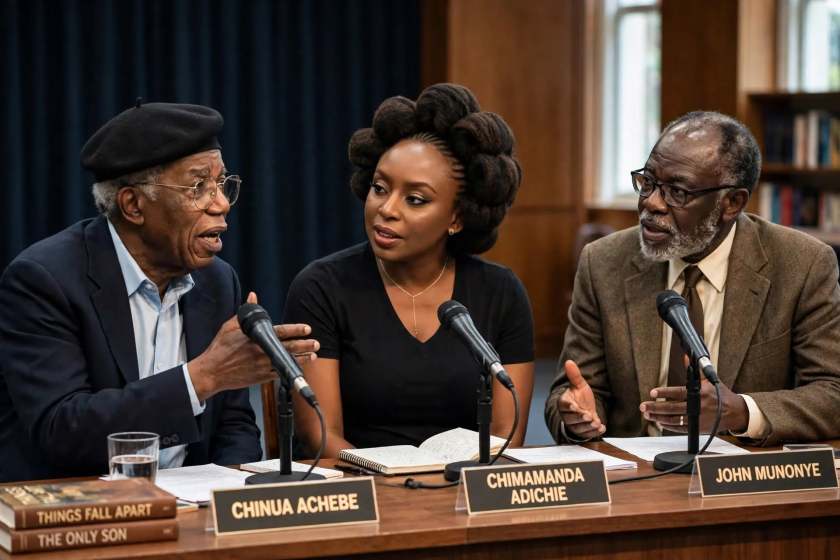
Reading three novels together—or reflecting on them in relation to one another, even when read them at different times—can reveal unexpected connections, allowing each work to cast new light on the others. This has been my experience with Chinua Achebe’s Arrow of God, Chimamanda Ngozi Adichie’s Purple Hibiscus, and John Munonye’s The Oil Man of Obange. Written by three Igbo authors whose works span different generations and historical moments, these novels invite a comparative exploration of how tragedy takes shape. Viewed alongside Arrow of God and Purple Hibiscus, The Oil Man of Obange brings into focus three distinct architectures of tragedy, each shaped by a different relationship to power: Achebe explores power hardened by inflexibility; Adichie examines its oppressive exercise within the family; and Munonye reveals the vulnerability of those who possess too little of it.

Join me as we plunge further into this challenging adventure of discovery.

Ezeulu, Eugene and Jeri as tragic figures

In Arrow of God, Ezeulu comes closest to the classical tragic protagonist. He is already a man of stature: Chief Priest of Ulu, intellectually formidable, proud, politically important and conscious of his authority. His tragedy develops through an interaction between character and historical circumstance. Colonial intervention destabilizes the traditional political and religious order, but Ezeulu’s pride, rigidity and increasingly uncompromising understanding of his own authority contribute significantly to the catastrophe.

The crucial point is that Ezeulu possesses power. His tragedy concerns, among other things, how he understands and exercises it. When his conflict with his community culminates in his refusal to announce the New Yam Festival before the ritual conditions have been fulfilled, religious authority becomes entangled with personal conflict. The resulting crisis threatens the community’s harvest and helps create the conditions in which Christianity gains converts.

Achebe’s tragic structure therefore retains something recognizably Aristotelian: a distinguished protagonist, exceptional qualities, consequential choices, reversal and catastrophic loss. Yet Achebe complicates the classical model because Ezeulu’s downfall cannot simply be attributed to hamartia. Colonialism has entered the political system and altered the field upon which Ezeulu acts.

Jeri, in “The Oil Man of Obange”, occupies almost the opposite position.

He possesses very little institutional, economic or social power. He is not destroyed because he exercises power unwisely; he is destroyed partly because he lacks sufficient power to protect himself and his family from adversity. This represents a second configuration of tragedy.

The situation is not so in the Purple Hibiscus: Here tragedy originates within and moves inside the household.

This offers a third configuration. Eugene Achike possesses considerable power—economic, patriarchal, religious and social. Publicly, he is generous, courageous and respected. Privately, however, his absolutist Catholicism becomes inseparable from authoritarian control and horrific violence against his family.

The resulting tragedy is profoundly paradoxical. Eugene possesses qualities that ought to make him admirable: generosity, courage, religious commitment and resistance to political oppression. Yet those virtues coexist with fanaticism and brutality. He can resist tyranny in public while reproducing tyranny in his own home.

His tragedy therefore contains something much closer to hamartia than Jeri’s does. Eugene’s inability to accommodate ambiguity—his absolutism, religious rigidity and desire for control—contributes directly to the destruction of the family he believes he is protecting.

There is an intriguing parallel here with Ezeulu. Both men possess authority; both are convinced of the legitimacy of that authority; both become increasingly rigid; and both ultimately lose what their authority was supposed to preserve.

But there is an important difference. Ezeulu’s rigidity occurs within a struggle involving traditional religious authority, community and colonial power. Eugene’s operates within religion, patriarchy and the intimate space of the family.

Jeri, by contrast, commands almost nothing.

Three relationships between agency and tragedy

This produces a useful continuum:

Ezeulu — Arrow of GodEugene — Purple HibiscusJeri — The Oil Man of Obange
Social positionPowerful religious leaderWealthy patriarch/businessmanPoor palm-oil trader
Primary arenaCommunity/politics/religionFamily/religionHousehold/economy
Source of tragedyCharacter + colonial disruptionAuthoritarianism + religious absolutismPoverty + accumulated adversity
Relationship to powerPossesses and contests powerPossesses and abuses powerLacks protective power
Role of personal agencyVery highVery highLimited
Approximation to hamartiaPride, rigidity, inflexibilityAbsolutism, fanaticism, controlMuch less obvious
Central vulnerabilityAuthority under historical assaultFamily subjected to patriarchal dominationEconomic and social precarity
Tragic movementPower → isolation → collapseControl → violence → family catastropheStriving → repeated shocks → depletion
What is destroyed?Religious/social authority and familial continuityFamily cohesion and eventually Eugene himselfEconomic security, family aspirations and hope

The comparison suggests a broader historical movement in Nigerian fiction: from the tragedy of the powerful individual towards the tragedy produced by systems and structures.

That proposition needs qualification, but it is potentially a strong journal argument.

The importance of hamartia

With Ezeulu, we can plausibly ask: What did he do that contributed to his downfall?

With Eugene, the question becomes even sharper: How did the very convictions by which he defined goodness become instruments of destruction?

But Jeri forces us to ask something different:

What exactly is his tragic flaw?

Working too hard? Loving his family too much? Hoping that sacrifice will improve his children’s future? Attempting to save and accumulate?

None adequately explains his suffering.

That is why Jeri may represent the most radical departure from classical tragedy of the three. Munonye shifts the causal centre of tragedy away from defective agency and towards vulnerability.

Jeri suffers not principally because he chooses wrongly but because he possesses too few resources with which to survive the consequences of things he did not choose.

Resilience also means something different

The concept of resilience becomes especially productive here.

Ezeulu is certainly strong, but his strength gradually becomes indistinguishable from inflexibility. His refusal to bend contributes to his destruction. In his case, therefore:

resilience can harden into rigidity.

Eugene is also extraordinarily strong-willed. But perseverance in his convictions becomes dangerous because the convictions themselves have become absolutist. His psychological certainty prevents self-correction.

Jeri’s resilience is fundamentally different. His persistence is not directed towards dominating others or defending authority. It is directed towards survival.

He absorbs one shock and gets up. Another arrives and he adjusts. Another consumes some of his resources. He begins again.

And this leads to Munonye’s cruelest irony: Jeri possesses the psychological resource of resilience but lacks the material resources that would allow resilience to succeed.

This observation on the links between the needs for the existence of adequate quantities of social and material resources for the full instantiation of resilience is a much more sophisticated proposition than saying simply that Jeri lacks resilience.

The three novels also locate tragedy at different social scales

Achebe’s tragedy is substantially communal and historical. Ezeulu’s crisis affects Ulu and unfolds against colonial transformation.

Adichie’s tragedy is primarily domestic and psychological, although military dictatorship, colonial religious inheritance and postcolonial social structures remain crucial contexts. The nation enters the home, but the family is the principal theatre in which tragedy is experienced.

Munonye’s tragedy is primarily socioeconomic. The central questions concern livelihood, family survival, illness, education, property and the household’s capacity to absorb shocks.

We could therefore express their tragic geographies almost schematically:

Achebe: community → colonial disruption → tragic collapse

Adichie: family → authoritarian control → tragic violence

Munonye: poverty → vulnerability → repeated shocks → depletion

And yet all three ultimately converge upon the family. Ezeulu’s tragedy damages his household. Eugene’s tragedy destroys the emotional integrity of his household. Jeri’s tragedy progressively consumes the resources upon which his household depends.

The Nigerian family becomes, in all three novels, the place where larger religious, political and economic forces acquire human consequences.

One further distinction: Jeri may produce greater pathos precisely because he is ordinary

Ezeulu and Eugene can provoke morally complicated responses. We can admire them and condemn them almost simultaneously. Their suffering is partly entangled with the suffering they cause others.

Jeri’s relationship with the reader is different. If your interpretation of Munonye is correct, the reader increasingly recognizes a disproportion between what Jeri deserves and what Jeri endures.

That disproportion produces pathos.

And here I think that the question—“Was Munonye fair to Jeri?”—becomes considerably more interesting when placed beside Achebe and Adichie.

We can reasonably say that Ezeulu helps make his tragedy.

We can say even more strongly that Eugene helps make his tragedy and that of his family.

But can we say the same of Jeri?

If the answer is largely no, then Munonye has constructed a fundamentally different tragic protagonist – a character who is a complete victim of circumstances. Since these overwhelming circumstances were created by the author, can we say that thebrotagonist is the victim of his creator?

Conclusion

Where Achebe’s Arrow of God locates tragedy in the collision between authority, character and historical disruption, and Adichie’s Purple Hibiscus locates it in the pathological exercise of patriarchal and religious power, Munonye’s The Oil Man of Obange relocates tragedy among the socially vulnerable. Jeri’s catastrophe proceeds less from hamartia than from precarity: he is not a powerful man destroyed partly by the manner in which he exercises agency, but an ordinary man whose agency is progressively overwhelmed by accumulated adversity. Munonye thereby transforms the Nigerian tragic protagonist from the bearer of consequential power into the bearer of consequential vulnerability.

Ezeulu, Eugene and Jeri can be read as three configurations of power in modern Nigerian tragedy: the man who has power and will not bend, the man who has power and uses it destructively, and the man who lacks enough power to protect himself from catastrophe.

The particularly powerful conclusion would be that Munonye does not abolish the tragic hero; he democratizes him. Tragic stature no longer comes from office, priesthood, wealth or authority. Jeri acquires tragic stature through endurance itself. In that sense, The Oil Man of Obange makes perhaps the most radical claim of the three novels: an ordinary person’s struggle to keep a family alive can possess as much tragic magnitude as the fall of a chief priest or the destruction of a powerful patriarch.

Posted in Christianity, corruption, governance, Moral conduct, power, The Christian life, Uncategorized

Pentecost Sunday and Us Catholics

By Noel Ihebuzor

Last Sunday was Pentecost Sunday, and our Parish Priest gave a powerful and moving homily. This was preceded by a praise worship session where we intoned the song – “Send your power, we pray thee, O Lord, send down your spirit, we say Amen….” The congregation was moved, and the homily, with its exhortation on the need to come together in a spirit of true fellowship, was powerfully moving. I was moved.

But I expected more, and perhaps for very personal and idiosyncratic reasons. I had expected him to challenge the Catholic faithful to break away from the shackles of fear and reject the debilitating culture of silence that keeps us mute in the face of abuse, maladministration, and betrayal of trust by political leaders. I had also hoped that his homily would weave in Prophet Isaiah’s liberation message (Isaiah 6), together with the calls for social justice from Prophet Amos and his condemnation of the exploitation of the poor.

Was I right to expect this from a Pentecost Sunday homily? I believe I was. Pentecost symbolizes the Spirit giving people courage and voice, the emergence of communal solidarity, and the use of that solidarity to call for justice openly and without fear. Such calls can inspire nonviolent witness and organized action for the common good.

Before Pentecost, Christ’s followers were marked by fear. Then came Pentecost: the chains of fear were broken, and the once fearful rose with courage to speak up and speak out, to the amazement of the public.

Yet the meaning and symbolism of speaking out extend far beyond the reversal of the Tower of Babel and the miracle of many languages. Pentecost signifies much more.

First, it marks the giving of the Holy Spirit, which in Catholic understanding enables believers to speak boldly and bear public witness. This sacramental and charismatic empowerment is often understood as a call to move from private faith to public engagement.

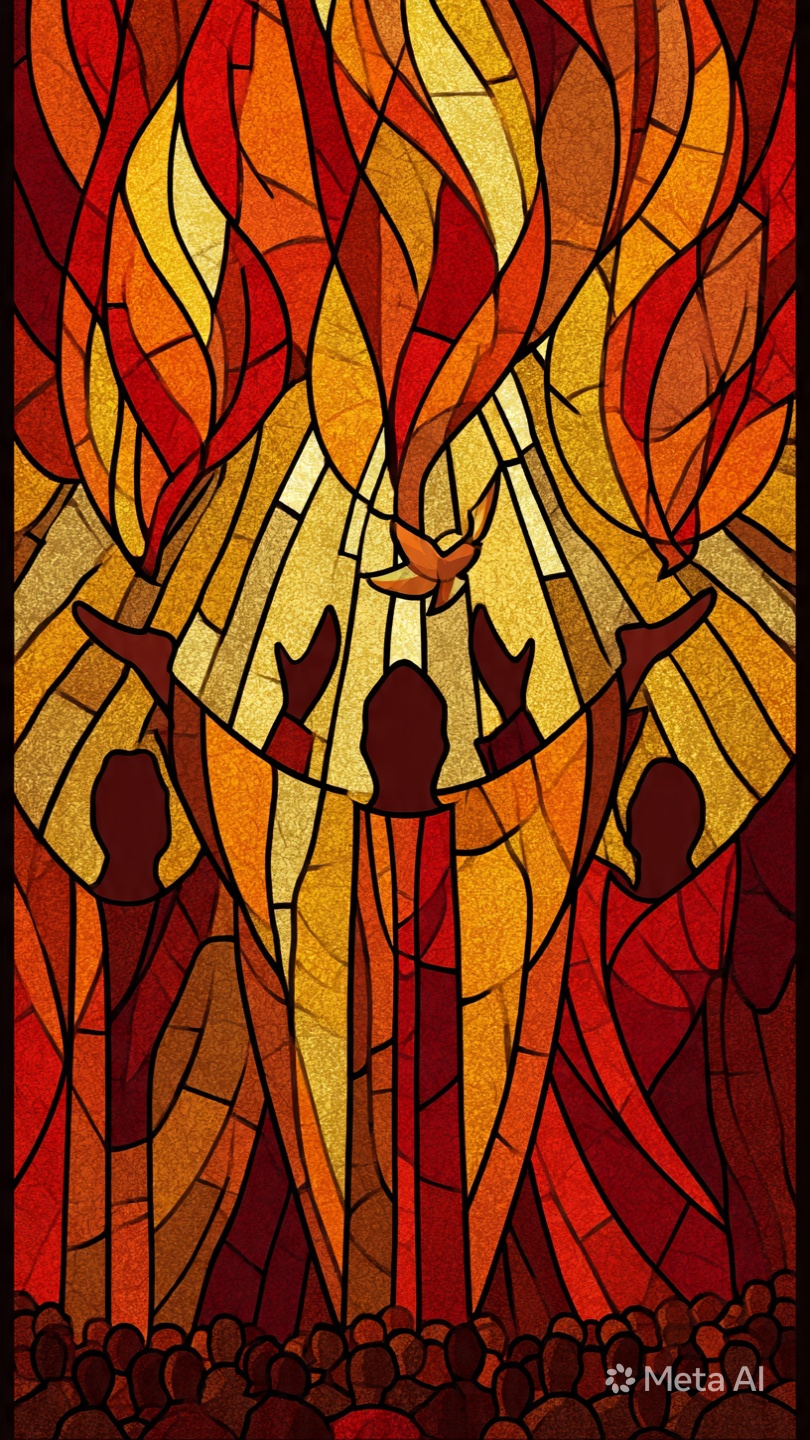
Secondly, for those who feel voiceless, Pentecost’s image of tongues of fire and speech in many languages reminds us that God equips ordinary people to communicate truth across divides and to name injustice in ways others can hear.

Finally, the feast and the homily preached to celebrate it can therefore be understood as both spiritual encouragement and a theological warrant for ethically speaking out against social evils rather than remaining silent.

We must always remind ourselves that Catholic social teaching links human dignity, solidarity, and the common good (John 10:10). The outpouring of the Spirit on Pentecost should be seen as a spiritual transfusion, empowering Catholics to develop the courage needed to help create communities where protection of the poor and resistance to structures that harm them become defining features.

By implication, Pentecost should embolden us to speak out against all those whose actions violate the principle of the common good. The need for such bold witness is particularly acute in contexts where public funds are abused and institutions fail. Pentecost can therefore reframe protest and advocacy as communal, faith-rooted obligations aimed at protecting the vulnerable and reclaiming public life for just ends.

Let me end by reaffirming the obvious: Pentecost gives Catholics both the inner courage to speak and the communal framework to act. It sanctifies public engagement by making speaking out a form of Christian witness aimed at restoring dignity and the common good in a society weakened by corruption and silence. Seen in this way, using a homily to invite Catholics to speak up against injustice becomes both a social and spiritual obligation, and indeed, an elevating one.

Posted in corruption, governance, Moral conduct, power

Omelogor, social iconoclast, sexual disruptor or gender avenger?

Author: Noel A Ihebuzor

oplus_34

One of the most fascinating lessons I’ve learnt about women in this my short life, and this is based on the women I’ve met, is that a man can never truly claim to know a woman, except perhaps his mum. Because essentially, women are basically unknowable.

Women are mysteries, and the moment they lose their mystery, they lose an essential trait, a trait that makes them women. I am inclined to concluding on the basis of my limited experience (error of limited sample size)  that this state of things just has to do with what I believe is at  the core of what being a woman, that quality of their “unknowability” to a man.  Let us suppose that this applies to the relationships between most women and men and is invariant in time and place. In that case, a man approaching trying to “know” a woman in fiction, and this woman herself being a creation by another woman (would “understand” be a better verb to use in this context?), faces a serious uphill task. Such a man could be said to be embarking on a task which even the bravest of souls would approach with a lot of caution and timorousness.

Yes, it is thus with a spirit of “quaking and trembling” that I embark on this assignment, or this self-imposed task that will not let me rest, of sharing a few thoughts about what I believe I’ve learnt or known or suspect to have known about one of the many female characters that populate Chimamanda Ngozi Adichie’s many books. I’ve picked on one of her female characters that is perhaps the most complex, the most unknowable, and indeed, the most difficult to trap. And this you must agree, is a difficult task for a specie (sincere apologies for any crude biologism here – it is totally unintended) that, at the outset, I’ve said is basically unknowable to most men.

The character in question here is Omelogor, Chiamaka’s cousin in Ngozi Chimamanda Adichie’s newest and most engaging novel – Dream Count. Omelogor is the person I’m trying to wrap my head around to try to see if I can present a description of her that makes sense to me before it can make sense to other people. Omelogor is very complex, but then, trying to decipher a complex character is a project that appeals to us as humans, even when we intuitively feel that failure could be the fate of such an exercise in the long run. But I’ll try. As the French say, “The difficulty of succeeding only makes it more imperative for us to try.” By the way, that’s a very bad translation indeed, because the original expression in Beaumarchais’ play = Le Barbier de Seville goes thus, “La difficulté de réussir ne fait qu’ajouter à la nécessité d’entreprendre.”.

Yes, the subject of my reflection is Omelogor, her actions and her thoughts as reflected in the story in the section of the book that bears her name. I am asking whether Omelogor is the world’s modern female Robin Hood, (And it should not surprise anyone that the name of the NGO she established and devoted to supporting female empowerment is known as Robyn Hood – how cheeky!). I am also wondering aloud whether Omelogor is a social iconoclast, a deliberate disruptor of social norms and conventions, a social avenger, a woman who is willing to stand up to the rich and powerful, a career banker who does not think twice about using a mop to poke at comfortable glass ceilings of society, a very composed male-eater or a bit of all of these. Who thus, is this engaging and unusual character, this bold character, who sets out to speak with frankness on several issues that most women would approach with a lot of caution, you may ask? Omelogor is someone who can throw caution to the wind and who speaks her mind on very difficult issues, can make up her mind on very complex social issues, and who can go ahead to do things that run counter to the dominant trends and the dominant models of sex roles in society. Once her mind is made up, she just goes ahead and does these things, without as much as batting an eyelid about what the consequences could be.

 Omelogor is a banker who returns to Nigeria from the USA, after a successful degree, and joins a bank, rises to the very top of the career and becomes a very close associate and confidant of a character in the book simply described as CEO. The appellation CEO is the only one we have of him. Could this be a technique that Chimamanda Adichie uses to suggest that the CEO could refer to anyone, to any of the many individuals who crowd and corrupt the numerous commercial establishments in Nigeria’s financial sector? Through the CEO and his antics, the reader gains an insight into the carryings-on and the putrefaction that has become a distinguishing feature of the dealings in our banking sector. These include money laundering, aiding and abetting financial heists, stealing from clients’ funds, armed with the knowledge that persons who operate accounts made up of stolen funds cannot speak up when those very same funds are expropriated from them by the persons they entrust them to.  CEO is just as criminal as those who steal government funds, as he steals from his very customers in the Bank.  Omelogor soon finds out that the CEO is stealing from his own bank but shows no moral outrage. This is a reflection of how badly her values have altered that rather than upbraid the CEO for larceny, she actually tells him that she can teach him better ways to cover his tracks and criminal acts, CEO takes the bait, and once he does this, he becomes Omelogor’s accomplice and partner in crime. By thus choosing to cover up the CEO, Omelogor has effectively pocketed him and silenced him forever. To keep him under her thumb, she says – “I never failed to perform respect” because she has come to realize that men like CEO “had shockingly thin skins”.  Notice that the expression “to perform respect” serves to convey the superficiality and fakeness of her actions since she actually feels nothing but contempt for these big men in society – “these same men who paraded wealth that they knew to be mere hull and all hollowness beneath.” Omelogor continues to thus “play” this society for her own gains and ends. Is it hypocrisy that she can still decry the collapse of morality in Nigeria or is it the silenced voice of her morality still struggling to speak out amidst all the financial rot and decadence?  Her observation that “It is not that Nigeria is poor, it is that it is virulently materialistic…….Money is at the of center of everything, absolutely everything. We don’t admire principle or purpose” is most apt but what gives the moral high ground to speak thus when we know that her behavior in managing funds entrusted to her financial house betrays this same trait?

 She makes a number of statements that condemn corruption in society and its consequences. And I find myself agreeing with her when she talks of the “fragile security of stolen wealth”.  When she comments thus of a politician – “He was surrounded by many people but he trusted so few because his power had robbed him of the ability to trust”, I find myself feeling very sorry for the politician because he is experiencing the effects of what I describe as a bad tradeoff. The story contains other instances of the damaging results of a life of criminality –aptly expressed in the reflection  “who do you go to complain when someone steals the money you stole from you”? This situation is well illustrated in the case of the politician whose money is stolen and who did nothing “because what can you do when a person has stolen what you stole”?

Omelogor crosses the stealing and cheating line and her excursion into philanthropy with stolen funds could be dismissed as the efforts of someone looking for ways to buy back her soul by using of some of the stolen money to financially empower needy women! But I could be wrong as some other reader could simply see Omelogor as  our brand new 21st century Robin Hood. She takes the money she shas stolen and sets up a foundation that embarks on an empowerment programme for women in rural communities. Redemption through restitution to non-expropriated? Does this clean up the act of stealing? Her model is that of a  thief who steals money with the intention is using it to empower the poor. But do intentions wipe out criminality? Because stealing is criminal. Taking what is not yours is criminal, even if what you’re taking is stolen. And it is important to say this and draw clear boundaries around these issues, for if not we could get trapped in a quagmire of philosophical ramblings, emotional tainted disputations and theological disagreements.  A man/woman who steals from the rich to give to the poor, is he/she doing the right thing? And if the intention is to do the right thing, do intentions redeem an act from what it was in the first instance? Now, those are the type of questions that Omelogor’s acts in the story throw our way. The case of stealing from a stealer raises important ethical and moral issues! Whilst Robin Hood is an appealing model for this type of moral conduct, one wonders what the world would become if we all became modern Robin Hoods, acting like EQUALIZERS in the Denzel Washington and Queen Latifa molds.

What would Immanuel Kant say about such a world in the light of his categorical imperatives? Ethics and Morality can often be slippery where acts are judged by the intentions of the perpetrator and not by its outcomes and consequences; The moral and ethical question of “stealing from a thief”—sometimes phrased as “Can it be right to take back what was stolen?” – is a nuanced issue in philosophy. It has attracted and continues to attract volumes and tomes in ethics and theology and Miss Adichie, in her presentation of Omelogor, walks dangerous and slippery grounds here as the actions of her character raise the important question, is it right to steal from someone who has stolen?  When Omelogor  says “Look, you have to understand that lying and deceiving are not moral issues in everyday life here – they are just survival tools.”

Should we extend the same claim to stealing and “pen robbery”? And she goes on to seal her position and indicate the protective seal one must apply on one’s mind to carry on the way she does – “Compunction is not even an option because you would need to think of these issues first as moral”. Our heroine has provided us with the moral code by which she wants to be judged. Is she rationalizing her dishonesty by thus creating a code by which her acts should be judged? Honestly, I do not know. How did her mind which condemned the sleaze and corruption in the banking sector, her mind which had so much contempt for the corrupt characters in the sector suddenly get twisted? How and why did she allow her soul to be seduced to cross over the line that separates the innocent from the damned?

Maybe the seeds for the conversion could be traced to her unusual sexual ethos. Here is a female character who picks men to sleep with and dispenses with them after the event without any trace of emotional connection. Is she real? Is she acting? Doesn’t she feel anything? Is she well? Is her characterization simply to convey, by role reversal, the frustration that women, like Zikora and Kadiatou, feel on being used and dumped by men. In one episode, she walks over and invites a man who she has spotted ogling her at a party to her flat. In another, she picks a young man in act devoid of emotional connection. She picks the men. She is not picked.

Listen to Omelogor speak about one of such pickups.  – “I sensed his fascination with and mild repulsion for women older than him”. Yet she goes on and ends up “bedding” him and this decision is the rational one of a female tigress. About this younger lover, Omelogor observes – “He was to me simply a younger man, an experiment because he was sweet”. Who else but a man-eater could speak thus – Men run for your lives! There is a man eater on the prowl! And she can be so detached during the act of coitus that she is able to provide a neutral and clinical description of the engagement taking place, taking time to talk of the practiced movement of fingers and tongue and accusing the young man trying to please her of simply going through a well-rehearsed performance whilst being completely enraptured with himself over his performance. Reads more like a description of male masturbation with a female accomplice.

There’s a role reversal here in terms of our stereotypes. In standard narratives, men use women and dump them and move on. In the cases of the encounters between Omelogor and men, the tables are turned. Here is a bold female character, an enterprising and upwardly mobile one at that too, a new manifestation of Jagua Nana if you want, who picks up men, chews them and spits them out without any emotional connection. Picking men and sleeping with them without due attention due to considerations such as shared values, social class and adequate background checks of one’s intended sleep mate carries certain risks as Omelogor discovers when one of her “captives” brutalizes her during coitus by pinching her breasts – and he confuses effective and pleasurable coitus with the act of riding her as if he were riding a horse. She is so turned off that she tells him to get off and get going.

I have a nagging feeling that the character Omelogor perhaps offers the author a good platform for speaking out against a number of male inadequacies in relationships with women, be they wives or mistresses. Take the case of Hauwa whose husband is described as a reason and not a person. Or take the case of Mmiliaku and her husband, Emmanuel. Mmiliaku complains that her husband “just climbs on top of her whilst she is sleeping!  “I just want us to have enjoyable sex and connect as man and wife. It is terrible, always the same thing: he forces himself into my body when I am asleep”. When Mmiliaku complains to Emmanuel about his approach to sexual relationships in a marriage, he resorts to the strategy of shaming, instead of agreeing to identify his shortcomings – accusing her of talking like a prostitute and advising her to change her ways! My fellow men are we such insensitive and sexually incompetent clods?

The story “Omelogor” is replete with her and the way she treats men. In a few episodes, she makes comments on masculinity and the size of the male organ, which is something you don’t usually find women talking about – but I could be wrong here. Does Adichie use Omelogor to have a laugh at men, and the type of insecurities they feel because of size. One episode during a sexual encounter illustrates this well. When one of her “sex captives” asks whether he was hurting her during the sex act, she reflects and comments to herself – ”hurting me when the man had an object of insufficient size further encumbered  by a significant belly, and yet he had the nerve, as he was huffing and puffing to keep asking “am I hurting you”. “Huffing and puffing”, like the ineffective Fox in the three pigs story! Huffing and puffing indeed – this is what a man’s action during coitus is now reduced to.

And the introduction of four of her lovers by the phrase – “There was a man” – is very unusual and subversive. “There was a man”, so we read, “there was a man with long elegant fingers”. “There was a man I could have loved, a man I wanted to love” –  all of these read more like the disinterested entries in the social diary of a female qualitative researcher working on the relationship between the sexes, – conducting initial frequency counts, tallying numbers and then making bland entries. There was this man with elegant long fingers she describes as erudite, self-possessed, and not crushingly handsome but he is disqualified by one flaw – self-love because nothing bores Omelogor more than the self-love of men who have their whole lives been praised for their looks. In another relationship, she gets really upset when the fellow keeps repeating “I love you” to her during the act of lovemaking and ends the relationship. Her longest relationship lasts 11 months! Yet this tigress is not immune from emotions that come from the type of autopsies we usually carry out at the end of relationships – “How could I have opened my door to this man who I did not want at all and could not possibly have wanted” = So what happened ? Did Omelogor open her door to him in a moment of irrationality?  Please do not ask me.

Like most men, I feel uncomfortable when females discuss male sizes. Why? It is simple –  I’m tempted to believe that the saying size matters actually is a derivative, an offshoot from male obsessions with their inadequacies. And that indeed, if you look at the current obsession in pornography, which incidentally Omelogor wanted to do a master’s degree in, and its consistent interest in exaggerations, exaggerated phalluses, exaggerated busts, exaggerated moans and visual exaggerations enhanced by different styles and angles of photography and close ups, you will understand why men feel uncomfortable when size is mentioned. In pornography where one sees such mechanistic and demeaning images, one is right to start to wonder whether sex is really an expression of affection or is it more a physical expression of power and asymmetries? Is the sexual act an expression of power symbolized by size; of force and invasions symbolized by entry for the man;  power symbolized by capture for the female; and  power symbolized by subjugation for the female? I say subjugation very responsibly and I do so because at the end of most sexual encounters, the man leaves the battlefront a reduced form of himself, feeling very, very insecure at the end of it.

It is these taboos that Omelogor exercises little reluctance in giving expression to. And this is what makes her fascinating as a character in this book. Because she talks freely about these inadequacies, and funny enough, she’s also so aware of male inadequacies that she even sets up a blog to talk to men about issues about sex and relationships that men tend to fret about and are unwilling and afraid to discuss with third parties. Reading the contents of her blog, one cannot but get the feeling that Omelogor is mocking men and having a good laugh at their expense. It is also interesting to note, as I’ve said earlier, that Omelogor decides to abandon her banking career to go to the States to do a master’s degree in all things…in all things on an unholy subject like pornography. Anyway, in the end, she abandons the degree, but that does not mean she has abandoned her restless mind. Her mind is full of energy and brimming with rebellion.

So, what we have here now is a picture of a new female. I’m careful not to say new feminist. Is this a new female that’s assertive, that’s independent, that knows what she wants to do, and that doesn’t really appear to give a hoot about what social conventions say, Is this the model for the new female? Is she the model for the new feminist in Nigeria? I don’t think that’s the author’s intention. The author’s intention is rather to tell us that it is also possible for females to choose paths that do not conform to the conventional. Females can choose paths that set them apart and that are not necessarily tied to obeying the strictures of social conventions.

In the end, looking at Omelogor, you realize that we are dealing with a female who can say what she wants, and does what she wants, and doesn’t allow herself or her horizon to be limited by social norms and conventions. Is this the definition of a feminist? Perhaps so.

Now, if this is the definition of a feminist, then Omelogor is one, a social iconoclast smashing away at all the barriers of morality, whittling down on all expectations of females in normal society, attacking preciously held notions about motherhood. In her discussion with her auntie, she’s very clear about it – attacking and showing very strong moral outrage about attempts to make her conform to the norms of a society. In that case, social iconoclasm for her becomes a route to self-expression. But when you look at her closely, you discover a woman who’s also very anxious to be loved, anxious to be possessed, anxious to possess, but who is not that lucky, because the men she meets don’t meet her criteria. Could it be that she set her criteria too high? Could the source of the problem be in the way she conceives of love as sudden panic syndrome, an emotion described by another writer Mario PUZO in the Godfather as the bolt of lightening effect? Must all love be of this highly romanticized nature?

Omelogor is a woman who has triumphed over a number of socio-cultural obstacles that stand between women and upward social mobility, who has overcome social constraints and barriers that stand between women and success, broken through the glass window and is there in our faces asserting herself, being herself, even at the risk of being labeled a social iconoclast, a man-eater who picks up the men she wants, a lady who trivializes pornography, and who is able to even take risks of sleeping with men she poorly understands. So perhaps our female Robin Hood, our female social iconoclast, our social avenger, our male-eater, is a woman who wants to be what she wants to be and who demands to be understood for what she is and wants to be. But then I’m not sure that men would understand her and accept her in that position.

But there’s a point at which she actually goes beyond this searching for identification and definition and goes into what one could call a subversive role. The typical relationship in society, the typical male-female relationship in society is one that is governed by, in many ways, in many relationships, by power asymmetry where the man either physically or financially or socially enjoys a more privileged status than the woman. That is our standard, paradigm for the relationship between a man and the woman. The man is either richer, stronger, older, more experienced or taller or whatever you want to name it. But there’s always that asymmetry which is a critical part of male-female relationship. Now, in Omelogor’s case that asymmetry is changed, is reversed, is subverted because whereas the rich man uses his money and social position to hire women to come and please him, Omelogor uses her power, her privilege, her connections to hire men to come and please her. Now, that’s subversion because it subverts our normal expectations.

It is also worth noting that in our culturally defined norms, it is the man who makes the move, who chooses, who decides where the playground will be. But then suddenly a woman emerges and she’s the one doing the choosing, choosing when it will start, choosing when it will end, choosing who she will play with, choosing on which terrain she will play with the person. And for me, that’s been very deliberately subversive because like I’ve said earlier, the typical male-female relationship is one that’s characterized by intersection of power, privilege, culture and patriarchy, and all end up favoring men. Omelogor, in one fell swoop, subverts all that. And it is that deliberate attempt to subvert and successfully subverting that qualifies her well as social iconoclast.

 There is also a play on the name Omelogor by the author. The name Omelogor in Igbo suggests social philanthropy, and most social philanthropists are men. There are a few women. It is also assumed that money used for such noble exercises was cleanly made. Was the money that Omelogor deploys  to social philanthropy made through honest means? No because we know that in Omelogor’s case, the money was made by robbing the rich who had robbed society. Philanthropy made possible with stolen funds is flawed right at the outset!  Why then would Chimamanda Ngozi Adichie, her creator “bless” her with a name as  Omelogor knowing that her social philanthropy which reflects her name is made possible by illegal-gotten wealth, even if this illegally gotten wealth is obtained by robbing the rich who have robbed society? I find to be another interesting dimension to this story.

 Omelogor is socially aware and she has agency. But her behavior shows traces of what can be called a socially amoral strain with a very pronounced pragmatist bent. Her unfolding persona clearly illustrates the difference between the immoral and the amoral person. I hope that I am not being unfair to her if I say that she can be indifferent to conventional morality and may indeed have created her own moral laws. I’m not sure I’ve understood Omelogor, but like I said, I don’t think I understand women and I don’t pretend I do and perhaps I never will.

But the story is well written by a very skilled word and phrase smith and powerful storyteller and the verses and lines flow so beautifully – Just a few examples will suffice to demonstrate this –

“a part of Zikora decayed into a bitterness which she imagines is wisdom”

“if I needed further proof that this was no emotion happening, it was the painful hailstorm of cascading regret that hit me each time I remembered him”

“Friendship should have prefixes, suffixes, gradations”.

“….and leave my skin unmarked by the stigmata of eternal gratitude”

“Jide thinks of his hopes as thwarted even before he hopes”


There is beauty in these lines, even if some of these lines are hauntingly so . Read the book and you will discover more.


Posted in corruption, governance, Moral conduct, Politics, power

Great Speech by Mr Atedo Peterside!! A Must-Read.

*Major Mistakes Nigeria made, Common thread to these Mistakes and how to correct them ~ Atedo Peterside*

*Nine major mistakes Nigeria made:*

1. Failure of Politicians to curb the excesses of their supporters.
2. The mindset that solution to violence is a greater violence.
3. The fixation of Public Servants on the pursuit of spoils of the Office they occupy rather than serving
4. The decision of the elites to bring religion into Politics for whatever reason
5. As a Nation we have not embraced proper conflict resolution mechanism.
6. The destruction of standards in the Civil Service by the military from the mid-seventies thereby  stripping Civil Servants of their sense of career and financial Security, making them transactional in their dealings with the populace
7. The words of the leader have become empty and deceptive: they can say one thing today and do the opposite tomorrow.
8. We enthroned injustice by making it impossible for people to access Justice thereby creating a vulnerable Society and resort to Self-help
9. We embraced moral hazards in the most terrible way by rewarding bad behaviours.

*The reason why we need to understand the mistakes is because it’s nearly impossible to solve any problem that has not been properly diagnosed, not because we want to get involved in blame games.*

*Two broad actions are needed:*
*1. Reformation of Structure (Constitution) and System*
*2. Reformation of the Processes of Leadership Selection to ensure that good Leaders emerge.*

*The Common thread:*

The Common thread or pattern to the fraud is that many actors  – Political and business actors  – are actually competing at a game called STATE CAPTURE (Making Nigeria to work for them and a handful of their friends instead of working for the whole Nigerians).

The danger with State Capture is that sometimes it is legal. The actors simply make laws to legalise the illegality.

Take Abia State, for instance, where the Governor revoked all past arrangements for paying Pensions to past Governors because effectively he believed it was a State Capture.

When one is in the Office and decides to Capture a huge slice of future revenue of the Government for ever(As was the Case in one State in Nigeria). They put in place an arrangement that says 10% of the revenue of a State must go to their Company – a legally protected but ethically flawed transaction.

State Capture has become the vogue with Politicians and Public Servants trying to outdo each other in using all manner of arrangements to capture the revenue that should accrue to the Government.

Creation of PPP Projects, disputes from it and arbitration to award a huge slice of the cake to oneself.

State capture is worse than Corruption because Corruption are not covered with legal instruments but State Capture can be legally covered.

*What to do to stop State Capture:*
1. Keep youths interested and engaged in the Political Process of Nigeria
2. Demand for electoral reform and the use of modern tools and techniques.
3. Hold every public Officer accountable. Let whistle blowing continue.
4. Work hard in improving the opposition. Give your opponent something to think about to curb his excesses
5. The enemies of Nigeria are those who engage in State Capture (buying Yacht and foreign SUVs with Nigerian scarce resources.
6. We must not give up. Make it a priority to fight for the rights of the 200 million Nigerians
7. Learn to trust and encourage the few leaders who still exhibit genuine love for the people.

*Conclusion:*

Our task is to seek and encourage the few leaders whose sense of Patriotism goes beyond seeking their share of the spoils. Indeed we must identify and celebrate the handful who continue to insist that their priority would remain seeking the greatest good for the greatest number of Nigerians because they are the rare breed. And finally  we must learn to put our trust in persons who still exhibit a genuine belief in social Justice and encourage them to deploy modern and traditional tools to expand their network and spread across the Nation.

Posted in governance, Politics, power, Prose

On “good and bad losers” by Noel Ihebuzor

On “good and bad losers” 1
Saturday’s presidential election introduced Nigerians to good losers and bad losers! Bad losers are those who call out inconsistencies in electoral processes and results. Good losers are those who remain silent in the face of gross irregularities, abuse of trust and misuse of power by organs of government.


On “good and bad losers” /2
Good losers acquiesce easily to offers of settlement, economic inducement and cultural pressures. They readily fling principles out of the window as expedience, considerations of personal gain and positioning are their principal decision making drivers; bad losers insist on the enthronement and the supremacy and application of principles of integrity, fairness and justice on all election related processes and decisions!


On “good and bad losers” /3
Good losers cringe readily before the threat of the use of power and force; bad losers recognize the supremacy of a recourse to legal means to resolve election disputes, such a recognition founded on a belief that an uncompromised judiciary is the rampart of all genuine democracies!

Posted in Colonialism, Creative writing, exploitation, greed, Literature, Aesthetics, power, Prose, racism

Was Achebe completely right to write off Heart of Darkness as a racist text? by Noel Ihebuzor

In an essay titled “An Image of Africa: Racism in Conrad’s Heart of Darkness” Chinua Achebe calls out Conrad for racism and spends time showing examples of racism, stereotyping, otherness and infantilzation of Africans in the novella. Whilst such a reading and reaction have their merits, they have the danger of also obscuring and downplaying Conrad’s strong critique and condemnation of colonialism and the then popular rationalisation of the invasion and despoiling of Africa by appeals to the theory of the white man’s burden. So, Heart of Darkness whilst it may have traces of racism is a good primer and introduction to any serious critique of colonialism. A fair appraisal would thus require putting its observed defects side by side with its shattering critique and dismantling of the false claims that were used to rationalise colonialism.

Heart of Darkness thus deserves a second trial by jury with a little bit more of emotional distance from the setting and characters than Chinua Achebe. I think that the great novelist Achebe overreacted in his response to Conrad. Such an overreaction is understandable in an African smarting from the sting of insults to Africa by white scholars such as the Regius professor of history Trevor Roper who had argued that Africa had no history before the coming of the white beyond the gyrations of tribes in the wilds of the dark continent.

So I understand why CA reacted the way he did . I have read and re-read the paper where CA calls Conrad out and some of the claims against Conrad there are justified.

But CA should also have recognized that Conrad, talking through Marlow, was very savage and scathing in his demolition of the justifications of the colonial enterprise. Nearly every white man in that novella is presented as grossly ignorant, lacking in depth and driven by greed. Conrad is particularly critical of the methods of the white colonizer. Even the pilgrims going up the river with Marlow come across as a bunch of poorly camouflaged mercenaries in search of loot and plunder. Kurtz is the archetype of evil, of cruelty and unspeakable savagery. Indeed the Heart of Darkness more appropriately refers to the heart of Kurtz and not to the Congo as a geographical space. The novel describes the depravity in the heart of Kurtz. It refers to that twisted heart ruined by its obsession with ivory, an obsession that pushes Kurtz to carry out ivory raids and to put the heads of all who opposed him on spikes!

A close reading of the sections of the novel would reveal instances of racism that would shock a 21st reader. Such passages therefore appear to justify the accusation of Conrad of racism. Examples abound – Conrad’s use of the “N” word severally in the novel is one good example of racism. Equally, his exaggerated description of the natives, and especially his characterisation of Kurtz’s black mistress suggest an almost identical mindset with early European writers on Africa such as Ryder Haggard who were blatantly racist! Worse still, in some sections of the novel, Conrad, through Marlow his narrator, almost infantalizes africans – they scatter and scamper at the sound of the whistle of the penny boat, Marlow skipper and helmsman conducts himself in the manner of a child with his exaggerated mannerisms. Even Marlow’s explanation of the working of the steam engine to his African assistant is highly patronising, insulting and steeped in prescientific animism. There was a terrible spirit trapped in the boiler and it must be pacified by a constant supply of fire! How insulting! Then there is suggestion of cannibalism on the part of the crew of the boat though they did not eat Marlow and his white companions. Are the instances revealing of a mind steeped in racism and that of a famous writer trapped in a Eurocentric mindset and who was writing for an European audience still trapped in its ignorance of Africa and who sought to market European adventure into Africa as being an act of benevolence of a super race anxious to bring civilisation to savages?

Such a reading is seriously challenges by the greed and imbecile rapacity which accompany the colonial in irsion and adventure. And Conrad does a good job in exposing this through the merciless unpeeling of the Belgian mission as a mad rush for ivory. Through the portrayal of the true mission of Kurtz and his fellow travellers, Conrad indicts colonialism and lays bare its false justifications. Yes, I agree that some of Conrad’s explanations for the origins of Kurtz’s lunacy, such as the one that the jungle had invaded Kurtz’s mind in retaliation for his invasion of its space, is deficient. Such an explanation belongs to an era of premature speculative animism masquerading as science but we must be careful not to mistake such dabbling into pseudoscience as an apologia for racism. I see Heart of Darkness as one of the earliest examples of anti-colonial literature.