Posted in Creative writing, hope, disappointment,, Literature, Aesthetics, power

The Tragedy of the Ordinary Man: Vulnerability, Resilience and Adversity in John Munonye’s The Oil Man of Obange

By

Noel A. Ihebuzor

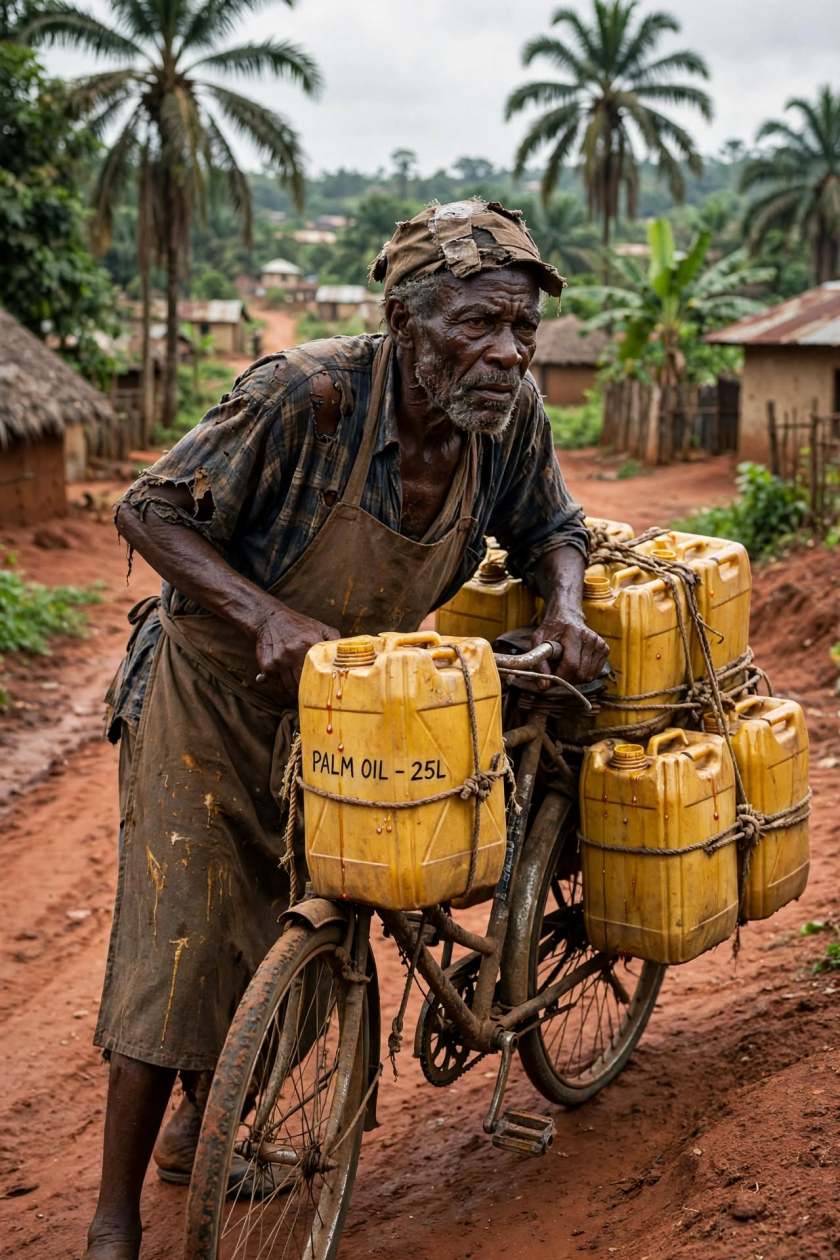
John Munonye’s The Oil Man of Obange invites a reconsideration of what constitutes tragedy and, more importantly, whose suffering is considered worthy of tragic representation. In the classical conception of tragedy, particularly as inherited from Greek drama, the tragic protagonist is frequently a person of elevated social standing whose fall from fortune is associated with error, misjudgment, or hamartia. Tragedy derives part of its force from the distance between the protagonist’s former stature and his eventual ruin. Munonye radically alters this configuration. His protagonist, Jeri, has no great height from which to fall. He is an ordinary palm-oil trader struggling to sustain himself and his family in a precarious colonial economy. His tragedy lies not in falling from greatness but in the exhausting struggle to achieve even a modest degree of security.

It is precisely this ordinariness that gives The Oil Man of Obange its distinctive tragic power. Munonye relocates tragedy from the palace to the marketplace, from the exceptional individual to the economically vulnerable household. Jeri is neither king nor warrior, neither statesman nor aristocrat. His aspirations are correspondingly modest: to work, provide for his family, educate his children, preserve his dignity and gradually improve his material circumstances. Yet the novel demonstrates how even these modest ambitions can become heroic when pursued under conditions of persistent deprivation and insecurity.

Jeri may therefore be understood as the protagonist of a modern social tragedy—a tragedy in which vulnerability, rather than hamartia, assumes explanatory importance. His suffering does not arise primarily from a fatal defect of character. Indeed, many of the qualities traditionally regarded as virtues—industry, perseverance, responsibility, thrift and devotion to family—are strongly present in him. The tragic irony is that these virtues prove insufficient. Munonye presents a social environment in which personal virtue cannot always compensate for structural disadvantage.

Adversity and the Architecture of Tragedy

Munonye constructs Jeri’s tragedy cumulatively. Adversity does not arrive as a single catastrophic event. Instead, the novel subjects him to a succession of pressures whose combined effects gradually diminish his capacity to recover. Taxation, financial insecurity, family obligations, bereavement, educational expenses, accident and the premature assumption of adult responsibilities by his daughter form part of an expanding field of misfortune.

This accumulation is crucial to the novel’s tragic method. A relatively prosperous individual may absorb an isolated shock; a poor household often cannot. The significance of adversity therefore depends not simply on the severity of the event itself but also on the resources available to the person experiencing it. Jeri’s vulnerability lies precisely in the narrowness of his margin for error. He possesses few reserves with which to absorb misfortune.

Munonye reinforces this vulnerability through the physical representation of his protagonist. Jeri’s scarred hands and his clothing—including the memorable oversized black shorts—locate him firmly within the world of manual labour and material scarcity. His body becomes, in a sense, an archive of hardship. The marks of labour upon him remind the reader that poverty in the novel is not an abstraction. It is lived physically, socially and psychologically.

This representational strategy generates pathos without requiring Jeri to be conventionally heroic. The reader’s sympathy derives from witnessing the disproportion between his efforts and his rewards. He works, saves, sacrifices and persists, yet every modest gain remains exposed to destruction by another unforeseen event.

Resilience and Its Limits

One of Jeri’s defining characteristics is resilience. Each encounter with adversity produces an effort at recovery. He refuses to surrender easily to despair, and Munonye repeatedly allows him to reconstitute his hopes after they have been damaged. In contemporary psychological language, one might describe Jeri as possessing considerable self-efficacy: he continues to believe that purposeful action can improve his circumstances.

Yet The Oil Man of Obange complicates any simplistic celebration of resilience. Jeri’s persistence does not guarantee success. This is one of the novel’s most important insights. Resilience is valuable, but resilience without resources has limits.

The distinction is critical. Popular narratives of success often suggest that perseverance eventually triumphs over adversity. Munonye offers a more disturbing proposition: perseverance may be necessary for survival while remaining insufficient for escape from poverty. Jeri can recover psychologically from one setback, but each recovery consumes resources—money, property, labour, social standing and emotional strength. Resilience itself therefore becomes progressively more expensive.

This is particularly evident when financial pressures force Jeri into increasingly desperate coping strategies. Funeral expenses, school fees, accident and other demands erode the small economic base upon which his aspirations depend. His eventual willingness to surrender land is especially significant. Land represents more than an immediately disposable economic asset. In the social world represented by the novel, it carries implications of security, continuity and belonging. To relinquish it is therefore to mortgage part of the future in order to survive the present.

Munonye thus exposes what might be called the paradox of poverty: the poor frequently survive today’s crisis by sacrificing resources needed to protect themselves against tomorrow’s.

Deferred Gratification and the Collapse of the Future

Jeri’s economic behaviour may also be interpreted through the concept of deferred gratification. He repeatedly accepts present hardship in anticipation of future improvement. His labour, savings and sacrifices are investments in a future that he imagines will be better than the present. Education, family advancement and economic security constitute different versions of this deferred future.

In conventional economic reasoning, postponing immediate consumption may permit accumulation and eventual improvement in welfare. But Munonye introduces a crucial qualification: deferred gratification works only where the present and its structures are sufficiently secure for sacrifice to yield its expected return in the future. Jeri inhabits no such secure environment.

Every attempt at accumulation remains vulnerable to illness, death, taxation, family emergency, and accident. Consequently, the future continually consumes the resources accumulated for it before it can arrive. The irony is devastating. Jeri sacrifices the present for the future, but repeated crises compel him to spend the future merely to survive the present.

The novel therefore transforms deferred gratification from a straightforward economic virtue into a tragic mechanism. Prudence cannot guarantee prosperity when individuals are exposed to risks against which they possess little protection.

The Death of Marcelina and the Social Production of Tragedy

The death of Jeri’s wife, Marcelina, is particularly revealing. Her death from tetanus carries significance beyond personal bereavement. It directs attention towards the inadequacy of the social and medical environment within which the family exists. What is experienced privately as devastating grief may simultaneously be understood as evidence of wider institutional deprivation.

This is an important feature of Munonye’s tragic vision. Misfortune appears personal because individuals experience its consequences, yet its origins and severity are often social. Illness becomes catastrophic where healthcare is inaccessible or inadequate. Bereavement becomes economically ruinous where households lack insurance or meaningful social protection. Educational aspiration becomes fragile where school costs must compete with subsistence. An accident becomes an existential economic threat where savings are negligible.

Munonye thereby blurs the distinction between private tragedy and public failure.

The circumstances surrounding Jeri’s daughter deepen this critique. Her pregnancy at thirteen and her decision to leave school in order to assist the family represent more than an individual misfortune. Childhood itself becomes a casualty of household vulnerability. The pressures generated by poverty travel across generations: the crisis experienced by the parents reshapes the possibilities available to the children.

The tragedy is therefore not Jeri’s alone. His vulnerability becomes familial and potentially intergenerational.

Community Without a Safety Net

Another striking feature of the novel is the contrast between communal recognition and effective communal assistance. Jeri may attract sympathy and even admiration, but sympathy does not necessarily translate into material protection.

This distinction deserves attention because it complicates romantic assumptions about traditional communal solidarity. Community can provide identity, companionship and moral recognition while remaining incapable of absorbing severe economic shocks. The people around Jeri may recognise his suffering, yet recognition cannot pay school fees, replace lost income, provide medical treatment or restore depleted assets.

Munonye therefore presents a society in which social relationships exist but an adequate social safety net does not. Jeri remains surrounded by people and yet, at crucial moments, structurally alone.

His vulnerability is consequently not simply the condition of being poor. It is the condition of possessing insufficient alternatives. Poverty narrows the range of possible responses to adversity. The wealthy confront crises with buffers; the poor confront them with choices between necessities.

Jeri’s predicament illustrates this distinction with painful clarity.

From Hamartia to Vulnerability

It is here that Munonye’s contribution to the idea of tragedy becomes most apparent. Classical tragedy often encourages the question: what flaw or error brought the protagonist to this end? The Oil Man of Obange encourages a different question: what resources did the protagonist possess with which to prevent this end?

The shift is profound.

Jeri’s tragedy is not convincingly explained by identifying a single fatal character flaw. His problem is not an excess of ambition comparable to that of certain classical tragic figures, nor an overwhelming pride that blinds him to reality. His aspirations are modest and socially recognisable. He wants security for himself and his family.

The source of tragedy therefore migrates from character towards condition.

This does not mean that Jeri lacks agency or that every decision he makes must be regarded as correct. Rather, it means that his decisions occur within severely restricted circumstances. Agency exists, but it is constrained agency. Choice exists, but the available choices are often between competing forms of loss.

From this perspective, vulnerability performs some of the narrative work traditionally assigned to hamartia. It exposes Jeri repeatedly to consequences from which more privileged individuals might recover. His poverty magnifies ordinary misfortunes into existential threats.

The tragedy of Jeri is thus not that a great man falls. It is that an ordinary man is given so little room in which to remain standing.

The Ethics of Munonye’s Tragic Method

The relentless accumulation of adversity inevitably raises an aesthetic and ethical question: does Munonye subject Jeri to too much suffering? At what point does the accumulation of calamities risk appearing authorially contrived?

The question is legitimate because tragedy depends upon plausibility. If suffering appears arbitrarily imposed merely to manipulate the reader’s emotions, pathos can deteriorate into sentimentality.

Yet the cumulative structure of Jeri’s suffering can be defended on precisely sociological grounds. Vulnerability tends to be cumulative. One shock depletes the resources needed to withstand the next. Illness produces expenditure; expenditure consumes savings; depleted savings increase exposure to subsequent crises; crisis may require the sale of productive assets; loss of assets then increases future vulnerability. What may appear, from a position of security, to be an improbable succession of disasters may represent the lived logic of chronic poverty.

Munonye’s apparent excess therefore has a deeper realism. Jeri is not merely unlucky again and again. He is progressively less protected against being unlucky.

This distinction is essential to understanding the novel.

Conclusion: A Tragedy Without Kings

The Oil Man of Obange ultimately enlarges the moral territory of tragedy. Munonye demonstrates that tragic dignity need not depend upon social rank and that catastrophic suffering need not begin with an extraordinary flaw. The life of an ordinary palm-oil trader can carry tragic weight because the fundamental materials of tragedy—hope, striving, attachment, loss, endurance and defeat—are not the exclusive possessions of kings.

Jeri emerges as a compelling tragic protagonist precisely because his aspirations are so recognisably human. He asks comparatively little of life: the opportunity to work, support his family, educate his children and achieve some measure of security. Yet the social and economic environment continually raises the cost of these modest aspirations.

His resilience intensifies rather than diminishes the tragedy. Had Jeri surrendered immediately, his fate might merely evoke pity. Because he repeatedly rises, struggles and attempts to rebuild, each subsequent reversal acquires greater emotional force. Munonye makes us witnesses not simply to suffering but to the gradual exhaustion of the resources with which suffering can be resisted.

The novel consequently proposes a powerful revision of the tragic form. In place of the classical movement from greatness to ruin, Munonye gives us the struggle from vulnerability towards security—and the repeated interruption of that struggle by forces larger than the individual’s capacity to absorb them. In place of hamartia, he gives us precarity; in place of the palace, the poor household; in place of the fallen great man, the ordinary working man attempting to preserve his dignity.

The most disturbing question raised by Jeri’s experience is therefore not whether he possessed sufficient resilience. He plainly did. The more important question is how much resilience society can reasonably demand from a human being before the celebration of endurance becomes an excuse for the absence of protection.

Munonye’s achievement lies in making that question tragic. Jeri’s defeat is moving not because he is extraordinary, but because he is ordinary—and because the forces that overwhelm him are precisely the kinds of forces to which ordinary lives remain most exposed. The Oil Man of Obange thus makes a persuasive case for a tragedy of the vulnerable: a modern tragic form in which the measure of the protagonist is not the height from which he falls, but the courage with which he struggles, again and again, to rise.
Posted in Colonialism, Creative writing, faith, hope, disappointment,, Politics, power, Prose, The Christian life

Reading and chatting with myself and a keyboard – my reactions to three novels – by three Igbo authors : “Arrow of God,” (Achebe) “Purple Hibiscus,” (Adichie)  and  “The Oil Man of Obange” (Munonye).

Noel A. Ihebuzor

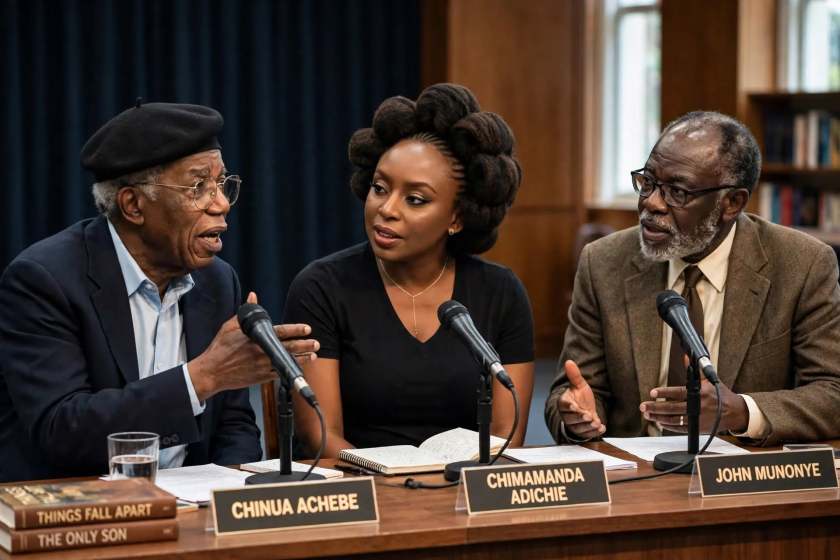
Reading three novels together—or reflecting on them in relation to one another, even when read them at different times—can reveal unexpected connections, allowing each work to cast new light on the others. This has been my experience with Chinua Achebe’s Arrow of God, Chimamanda Ngozi Adichie’s Purple Hibiscus, and John Munonye’s The Oil Man of Obange. Written by three Igbo authors whose works span different generations and historical moments, these novels invite a comparative exploration of how tragedy takes shape. Viewed alongside Arrow of God and Purple Hibiscus, The Oil Man of Obange brings into focus three distinct architectures of tragedy, each shaped by a different relationship to power: Achebe explores power hardened by inflexibility; Adichie examines its oppressive exercise within the family; and Munonye reveals the vulnerability of those who possess too little of it.

Join me as we plunge further into this challenging adventure of discovery.

Ezeulu, Eugene and Jeri as tragic figures

In Arrow of God, Ezeulu comes closest to the classical tragic protagonist. He is already a man of stature: Chief Priest of Ulu, intellectually formidable, proud, politically important and conscious of his authority. His tragedy develops through an interaction between character and historical circumstance. Colonial intervention destabilizes the traditional political and religious order, but Ezeulu’s pride, rigidity and increasingly uncompromising understanding of his own authority contribute significantly to the catastrophe.

The crucial point is that Ezeulu possesses power. His tragedy concerns, among other things, how he understands and exercises it. When his conflict with his community culminates in his refusal to announce the New Yam Festival before the ritual conditions have been fulfilled, religious authority becomes entangled with personal conflict. The resulting crisis threatens the community’s harvest and helps create the conditions in which Christianity gains converts.

Achebe’s tragic structure therefore retains something recognizably Aristotelian: a distinguished protagonist, exceptional qualities, consequential choices, reversal and catastrophic loss. Yet Achebe complicates the classical model because Ezeulu’s downfall cannot simply be attributed to hamartia. Colonialism has entered the political system and altered the field upon which Ezeulu acts.

Jeri, in “The Oil Man of Obange”, occupies almost the opposite position.

He possesses very little institutional, economic or social power. He is not destroyed because he exercises power unwisely; he is destroyed partly because he lacks sufficient power to protect himself and his family from adversity. This represents a second configuration of tragedy.

The situation is not so in the Purple Hibiscus: Here tragedy originates within and moves inside the household.

This offers a third configuration. Eugene Achike possesses considerable power—economic, patriarchal, religious and social. Publicly, he is generous, courageous and respected. Privately, however, his absolutist Catholicism becomes inseparable from authoritarian control and horrific violence against his family.

The resulting tragedy is profoundly paradoxical. Eugene possesses qualities that ought to make him admirable: generosity, courage, religious commitment and resistance to political oppression. Yet those virtues coexist with fanaticism and brutality. He can resist tyranny in public while reproducing tyranny in his own home.

His tragedy therefore contains something much closer to hamartia than Jeri’s does. Eugene’s inability to accommodate ambiguity—his absolutism, religious rigidity and desire for control—contributes directly to the destruction of the family he believes he is protecting.

There is an intriguing parallel here with Ezeulu. Both men possess authority; both are convinced of the legitimacy of that authority; both become increasingly rigid; and both ultimately lose what their authority was supposed to preserve.

But there is an important difference. Ezeulu’s rigidity occurs within a struggle involving traditional religious authority, community and colonial power. Eugene’s operates within religion, patriarchy and the intimate space of the family.

Jeri, by contrast, commands almost nothing.

Three relationships between agency and tragedy

This produces a useful continuum:

Ezeulu — Arrow of GodEugene — Purple HibiscusJeri — The Oil Man of Obange
Social positionPowerful religious leaderWealthy patriarch/businessmanPoor palm-oil trader
Primary arenaCommunity/politics/religionFamily/religionHousehold/economy
Source of tragedyCharacter + colonial disruptionAuthoritarianism + religious absolutismPoverty + accumulated adversity
Relationship to powerPossesses and contests powerPossesses and abuses powerLacks protective power
Role of personal agencyVery highVery highLimited
Approximation to hamartiaPride, rigidity, inflexibilityAbsolutism, fanaticism, controlMuch less obvious
Central vulnerabilityAuthority under historical assaultFamily subjected to patriarchal dominationEconomic and social precarity
Tragic movementPower → isolation → collapseControl → violence → family catastropheStriving → repeated shocks → depletion
What is destroyed?Religious/social authority and familial continuityFamily cohesion and eventually Eugene himselfEconomic security, family aspirations and hope

The comparison suggests a broader historical movement in Nigerian fiction: from the tragedy of the powerful individual towards the tragedy produced by systems and structures.

That proposition needs qualification, but it is potentially a strong journal argument.

The importance of hamartia

With Ezeulu, we can plausibly ask: What did he do that contributed to his downfall?

With Eugene, the question becomes even sharper: How did the very convictions by which he defined goodness become instruments of destruction?

But Jeri forces us to ask something different:

What exactly is his tragic flaw?

Working too hard? Loving his family too much? Hoping that sacrifice will improve his children’s future? Attempting to save and accumulate?

None adequately explains his suffering.

That is why Jeri may represent the most radical departure from classical tragedy of the three. Munonye shifts the causal centre of tragedy away from defective agency and towards vulnerability.

Jeri suffers not principally because he chooses wrongly but because he possesses too few resources with which to survive the consequences of things he did not choose.

Resilience also means something different

The concept of resilience becomes especially productive here.

Ezeulu is certainly strong, but his strength gradually becomes indistinguishable from inflexibility. His refusal to bend contributes to his destruction. In his case, therefore:

resilience can harden into rigidity.

Eugene is also extraordinarily strong-willed. But perseverance in his convictions becomes dangerous because the convictions themselves have become absolutist. His psychological certainty prevents self-correction.

Jeri’s resilience is fundamentally different. His persistence is not directed towards dominating others or defending authority. It is directed towards survival.

He absorbs one shock and gets up. Another arrives and he adjusts. Another consumes some of his resources. He begins again.

And this leads to Munonye’s cruelest irony: Jeri possesses the psychological resource of resilience but lacks the material resources that would allow resilience to succeed.

This observation on the links between the needs for the existence of adequate quantities of social and material resources for the full instantiation of resilience is a much more sophisticated proposition than saying simply that Jeri lacks resilience.

The three novels also locate tragedy at different social scales

Achebe’s tragedy is substantially communal and historical. Ezeulu’s crisis affects Ulu and unfolds against colonial transformation.

Adichie’s tragedy is primarily domestic and psychological, although military dictatorship, colonial religious inheritance and postcolonial social structures remain crucial contexts. The nation enters the home, but the family is the principal theatre in which tragedy is experienced.

Munonye’s tragedy is primarily socioeconomic. The central questions concern livelihood, family survival, illness, education, property and the household’s capacity to absorb shocks.

We could therefore express their tragic geographies almost schematically:

Achebe: community → colonial disruption → tragic collapse

Adichie: family → authoritarian control → tragic violence

Munonye: poverty → vulnerability → repeated shocks → depletion

And yet all three ultimately converge upon the family. Ezeulu’s tragedy damages his household. Eugene’s tragedy destroys the emotional integrity of his household. Jeri’s tragedy progressively consumes the resources upon which his household depends.

The Nigerian family becomes, in all three novels, the place where larger religious, political and economic forces acquire human consequences.

One further distinction: Jeri may produce greater pathos precisely because he is ordinary

Ezeulu and Eugene can provoke morally complicated responses. We can admire them and condemn them almost simultaneously. Their suffering is partly entangled with the suffering they cause others.

Jeri’s relationship with the reader is different. If your interpretation of Munonye is correct, the reader increasingly recognizes a disproportion between what Jeri deserves and what Jeri endures.

That disproportion produces pathos.

And here I think that the question—“Was Munonye fair to Jeri?”—becomes considerably more interesting when placed beside Achebe and Adichie.

We can reasonably say that Ezeulu helps make his tragedy.

We can say even more strongly that Eugene helps make his tragedy and that of his family.

But can we say the same of Jeri?

If the answer is largely no, then Munonye has constructed a fundamentally different tragic protagonist – a character who is a complete victim of circumstances. Since these overwhelming circumstances were created by the author, can we say that thebrotagonist is the victim of his creator?

Conclusion

Where Achebe’s Arrow of God locates tragedy in the collision between authority, character and historical disruption, and Adichie’s Purple Hibiscus locates it in the pathological exercise of patriarchal and religious power, Munonye’s The Oil Man of Obange relocates tragedy among the socially vulnerable. Jeri’s catastrophe proceeds less from hamartia than from precarity: he is not a powerful man destroyed partly by the manner in which he exercises agency, but an ordinary man whose agency is progressively overwhelmed by accumulated adversity. Munonye thereby transforms the Nigerian tragic protagonist from the bearer of consequential power into the bearer of consequential vulnerability.

Ezeulu, Eugene and Jeri can be read as three configurations of power in modern Nigerian tragedy: the man who has power and will not bend, the man who has power and uses it destructively, and the man who lacks enough power to protect himself from catastrophe.

The particularly powerful conclusion would be that Munonye does not abolish the tragic hero; he democratizes him. Tragic stature no longer comes from office, priesthood, wealth or authority. Jeri acquires tragic stature through endurance itself. In that sense, The Oil Man of Obange makes perhaps the most radical claim of the three novels: an ordinary person’s struggle to keep a family alive can possess as much tragic magnitude as the fall of a chief priest or the destruction of a powerful patriarch.

Posted in corruption, Creative writing, hope, disappointment,, Literature, Aesthetics, Politics, Prose, Religion

Purple Hibiscus – a critique of patriarchy and misguided religiosity

By Noel Ihebuzor

Purple hibiscus is a tragic tale of lives and family destroyed by the effects of extreme religiosity, a religiosity that strays quite frequently into the irrational and the psychotic. It is also a tale on the dangers of patriarchy, of domestic violence (spousal and GBV) and what could happen when the battered acquiesce for too long in their systematic humiliation. I also see it as a critique of crude and arrogant Catholicism of the type practised in some parishes in Nigeria. The author of the novel, Chimamanda Adichie has certainly amplified that criticism in her recent address to the council of Nigeria’s, and thereby called out the church and its leaders on a public platform.

But let us go back to the story and see what it tells us – simply this – a fanatical father infected with extremes of religious belief engages in behaviors which systematically estrange from his family, his own father and his sister. In the end, he is poisoned by his wife who sees murder as the only route to end his reign of terror and her suffering.

Let us look at the characters – Papa, a Catholic and publisher of a newspaper, mama, his subdued wife who he humiliates at will, their two children, Kambili and Jaja, whom Papa terrorises and who live in total fear of his fits of temper and excesses, Aunty Ifeoma, Papa’s sister, a lecturer and a beacon of liberalism and radicalism, her two children and finally Papa Nnukwu, Papa’s dad and the children’s grandfather. Papa Nnukwu practices traditional religion and this reality creates a permanent tension between him and his son. The tension is such as that it stands permanently in the way of any demonstration of any bond of filial loyalty from our super Christian pater familias to his father.

Interwoven in this sad tale and in the lives of the characters are snippets of the social ills of Nigeria, including that of corruption, poor governance, abuse of office, wrong and aggressive policing, the corrupting and corrosive effects of a poorly examined religious life and what could happen when a young girl either falls in love with or fantasizes over her priest. The tension is intense and eventually leads to the tragic ending of the novel. The title of the novel ” Purple Hibiscus” is thus at variance with its content.

In the end papa dies from the effects of sustained poisoning by his wife but Jaja takes the rap for his mum. A family is destroyed because of the misguided religiosity of a domineering and aggressive father.

This is a troubling and troubled novel told with sensitivity and tact. One sees in it also the early signs of the author’s feminism, a feminism that has since blossomed as can seen in her positions and speeches on several social media platforms. But some questions persist. One of these is this – is papa a rounded character or a flat character? Does his characterization lean towards a single story approach? Remember that Adichie comes against single stories in one of her now famous lectures? What does the reader think?

Posted in Colonialism, Creative writing, exploitation, greed, Literature, Aesthetics, power, Prose, racism

Was Achebe completely right to write off Heart of Darkness as a racist text? by Noel Ihebuzor

In an essay titled “An Image of Africa: Racism in Conrad’s Heart of Darkness” Chinua Achebe calls out Conrad for racism and spends time showing examples of racism, stereotyping, otherness and infantilzation of Africans in the novella. Whilst such a reading and reaction have their merits, they have the danger of also obscuring and downplaying Conrad’s strong critique and condemnation of colonialism and the then popular rationalisation of the invasion and despoiling of Africa by appeals to the theory of the white man’s burden. So, Heart of Darkness whilst it may have traces of racism is a good primer and introduction to any serious critique of colonialism. A fair appraisal would thus require putting its observed defects side by side with its shattering critique and dismantling of the false claims that were used to rationalise colonialism.

Heart of Darkness thus deserves a second trial by jury with a little bit more of emotional distance from the setting and characters than Chinua Achebe. I think that the great novelist Achebe overreacted in his response to Conrad. Such an overreaction is understandable in an African smarting from the sting of insults to Africa by white scholars such as the Regius professor of history Trevor Roper who had argued that Africa had no history before the coming of the white beyond the gyrations of tribes in the wilds of the dark continent.

So I understand why CA reacted the way he did . I have read and re-read the paper where CA calls Conrad out and some of the claims against Conrad there are justified.

But CA should also have recognized that Conrad, talking through Marlow, was very savage and scathing in his demolition of the justifications of the colonial enterprise. Nearly every white man in that novella is presented as grossly ignorant, lacking in depth and driven by greed. Conrad is particularly critical of the methods of the white colonizer. Even the pilgrims going up the river with Marlow come across as a bunch of poorly camouflaged mercenaries in search of loot and plunder. Kurtz is the archetype of evil, of cruelty and unspeakable savagery. Indeed the Heart of Darkness more appropriately refers to the heart of Kurtz and not to the Congo as a geographical space. The novel describes the depravity in the heart of Kurtz. It refers to that twisted heart ruined by its obsession with ivory, an obsession that pushes Kurtz to carry out ivory raids and to put the heads of all who opposed him on spikes!

A close reading of the sections of the novel would reveal instances of racism that would shock a 21st reader. Such passages therefore appear to justify the accusation of Conrad of racism. Examples abound – Conrad’s use of the “N” word severally in the novel is one good example of racism. Equally, his exaggerated description of the natives, and especially his characterisation of Kurtz’s black mistress suggest an almost identical mindset with early European writers on Africa such as Ryder Haggard who were blatantly racist! Worse still, in some sections of the novel, Conrad, through Marlow his narrator, almost infantalizes africans – they scatter and scamper at the sound of the whistle of the penny boat, Marlow skipper and helmsman conducts himself in the manner of a child with his exaggerated mannerisms. Even Marlow’s explanation of the working of the steam engine to his African assistant is highly patronising, insulting and steeped in prescientific animism. There was a terrible spirit trapped in the boiler and it must be pacified by a constant supply of fire! How insulting! Then there is suggestion of cannibalism on the part of the crew of the boat though they did not eat Marlow and his white companions. Are the instances revealing of a mind steeped in racism and that of a famous writer trapped in a Eurocentric mindset and who was writing for an European audience still trapped in its ignorance of Africa and who sought to market European adventure into Africa as being an act of benevolence of a super race anxious to bring civilisation to savages?

Such a reading is seriously challenges by the greed and imbecile rapacity which accompany the colonial in irsion and adventure. And Conrad does a good job in exposing this through the merciless unpeeling of the Belgian mission as a mad rush for ivory. Through the portrayal of the true mission of Kurtz and his fellow travellers, Conrad indicts colonialism and lays bare its false justifications. Yes, I agree that some of Conrad’s explanations for the origins of Kurtz’s lunacy, such as the one that the jungle had invaded Kurtz’s mind in retaliation for his invasion of its space, is deficient. Such an explanation belongs to an era of premature speculative animism masquerading as science but we must be careful not to mistake such dabbling into pseudoscience as an apologia for racism. I see Heart of Darkness as one of the earliest examples of anti-colonial literature.

Posted in Creative writing, Literature, Aesthetics, Uncategorized

Poverty Porn or Pity Porn

By

Noel Ihebuzor

Critics often react differently to a work of art. Some react to the theme, others to the content and yet others react to the considerations that may have guided the selection of content whilst others react to the narrative style, the way selected content and themes are presented. Put such reactions against the backdrop of authors’ claims to some creative independence and some would immediately argue that the author has a right to certain autonomy in selecting what to write on! In situations such as these, the conditions are set for conflicts between an author’s claim to independence and autonomy and the assumed rights of a critic to make judgments on artistic production.

In the field of African literary aesthetics, the issue of poverty porn is on that has divided author and critic most forcefully and sharply drawn the battle lines. There are essentially those who argue for author autonomy and those ranged against them in battles; who preach moderation and balance in content and how it is presented. Such conflicts are not new. In the 19th century, Stendhal had commented through one of the characters in his book “The Red and the Black” as follows:

“Ah, Sir, a novel is a mirror carried along a high road. At one moment it reflects to your vision the azure skies, at another the mire of the puddles at your feet. And the man who carries this mirror in his pack will be accused by you of being immoral! His mirror shews the mire, and you blame the mirror! Rather blame that high road upon which the puddle lies, still more the inspector of roads who allows the water to gather and the puddle to form.”

Similar strains have been heard in defense of stories that have been rated highly in the Caine Prize for Literature. Habila, a Nigerian writer and critic, uses Poverty Porn to refer to a “certain kind of literary work that represents Africa as a space of suffering, wretchedness, and despair.” Habila expands on this view in a scorching commentary:

“I was at a Caine prize seminar a few years back and the discussion was on the state of the new fiction coming out of Africa. One of the panelists, in passing, accused the new writers of “performing Africa” for the world. To perform Africa, the distinguished panelist explained, is to inundate one’s writing with images and symbols and allusions that evoke, to borrow a phrase from Aristotle, pity and fear, but not in a real tragic sense, more in a CNN, western-media-coverage-of-Africa, poverty-porn sense. We are talking child soldiers, genocide, child prostitution, female genital mutilation, political violence, police brutality, dictatorships, predatory preachers, dead bodies on the roadside. The result, for the reader, isn’t always catharsis, as Aristotle suggested, but its direct opposite: a sort of creeping horror that leads to a desensitization to the reality being represented”

In defense of the creative writer, one can ask bluntly – what is wrong with writing what you see, what you think you have seen so long as you are sure that what you write is what you see and not what someone has cleverly whispered into your ears or subtly manipulated you into thinking is what you see or what you must see? In the unfortunate case that what you write is what someone has cleverly planted in your psyche, perception is flawed and your scribbles are nothing but the echoes of another. Your narrative style is also likely to be vitiated. And that would be really sad. Similar sadness would also result if you were writing what you saw or see but presenting in a frame that conforms to or confirms another person’s judgment of your reality or his/her preferred image of your reality. In this second case, whereas perception could be objective, the presentation and narration of what is perceived is influenced by a desire to pander to the preferences of a target readership. Most stories written on African and about Africa have two target readership audiences in mind. There is the African readership and then there is the Western readership. The West has its own preferred images of Africa and the developing world. It is a world overrunning with images of poorly fed children, emaciated mothers and kids with running noses, singed copper-colored hair, shriveled limbs and bloated tummies vegetating in an environment filled with buzzing flies and overrun with dirt and signs of squalor. Other variants of the preferred images include images of cruelty, wars, famine, and machete-wielding red-eyed adolescents. These are marketed as metonyms for Africa and find outlets in programmes on TV and in publications by well-meaning but patronizingly condescending international NGOs who try to use such images in their fund mobilization efforts for Africa and the third world. Similar presentations of Africa and the third world have crept into the arts and creative writing where African realities are often presented as a series of unremitting tragedies, savagery, immorality and wretchedness.

Poverty porn is a term used by critics to describe works of art that attempt to depict a reality in such bold and extreme strokes that the reader’s response often becomes one of pity followed by an overwhelming sense of powerless. Like porn, the style is seen to be direct and with no efforts at diversion or depth. Sadness is layered upon sadness, bad situations fall on top of one another and a canvas of crushing negativity is imposed on the reader’s perceptual field as a result of the exhaustive description of sorrow and destruction which are projected ad nauseam as substitutes for critical distance, balanced narration, analysis and creativity.

Choice is one basic and foundational feature of every work of art. Every piece of writing involves a series of choices – at the phonological, lexical and syntactical levels. And a writer makes choices on what to present and the extent to which he/she goes presenting them. One feature of a good presentation is balance, and a presentation that lacks balance is deficient in many ways. Yet some writers, presenters and narrators carry on as if the concept of balance does not exist in their portrayal of realities. And this begs the question why this is so. Are some realities so strong that they overwhelm and force the descriptor or narrator to extremes in a bid to express the same shock that such painful realities imposed on his or her? One could well be reading the work notes of a morbid anatomist, enamored of his/her art and treating us to full screen presentations of malignant cells and dying and decaying tissues. Every line is so soaked in a suffocating dampness that depresses the reader, and this is true whether the writer’s prose is beautiful, elegant, cadenced and effortless, something which could give rise to the oxymoron “beautiful ugliness”. Whether written in beautiful prose or in deliberate destructive and discordant prose, the effect is the same – the layer upon layer description of poverty, of cruelty, of rot, of helpless souls trapped in it floods every bit of the reader with pity. It bathes you in a slow unending stream of negative images and imagery which ultimately wear you down. The unremitting negativity overwhelms and sucks you under. Sorrow triumphs at the expense of solution, surrender trumps any survival urge. Pity porn would appear to me to also be a good label for works in this genre.

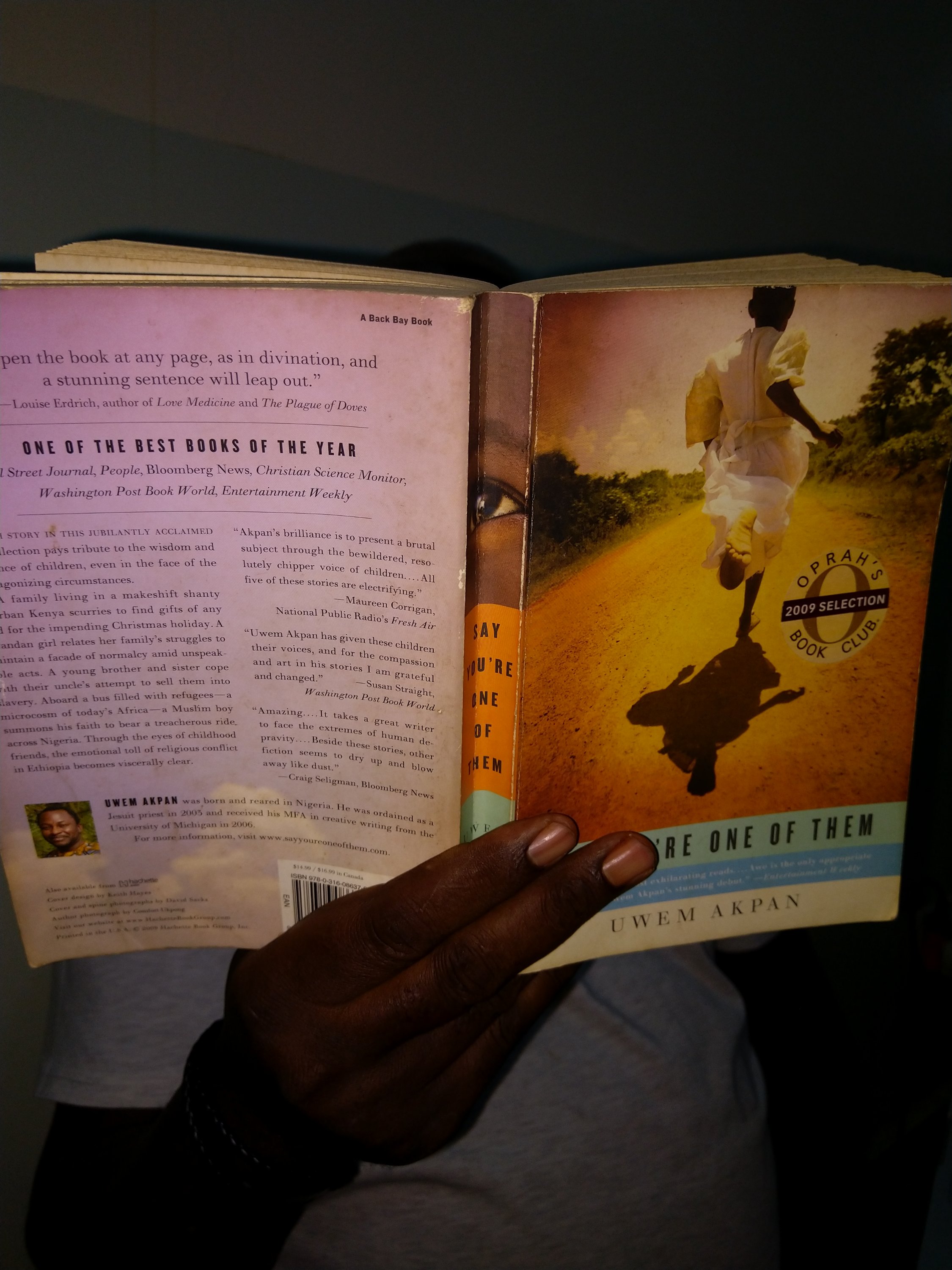
Father Uwem Akpan’s book – Say you‘re one of them has been criticized as an example of this dangerous literary genre of poverty porn or pity porn. Published by Back Bay Books, it is a collection of five stories, all tragic and all overflowing with negative images. “An Ex-mas feast” is set in Nairobi and is a description of life, deprivation and survival in one of its largest slumps, “Fattening for Gabon” is set somewhere in the fuzzy land between Seme border and Nigeria and deals with child trafficking, “What language is that” is set somewhere around Ethiopia and is about tensions caused by linguistic differences. “Luxurious Hearses” is set in the north of Nigeria and is a tale of religious inspired violence and killings, and the last story “My parents’ bedroom” is a story around the genocide in Rwanda.

Apart from a few geographical and time inaccuracies in some of the stories, the stories and the research that informed them are pithy and informed by a commitment to realism. Yet one is overcome by a sense of sadness as one completes reading each story. There is no escape from the enveloping sadness, from the negativity that nibbles at the core of your being as you read about Africa.

One of the sharpest minds for now in African literary aesthetics is Ikhide Ikheloa. I am yet to meet him in person but judging from his many contributions, he is a man of great erudition, astounding intellectual depth, amazing energy, great wit and someone with a discernable social vision and commitment. He also has a strong aversion for poverty porn/pity porn and has deployed his massive intellectual energy, wit and sarcasm to come against any African writer he thinks is producing such. His views on Poverty Porn in the articles with link lines below are highly critical of Poverty Porn and its purveyors.

The comment below is sweltering:

“The mostly lazy, predictable stories that made the 2011 shortlist celebrate orthodoxy and mediocrity. They are a riot of exhausted clichés even as ancient conflicts and anxieties fade into the past tense: Huts, moons, rapes, wars, and poverty. The monotony of misery simply overwhelms the reader. …..The stories are uniquely wretched”.

Listen to Ikhide speak again:

“I am still fuming over the wretchedness of almost all the offerings on the shortlist of the 2011 Caine Prize for African Writing. Aided by some needy “African” writers, Africa is being portrayed as an issues-laden continent that is best viewed on a fly-infested canvas. Memo to the Caine Prize folks: It doesn’t have to be all about issues. Just tell me a story, any story”.

I have read somewhere where he blasts Father Uwem’s book as another example of poverty porn. Is this fair, I mean this effort to classify to classify Father Uwem Akpan’s book as belonging to this genre of poverty porn? Is Father Akpan wrong in describing what he sees or is his vision biased or his depiction exaggerated? Is the critic right in castigating a writer for choosing a point of view? And in response to the critic’s lambast, could the writer simply not respond by saying: You may not like it but that is what I saw and what I felt when I confronted the reality that prompted and released my creative impulse? Before such expostulation, can the critic not simply ask the creative writer to go check his/her eyes? Would such exchanges not raise key philosophical and epistemological issues about the objectivity and subjectivity of reality and perception?

We all know that life and reality are a blend of the good and the bad, of hope and despair, of wickedness and kindness or nobility and knavery. A good storyteller must then seek to capture this dual face of life and reality and not just focus only on the ugly or the good. Focusing only on the positive and optimistic can be as damaging as focusing on the negative and pessimistic. Voltaire’s “Candide”, for example, is a riotous routing of the dangers in unbridled and unchecked optimism! Voltaire Candide checked that unhealthy tendency and in many ways prepared the ground for the emergence of realism. Is the rage against poverty porn driven by a similar impulse to call out and check the sprouting of effusive negativity and pessimism in artistic depictions of the African reality?

If the answer is yes, the question then becomes how to distinguish works we can define as poverty porn. How is it different from other works of art? Could its distinguishing feature then be a deliberate choice by the author to exaggerate negativity without making an effort to balance such negative images with strategic injections of rays of positivity? For in life, there is sadness but within sad situations, a narrator who looks hard enough could find something that ennobles and which contains the seeds for the defeat of despair. Is one guilty of prescriptivism if one then suggests that the duty of an author could be to seek such balanced presentation even when one allows the author a right to betray a preference for giving the upper hand to the tragic?

I have lived experiences with backgrounds similar to those of two or three of Fr Uwem’s stories. I can say that these experiences can be presented in manners that do not create a numbing stasis and inability to respond creatively to life’s challenges?

The first one was sometime around 2002/2003. It was one of those slow mornings in a typical UN office I was heading. I was going through implementation reports line by line and also checking up to see which of the partners that we had advanced funds to had satisfactorily accounted for those funds. Then all of a sudden, all hell broke loose. The police had intercepted a vehicle loaded with children headed for the Idi-Iroko border. The stories the children told were not too satisfactory. They all claimed that the lady they were traveling with was their aunty but on close examination, the story turned out not be true. The lady was the wife of a highly placed person and was clearly well connected and the children were from Kaduna. She claimed she was taking the children to the Republic of Benin for a vacation project but again it was difficult to believe that as schools were still in session. This was beginning to look like a case of cross-border smuggling gone wrong and in the end, the children had to be returned to their parents with the assistance of the Ogun State department of Child welfare to Kaduna state. So child border smuggling is real. Uwem has a story that deals with such a situation – the difference is on the layered incidences of unremitting sadness in his story. It is such unremitting sadness, the pounding presentation of a sad reality that dwells extensively on negative episodes that in a way threaten to reduce the literary value of Uwem’s storytelling and to paralyze our ability to respond to it. In the case under review, I refused to be discouraged, always assuring the children that they would soon be united to their parents and doing my best to see that they were fed whilst they remained in the protective custody of the Ogun state government. Sad event, but positivity results in a happy ending.

My second experience was in 2004. I had just arrived Nairobi and after a few weeks living there, I decided to visit Kibera. I had two reasons to do this. The first was to satisfy my curiosity. The second was more professional. In 1996, I had directed a UNESCO funded project to produce a module capable of teaching urbanization in secondary schools in a manner that would reflect the innovative strands from the Rio, Cairo and Beijing conferences on the environment, population and gender respectively. Tall order! But I managed to assemble a very strong team made of demographers, sociologists, educationists, environmental experts and curriculum developers and we came out with an output that we were very proud of. A book of readings titled “An EPD approach to teaching Urbanization in secondary schools” edited by Professor UMO Ivowi and myself was also published. A lot of our background stuff on urban settings were gleaned from Ajegunle, the jungle.

Kibera, another slum, was thus my opportunity to test whether the “truths” we told about one slum had universal application. The visit to Kibera shook me to the roots. It brought tears to my ears. The poverty I saw there tormented me. It offended every sense of decency. Kibera’s inhabitants were more like animals trapped in a place with no exit. Later to achieve some catharsis, I wrote a long, rambling, poorly structured poem – A song for Kibera.

Later in 2005, I chanced upon “Say you’re one of them” and I was amazed to notice how despite the differences in genres, Father Uwem’s images and mine of Kibera had very strong resemblances. Was I doing poverty porn or writing down what I saw in this poem? Yes, I now recognize that I deliberately ended the poem on a note of rebellion, a note that affirmed my hope and prayer that the Kiberas of this world must no longer be allowed to exist and that social policy could put an end to Kiberas and wipe them off the face of Africa. Hence, my poem ends with a choice of positivity over negativity and optimism over pessimism.

What is my point? Two authors may confront and be inspired by almost identical realities but choices made all along the narrative trajectory could produce a difference in effect and could determine whether one is doing poverty porn or simply engaging in an exercise in realism.