
Noel A. Ihebuzor
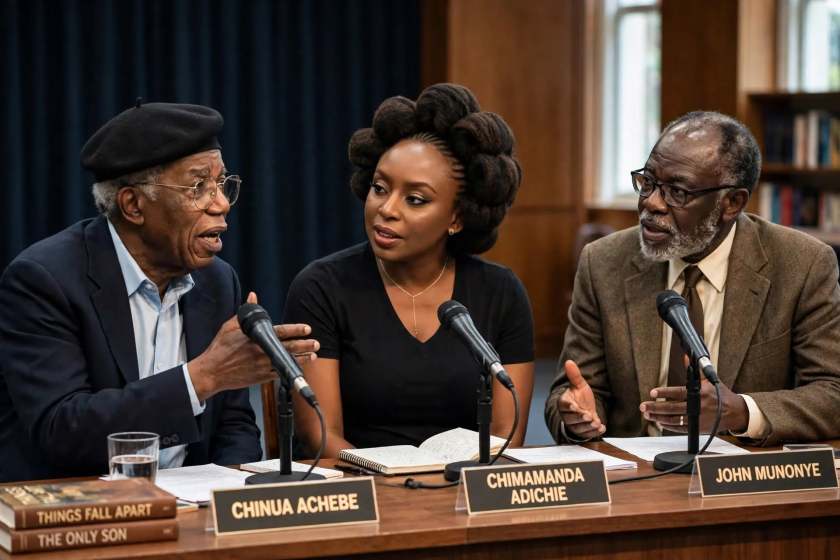
Reading three novels together—or reflecting on them in relation to one another, even when read them at different times—can reveal unexpected connections, allowing each work to cast new light on the others. This has been my experience with Chinua Achebe’s Arrow of God, Chimamanda Ngozi Adichie’s Purple Hibiscus, and John Munonye’s The Oil Man of Obange. Written by three Igbo authors whose works span different generations and historical moments, these novels invite a comparative exploration of how tragedy takes shape. Viewed alongside Arrow of God and Purple Hibiscus, The Oil Man of Obange brings into focus three distinct architectures of tragedy, each shaped by a different relationship to power: Achebe explores power hardened by inflexibility; Adichie examines its oppressive exercise within the family; and Munonye reveals the vulnerability of those who possess too little of it.
Join me as we plunge further into this challenging adventure of discovery.
Ezeulu, Eugene and Jeri as tragic figures
In Arrow of God, Ezeulu comes closest to the classical tragic protagonist. He is already a man of stature: Chief Priest of Ulu, intellectually formidable, proud, politically important and conscious of his authority. His tragedy develops through an interaction between character and historical circumstance. Colonial intervention destabilizes the traditional political and religious order, but Ezeulu’s pride, rigidity and increasingly uncompromising understanding of his own authority contribute significantly to the catastrophe.
The crucial point is that Ezeulu possesses power. His tragedy concerns, among other things, how he understands and exercises it. When his conflict with his community culminates in his refusal to announce the New Yam Festival before the ritual conditions have been fulfilled, religious authority becomes entangled with personal conflict. The resulting crisis threatens the community’s harvest and helps create the conditions in which Christianity gains converts.
Achebe’s tragic structure therefore retains something recognizably Aristotelian: a distinguished protagonist, exceptional qualities, consequential choices, reversal and catastrophic loss. Yet Achebe complicates the classical model because Ezeulu’s downfall cannot simply be attributed to hamartia. Colonialism has entered the political system and altered the field upon which Ezeulu acts.
Jeri, in “The Oil Man of Obange”, occupies almost the opposite position.
He possesses very little institutional, economic or social power. He is not destroyed because he exercises power unwisely; he is destroyed partly because he lacks sufficient power to protect himself and his family from adversity. This represents a second configuration of tragedy.
The situation is not so in the Purple Hibiscus: Here tragedy originates within and moves inside the household.
This offers a third configuration. Eugene Achike possesses considerable power—economic, patriarchal, religious and social. Publicly, he is generous, courageous and respected. Privately, however, his absolutist Catholicism becomes inseparable from authoritarian control and horrific violence against his family.
The resulting tragedy is profoundly paradoxical. Eugene possesses qualities that ought to make him admirable: generosity, courage, religious commitment and resistance to political oppression. Yet those virtues coexist with fanaticism and brutality. He can resist tyranny in public while reproducing tyranny in his own home.
His tragedy therefore contains something much closer to hamartia than Jeri’s does. Eugene’s inability to accommodate ambiguity—his absolutism, religious rigidity and desire for control—contributes directly to the destruction of the family he believes he is protecting.
There is an intriguing parallel here with Ezeulu. Both men possess authority; both are convinced of the legitimacy of that authority; both become increasingly rigid; and both ultimately lose what their authority was supposed to preserve.
But there is an important difference. Ezeulu’s rigidity occurs within a struggle involving traditional religious authority, community and colonial power. Eugene’s operates within religion, patriarchy and the intimate space of the family.
Jeri, by contrast, commands almost nothing.
Three relationships between agency and tragedy
This produces a useful continuum:
| Ezeulu — Arrow of God | Eugene — Purple Hibiscus | Jeri — The Oil Man of Obange | |
| Social position | Powerful religious leader | Wealthy patriarch/businessman | Poor palm-oil trader |
| Primary arena | Community/politics/religion | Family/religion | Household/economy |
| Source of tragedy | Character + colonial disruption | Authoritarianism + religious absolutism | Poverty + accumulated adversity |
| Relationship to power | Possesses and contests power | Possesses and abuses power | Lacks protective power |
| Role of personal agency | Very high | Very high | Limited |
| Approximation to hamartia | Pride, rigidity, inflexibility | Absolutism, fanaticism, control | Much less obvious |
| Central vulnerability | Authority under historical assault | Family subjected to patriarchal domination | Economic and social precarity |
| Tragic movement | Power → isolation → collapse | Control → violence → family catastrophe | Striving → repeated shocks → depletion |
| What is destroyed? | Religious/social authority and familial continuity | Family cohesion and eventually Eugene himself | Economic security, family aspirations and hope |
The comparison suggests a broader historical movement in Nigerian fiction: from the tragedy of the powerful individual towards the tragedy produced by systems and structures.
That proposition needs qualification, but it is potentially a strong journal argument.
The importance of hamartia
With Ezeulu, we can plausibly ask: What did he do that contributed to his downfall?
With Eugene, the question becomes even sharper: How did the very convictions by which he defined goodness become instruments of destruction?
But Jeri forces us to ask something different:
What exactly is his tragic flaw?
Working too hard? Loving his family too much? Hoping that sacrifice will improve his children’s future? Attempting to save and accumulate?
None adequately explains his suffering.
That is why Jeri may represent the most radical departure from classical tragedy of the three. Munonye shifts the causal centre of tragedy away from defective agency and towards vulnerability.
Jeri suffers not principally because he chooses wrongly but because he possesses too few resources with which to survive the consequences of things he did not choose.
Resilience also means something different
The concept of resilience becomes especially productive here.
Ezeulu is certainly strong, but his strength gradually becomes indistinguishable from inflexibility. His refusal to bend contributes to his destruction. In his case, therefore:
resilience can harden into rigidity.
Eugene is also extraordinarily strong-willed. But perseverance in his convictions becomes dangerous because the convictions themselves have become absolutist. His psychological certainty prevents self-correction.
Jeri’s resilience is fundamentally different. His persistence is not directed towards dominating others or defending authority. It is directed towards survival.
He absorbs one shock and gets up. Another arrives and he adjusts. Another consumes some of his resources. He begins again.
And this leads to Munonye’s cruelest irony: Jeri possesses the psychological resource of resilience but lacks the material resources that would allow resilience to succeed.
This observation on the links between the needs for the existence of adequate quantities of social and material resources for the full instantiation of resilience is a much more sophisticated proposition than saying simply that Jeri lacks resilience.
The three novels also locate tragedy at different social scales
Achebe’s tragedy is substantially communal and historical. Ezeulu’s crisis affects Ulu and unfolds against colonial transformation.
Adichie’s tragedy is primarily domestic and psychological, although military dictatorship, colonial religious inheritance and postcolonial social structures remain crucial contexts. The nation enters the home, but the family is the principal theatre in which tragedy is experienced.
Munonye’s tragedy is primarily socioeconomic. The central questions concern livelihood, family survival, illness, education, property and the household’s capacity to absorb shocks.
We could therefore express their tragic geographies almost schematically:
Achebe: community → colonial disruption → tragic collapse
Adichie: family → authoritarian control → tragic violence
Munonye: poverty → vulnerability → repeated shocks → depletion
And yet all three ultimately converge upon the family. Ezeulu’s tragedy damages his household. Eugene’s tragedy destroys the emotional integrity of his household. Jeri’s tragedy progressively consumes the resources upon which his household depends.
The Nigerian family becomes, in all three novels, the place where larger religious, political and economic forces acquire human consequences.
One further distinction: Jeri may produce greater pathos precisely because he is ordinary
Ezeulu and Eugene can provoke morally complicated responses. We can admire them and condemn them almost simultaneously. Their suffering is partly entangled with the suffering they cause others.
Jeri’s relationship with the reader is different. If your interpretation of Munonye is correct, the reader increasingly recognizes a disproportion between what Jeri deserves and what Jeri endures.
That disproportion produces pathos.
And here I think that the question—“Was Munonye fair to Jeri?”—becomes considerably more interesting when placed beside Achebe and Adichie.
We can reasonably say that Ezeulu helps make his tragedy.
We can say even more strongly that Eugene helps make his tragedy and that of his family.
But can we say the same of Jeri?
If the answer is largely no, then Munonye has constructed a fundamentally different tragic protagonist – a character who is a complete victim of circumstances. Since these overwhelming circumstances were created by the author, can we say that thebrotagonist is the victim of his creator?
Conclusion
Where Achebe’s Arrow of God locates tragedy in the collision between authority, character and historical disruption, and Adichie’s Purple Hibiscus locates it in the pathological exercise of patriarchal and religious power, Munonye’s The Oil Man of Obange relocates tragedy among the socially vulnerable. Jeri’s catastrophe proceeds less from hamartia than from precarity: he is not a powerful man destroyed partly by the manner in which he exercises agency, but an ordinary man whose agency is progressively overwhelmed by accumulated adversity. Munonye thereby transforms the Nigerian tragic protagonist from the bearer of consequential power into the bearer of consequential vulnerability.
Ezeulu, Eugene and Jeri can be read as three configurations of power in modern Nigerian tragedy: the man who has power and will not bend, the man who has power and uses it destructively, and the man who lacks enough power to protect himself from catastrophe.
The particularly powerful conclusion would be that Munonye does not abolish the tragic hero; he democratizes him. Tragic stature no longer comes from office, priesthood, wealth or authority. Jeri acquires tragic stature through endurance itself. In that sense, The Oil Man of Obange makes perhaps the most radical claim of the three novels: an ordinary person’s struggle to keep a family alive can possess as much tragic magnitude as the fall of a chief priest or the destruction of a powerful patriarch.


