By Noel A.Ihebuzor
Abstract
This essay examines the changing configuration of tragedy in John Munonye’s The Oil Man of Obange, Chinua Achebe’s Arrow of God, and Chimamanda Ngozi Adichie’s Purple Hibiscus. It argues that the three novels construct tragedy through markedly different relationships among power, agency, resilience, flexibility, choice, and vulnerability. Ezeulu in Arrow of God possesses considerable religious and institutional authority, but his resilience increasingly hardens into inflexibility as colonial disruption and personal agency interact to produce catastrophe. Eugene in Purple Hibiscus similarly possesses substantial economic, patriarchal, and moral authority, but converts agency into domination through religious absolutism and an inability to accommodate difference. Jeri, the protagonist of The Oil Man of Obange, occupies the opposite end of the spectrum. His tragedy arises not principally from the misuse of power or from a recognisable hamartia, but from constrained agency under conditions of socioeconomic vulnerability. Although resilient and capable of purposeful action, he lacks the material resources and institutional protections necessary to convert resilience into sustainable recovery. Reading these protagonists comparatively, the essay proposes a continuum of modern Nigerian tragic representation: from the tragedy of consequential power to the tragedy of consequential vulnerability. Munonye, in particular, democratizes the tragic protagonist by demonstrating that tragic magnitude may arise not from the fall of the socially elevated but from the struggle of an ordinary person to preserve dignity, family, and hope under conditions of cumulative adversity.
Keywords: tragedy; resilience; vulnerability; agency; flexibility; choice; precarity; John Munonye; Chinua Achebe; Chimamanda Ngozi Adichie
Introduction: Who Qualifies for Tragedy?
One of the enduring questions in the theory of tragedy concerns the identity and social standing of the tragic protagonist. Classical conceptions of tragedy, particularly those derived from Aristotle, have often been associated with protagonists of consequence: kings, warriors, rulers, and other socially elevated individuals whose reversals of fortune acquire public as well as personal significance. Within this tradition, hamartia—variously understood as error, misjudgment, or tragic flaw—provides one important mechanism through which agency becomes implicated in catastrophe. The tragic protagonist does not merely suffer; in some significant sense, his actions, decisions, dispositions, or errors participate in the production of his suffering.
Modern literature has substantially complicated this model. Once tragedy moves from palace and battlefield into marketplace, workplace, village, and household, a different question emerges. What happens to tragedy when its protagonist possesses little power and when catastrophe arises less from the misuse of agency than from the insufficiency of the resources necessary to make agency effective?
John Munonye’s The Oil Man of Obange offers a particularly productive context in which to pursue this question. Read comparatively with Chinua Achebe’s Arrow of God and Chimamanda Ngozi Adichie’s Purple Hibiscus, Munonye’s novel suggests an important reconfiguration of the tragic protagonist in Nigerian fiction. Ezeulu, Eugene, and Jeri are all figures of suffering, endurance, choice, and consequence, but they occupy radically different positions in relation to power. Ezeulu possesses religious and institutional authority; Eugene possesses economic, patriarchal, and moral authority; Jeri possesses comparatively little authority beyond his determination to work and provide for his family.
This essay argues that these differences produce three distinct architectures of tragedy. Arrow of God constructs tragedy through the collision of authority, historical disruption, agency, and inflexibility. Purple Hibiscus locates tragedy substantially in the authoritarian exercise of patriarchal and religious power within the family. The Oil Man of Obange, by contrast, locates tragedy in vulnerability, constrained choice, and the progressive exhaustion of an ordinary man’s capacity to absorb adversity.
The comparison therefore requires us to distinguish between possessing agency and possessing the resources necessary to make agency effective. It also requires a distinction between resilience and flexibility. Resilience enables individuals to persist after adversity; flexibility enables them to modify strategies, assumptions, and behaviour when circumstances change. Neither, however, operates independently of material and social conditions. The central proposition of this essay is consequently that tragedy in these three novels can be illuminated by examining the dynamic relationship among resilience, flexibility, agency, choice, and vulnerability.
Ezeulu: Agency, Authority, and the Tragedy of Inflexibility
Of the three protagonists, Ezeulu in Arrow of God most obviously recalls the classical tragic figure. As Chief Priest of Ulu, he occupies a position of substantial religious and symbolic authority. His identity is inseparable from his office, and his decisions carry consequences extending beyond his household to the wider community.
Yet Ezeulu does not operate in a stable social universe. Colonialism has intruded into the political and religious ecology of Umuaro, altering existing relationships of authority and introducing an external power whose categories and procedures frequently fail to comprehend indigenous institutions. Ezeulu’s tragedy therefore cannot adequately be explained by personality alone. It emerges from an interaction between historical disruption and individual agency.
This distinction matters. To reduce Ezeulu’s catastrophe simply to pride would reproduce an overly narrow version of hamartia. His choices occur within a field of power already destabilized by colonial intervention. Nevertheless, Achebe refuses to deprive him of agency. Ezeulu interprets circumstances, makes decisions, responds to challenges, and chooses among alternatives. His tragedy is therefore neither wholly self-generated nor wholly imposed upon him.
The concept of flexibility becomes especially useful here. Ezeulu possesses extraordinary resilience. He survives humiliation, political conflict, detention, familial tension, and challenges to his authority. But resilience is not synonymous with adaptability. Indeed, his strength becomes increasingly inseparable from rigidity.
This produces one of the central paradoxes of Arrow of God: a quality necessary for endurance may become destructive when it loses the capacity for adaptation. Resilience without flexibility can harden into inflexibility.
Ezeulu’s determination to maintain his understanding of ritual obligation during the New Yam crisis demonstrates this tension. From his perspective, he acts within the requirements of sacred office. From the community’s perspective, however, his position threatens collective survival. The resulting conflict exposes the dangerous intersection between institutional responsibility, personal grievance, religious conviction, and individual agency.
Ezeulu’s tragedy therefore arises partly from the narrowing of his repertoire of possible responses. He possesses choices, but increasingly appears able to recognize only those compatible with his conception of himself and his authority. His vulnerability is consequently paradoxical: the very power that enlarges his agency also increases the consequences of his inflexibility.
His is the tragedy of a powerful man whose capacity to act remains substantial but whose capacity to adapt becomes progressively constrained.
Eugene: Agency Converted into Domination
If Ezeulu represents the tragedy of authority under historical assault, Eugene Achike in Purple Hibiscus represents the tragedy of authority turned inward upon the family.
Eugene possesses forms of power unavailable to either Ezeulu or Jeri. He is economically successful, socially respected, religiously influential, and publicly courageous. He uses his wealth philanthropically and opposes political repression through his newspaper. In the public sphere, therefore, he appears as a figure of unusual moral courage.
The domestic Eugene, however, presents a disturbing contradiction. Within his household, religious certainty becomes authoritarian control. His Catholic absolutism creates a moral universe in which deviation becomes contamination and punishment can be interpreted as correction. The result is a household structured by fear.
Agency operates differently here than it does in Arrow of God. Eugene is not primarily a victim of insufficient power. On the contrary, tragedy develops because his considerable agency is exercised in ways that radically diminish the agency of others.
Kambili, Jaja, and Beatrice live within a regime in which choices are severely restricted. Schedules, speech, religious practice, relationships, and even emotional expression become subject to paternal regulation. Eugene’s expansive agency is thus purchased at the expense of his family’s constrained agency.
This relationship reveals an important principle: vulnerability is frequently relational. People may become vulnerable not merely because they lack personal strength but because another person’s superior power reduces their range of meaningful choices.
Eugene is himself shaped by historical, cultural, and religious forces, including the legacy of missionary Catholicism and colonial constructions of moral value. Yet these influences do not eliminate his responsibility. Like Ezeulu, he acts within inherited structures, but he also exercises choice within them.
Flexibility again becomes crucial. Eugene’s worldview admits little ambiguity. His moral categories are sharply polarized: purity and sin, orthodoxy and deviation, salvation and damnation. Such rigidity prevents the self-correction that flexibility might have made possible.
His tragedy therefore lies partly in a catastrophic contradiction: the man who courageously resists political tyranny reproduces tyranny within his own home.
In Eugene, resilience becomes ideological persistence; conviction becomes absolutism; agency becomes domination; and authority, deprived of flexibility, becomes violence.
Jeri and the Tragedy of Constrained Agency
Jeri in The Oil Man of Obange represents a fundamentally different tragic configuration.
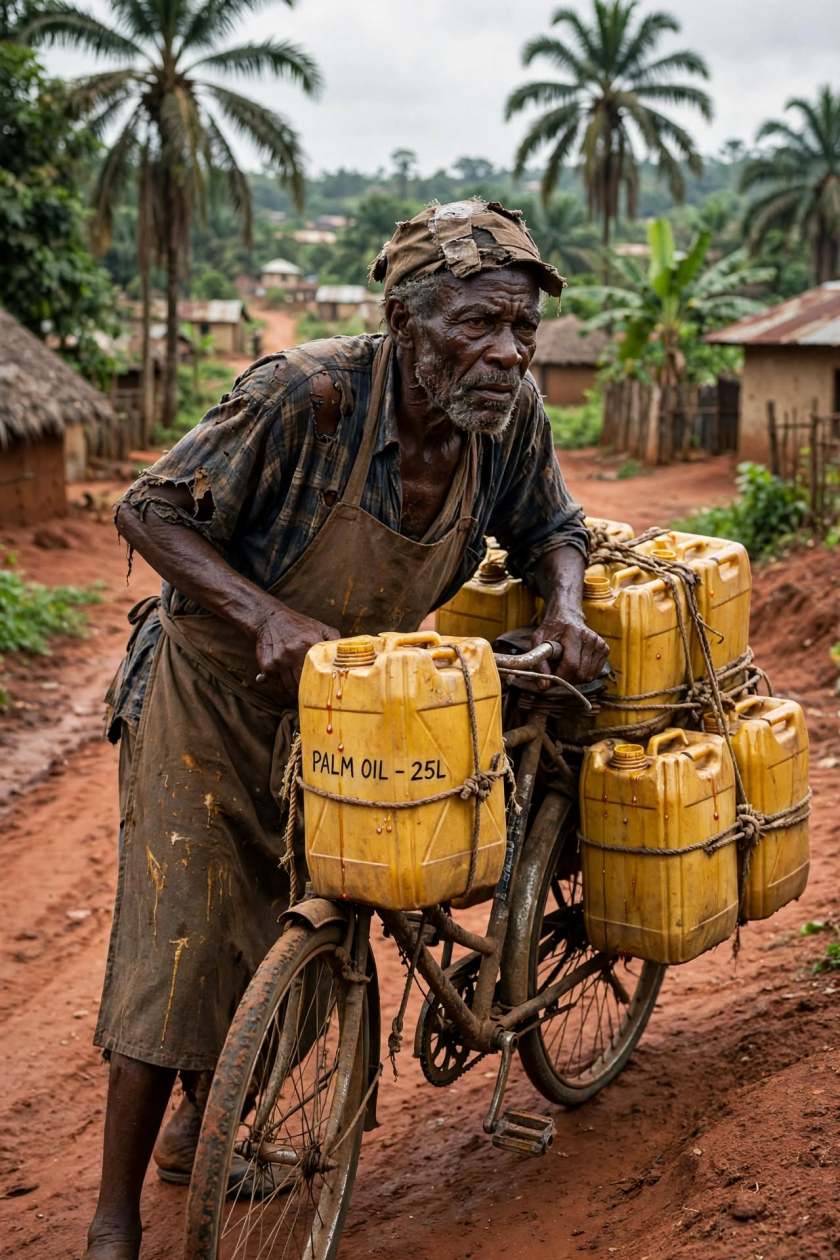
Unlike Ezeulu, he possesses no important institutional office. Unlike Eugene, he commands neither wealth nor substantial social power. He is an ordinary palm-oil trader whose aspirations are correspondingly modest: to work, maintain his family, educate his children, preserve his dignity, and achieve a measure of economic security.
Yet these modest aspirations acquire tragic magnitude precisely because the social and economic conditions surrounding Jeri make their realization extraordinarily difficult.
Jeri possesses agency. He works, plans, saves, makes sacrifices, responds to adversity, and attempts repeatedly to improve his circumstances. It would therefore be inaccurate to characterize him merely as a passive victim. Indeed, his persistence constitutes one of his defining attributes.
What Jeri lacks is not agency itself but effective agency: the combination of personal capacity, material resources, institutional support, and viable alternatives that enables choices to produce intended outcomes.
This distinction is essential.
To say that a person can choose is not necessarily to say that the person possesses meaningful choice. Choices are meaningful to the extent that viable alternatives exist. Poverty narrows those alternatives. A person compelled to choose between school fees and food, between medical expenditure and productive assets, or between present survival and future security technically exercises choice, but under conditions radically different from those enjoyed by someone protected by savings, insurance, healthcare, or social support.
Jeri’s tragedy therefore emerges from constrained agency.
Vulnerability as an Alternative to Hamartia
The concept of vulnerability provides perhaps the most significant point of departure between Munonye and the more conventionally tragic structures visible in Achebe and Adichie.
With Ezeulu, the reader can reasonably ask how pride, rigidity, or misjudgment contributes to catastrophe. With Eugene, the connection between character and catastrophe is even stronger: religious absolutism, authoritarianism, and violence directly contribute to the destruction of the household he seeks to control.
Jeri poses a more difficult question:
What, precisely, is his tragic flaw?
His determination to work? His commitment to his family? His willingness to sacrifice present consumption for future security? His faith in education? His persistence after setbacks?
None provides a convincing equivalent of classical hamartia.
Munonye therefore relocates the causal centre of tragedy. The question ceases to be merely, What did the protagonist do to bring about his downfall? It becomes, What resources did the protagonist possess with which to prevent adversity from becoming catastrophe?
Jeri’s tragedy is consequently better understood through vulnerability than through hamartia.
Vulnerability, in this context, should not be confused with weakness. It describes exposure to risk combined with limited capacity to absorb its consequences. A resilient person can therefore remain highly vulnerable. Indeed, Jeri embodies precisely this combination: considerable psychological resilience alongside acute material vulnerability.
This distinction is central to Munonye’s tragic vision.
Resilience Is Not Enough
Jeri repeatedly demonstrates resilience. He suffers setbacks and attempts to recover. Adversity does not immediately extinguish his capacity for purposeful action. His persistence encourages the reader to believe, repeatedly, that recovery remains possible.
But Munonye steadily dismantles any simplistic assumption that resilience inevitably produces successful outcomes.
Resilience operates within material conditions.
A household with savings, insurance, accessible healthcare, stable income, and supportive institutions may experience a shock without experiencing collapse. The same shock can be catastrophic for a household possessing none of these protections. The difference does not necessarily lie in character. It lies in adaptive capacity.
Jeri’s experience therefore exposes the limitations of moralizing resilience. Celebrating people’s capacity to endure adversity can become problematic if it obscures the structures that continually expose them to adversity.
The critical question is not simply:
How resilient is Jeri?
It is:
How much adversity can resilience reasonably be expected to absorb in the absence of resources?
Munonye’s answer appears increasingly pessimistic. Each act of recovery consumes something. Money disappears. Assets are threatened. Emotional resources diminish. Family aspirations are compromised. The capacity to recover from the next shock becomes weaker because the previous recovery has already consumed resources.
Jeri does not merely encounter repeated adversity. He encounters adversity cumulatively.
The distinction is decisive.
Cumulative Vulnerability and the Erosion of Choice
Munonye’s tragic structure resembles what might be described as a cascade of vulnerability. One shock alters the protagonist’s ability to withstand the next.
Illness produces expenditure. Expenditure reduces savings. Reduced savings narrow choices. Narrowed choices may require the disposal of assets. Loss of assets reduces future earning or coping capacity. The next adverse event therefore encounters a household already weakened by the previous one.
This explains why the accumulation of calamities in Jeri’s life should not automatically be dismissed as excessive authorial manipulation. The sequence possesses a socioeconomic logic.
Adversity compounds.
Jeri’s wife’s death from tetanus is especially significant in this respect. The event is simultaneously emotional, medical, economic, and social. Bereavement generates grief, but it also generates costs and destabilizes the household’s organization. What appears to be an individual tragedy consequently produces secondary vulnerabilities.
His daughter’s circumstances similarly reveal how vulnerability can become intergenerational. When economic pressure disrupts education or forces a child prematurely into adult responsibilities, the consequences of present poverty migrate into the future.
Munonye thus depicts poverty not simply as an absence of money but as an erosion of possible futures.
Flexibility Under Constraint
At first glance, Jeri might appear more flexible than either Ezeulu or Eugene. He adjusts repeatedly to changing circumstances. He does not possess Ezeulu’s investment in institutional authority or Eugene’s absolutist need for control. Survival requires improvisation.
Yet flexibility itself requires resources.
This introduces another important distinction. Adaptability cannot mean endlessly adjusting to worsening conditions. There comes a point at which all available adaptations involve loss.
A wealthy person facing adversity may choose among several viable strategies. A poor person may confront a choice between sacrificing one essential resource and sacrificing another. Both technically exercise agency, but their choice sets are radically different.
Jeri’s flexibility therefore operates within shrinking boundaries.
The more adversity he experiences, the fewer alternatives remain available. At the beginning of such a process, he may choose how to deploy resources. Later, he may choose which resource to sacrifice. Eventually, tragedy emerges when choice approaches the point of choosing only which loss to accept.
This is perhaps the deepest connection among vulnerability, agency, and tragedy in Munonye’s novel.
Three Tragic Configurations
The three protagonists can therefore be located along a continuum of agency and vulnerability.
Ezeulu possesses substantial agency and exercises it within a rapidly changing historical environment. His resilience is formidable, but his declining flexibility contributes to catastrophe. His tragedy involves the problematic exercise of consequential power.
Eugene possesses even greater material autonomy. Yet his rigid religious worldview converts agency into domination. His tragedy emerges from the destructive exercise of power and the denial of agency to others.
Jeri possesses resilience and willingness to adapt but lacks the material resources that would make adaptation sustainably effective. His tragedy derives from insufficient power in the face of cumulative vulnerability.
The contrast may be stated succinctly:
Ezeulu possesses power but cannot bend.
Eugene possesses power but cannot tolerate difference.
Jeri possesses resilience and can adapt, but lacks sufficient resources to convert adaptation into security.
These are three profoundly different pathways towards tragedy.
Agency and the Unequal Distribution of Consequences
Comparison of the three novels also reveals that agency is never merely an individual psychological possession. It is socially distributed.
Ezeulu’s position gives his choices communal consequences. Eugene’s wealth and patriarchal status allow his choices to determine the lives of his wife and children. Jeri’s poverty means that even responsible choices may produce only limited results.
The relationship between choice and outcome is therefore mediated by power.
This complicates moral interpretations of success and failure. If individuals possess unequal resources, then identical qualities—discipline, perseverance, thrift, courage—cannot be expected to produce identical outcomes.
Jeri is important precisely because he destabilizes the assumption that virtue is eventually rewarded by success. Munonye confronts the reader with the uncomfortable possibility that a person can display many of the qualities societies praise—industry, perseverance, sacrifice, responsibility—and still be defeated.
The result is tragedy without moral failure.
From the Palace to the Household: The Democratization of Tragedy
Placed beside Achebe and Adichie, Munonye’s most distinctive achievement may therefore be understood as a democratization of tragic experience.
Ezeulu’s tragedy derives part of its magnitude from his public position. His fate is inseparable from the religious and political destiny of Umuaro. Eugene’s tragedy derives from the enormous authority he exercises within the household and society.
Jeri begins with neither form of grandeur.
Yet Munonye insists that ordinary life possesses its own tragic magnitude.
Jeri’s desire to feed his family, educate his children, maintain his livelihood, and preserve hope may appear less dramatic than the struggles of a chief priest. But these modest ambitions involve fundamental human values: dignity, attachment, responsibility, continuity, and hope.
Munonye consequently relocates tragedy from the exceptional to the everyday.
The result recalls the modern argument that tragic stature need not depend upon aristocratic status. The ordinary person’s struggle to secure dignity can possess the seriousness conventionally reserved for kings. Munonye’s distinctive contribution is to place this proposition within an African socioeconomic environment in which vulnerability profoundly shapes the relationship between effo uprt and outcome.
Jeri becomes tragic not because he falls from a great height but because he struggles so persistently to rise from a low one.
The Family as the Convergence Point of Tragedy
Despite their differences, all three novels ultimately converge upon the family.
Ezeulu’s conflict affects his household as well as the religious community. Eugene’s exercise of authority makes the family the principal theatre of tragedy. Jeri’s economic vulnerability progressively threatens the welfare and future of his household.
The family thus becomes the point at which larger historical structures acquire intimate consequences.
In Arrow of God, colonialism and religious transformation enter the family through Ezeulu’s crisis of authority.
In Purple Hibiscus, religious absolutism, patriarchy, and political authoritarianism intersect within domestic life.
In The Oil Man of Obange, economic precarity, inadequate institutional protection, illness, and limited opportunity enter the family through Jeri’s struggle for survival.
The three novels therefore demonstrate that tragedy is simultaneously personal and structural. Historical forces do not remain abstract. They enter homes, alter relationships, constrain choices, and reshape futures.
Conclusion: From Consequential Power to Consequential Vulnerability
Reading Munonye alongside Achebe and Adichie reveals a striking range within Nigerian representations of tragedy. Arrow of God presents a protagonist endowed with substantial authority whose resilience increasingly becomes inseparable from inflexibility. Purple Hibiscus presents a powerful patriarch whose absolutism converts agency into domination and destroys the security of those closest to him. The Oil Man of Obange, however, presents an ordinary man whose resilience and flexibility remain insufficient because his agency is constrained by poverty and cumulative vulnerability.
The difference can be expressed through three relationships between character and catastrophe.
Ezeulu partly participates in the production of his tragedy through the inflexible exercise of power.
Eugene substantially produces tragedy through the authoritarian exercise of power.
Jeri largely struggles against a tragedy generated by his vulnerability to forces he lacks sufficient power to absorb.
This distinction suggests that The Oil Man of Obange represents a significant modification of the conventional tragic paradigm. Munonye does not eliminate agency, for Jeri continues to choose, act, sacrifice, and adapt. What he eliminates is the assumption that agency necessarily entails control over outcomes.
Jeri possesses agency without sovereignty over circumstance.
He possesses resilience without adequate protection.
He possesses flexibility within an increasingly restricted range of alternatives.
He makes choices, but poverty progressively reduces the quality of the choices available to him.
And he possesses hope in a world in which hope itself requires resources to survive.
It is precisely here that vulnerability assumes the structural role that hamartia occupies in more conventional tragedy. The fundamental question is no longer simply why the protagonist made the wrong choice, but why the social environment provided so few good choices from which to choose.
This is what makes Munonye’s treatment of Jeri particularly significant. He relocates tragic dignity from social elevation to human endurance. Jeri does not require a throne, priesthood, wealth, or exceptional authority to qualify as a tragic protagonist. His determination to preserve family, livelihood, dignity, and hope is sufficient to give his struggle moral magnitude.
Concluding thoughts?
The comparison among Ezeulu, Eugene, and Jeri consequently yields a broader proposition about tragedy itself. Power enlarges agency, but it also enlarges the consequences of rigidity and error; vulnerability restricts agency while magnifying the consequences of adversity. Ezeulu and Eugene demonstrate the dangers of power without sufficient flexibility. Jeri demonstrates the limits of resilience and flexibility without sufficient power.
Munonye’s achievement, therefore, is not simply that he makes an ordinary man tragic. He reveals something more unsettling: human beings may act responsibly, remain resilient, adapt repeatedly, and make the best choices available to them, yet still be defeated when vulnerability progressively reduces the space within which agency can operate.
Seen in this light, Jeri’s tragedy is neither the tragedy of weakness nor the tragedy of a conventional fatal flaw. It is the tragedy of resilience without resources, flexibility without adequate alternatives, agency without sufficient power, and choice under conditions of vulnerability.
Munonye thereby extends the boundaries of tragedy itself. The tragic protagonist need no longer be measured by the height from which he falls. He may instead be measured by the distance he struggles to rise—and by the courage with which he continues that struggle even as the space for meaningful choice progressively disappears.