Posted in Uncategorized

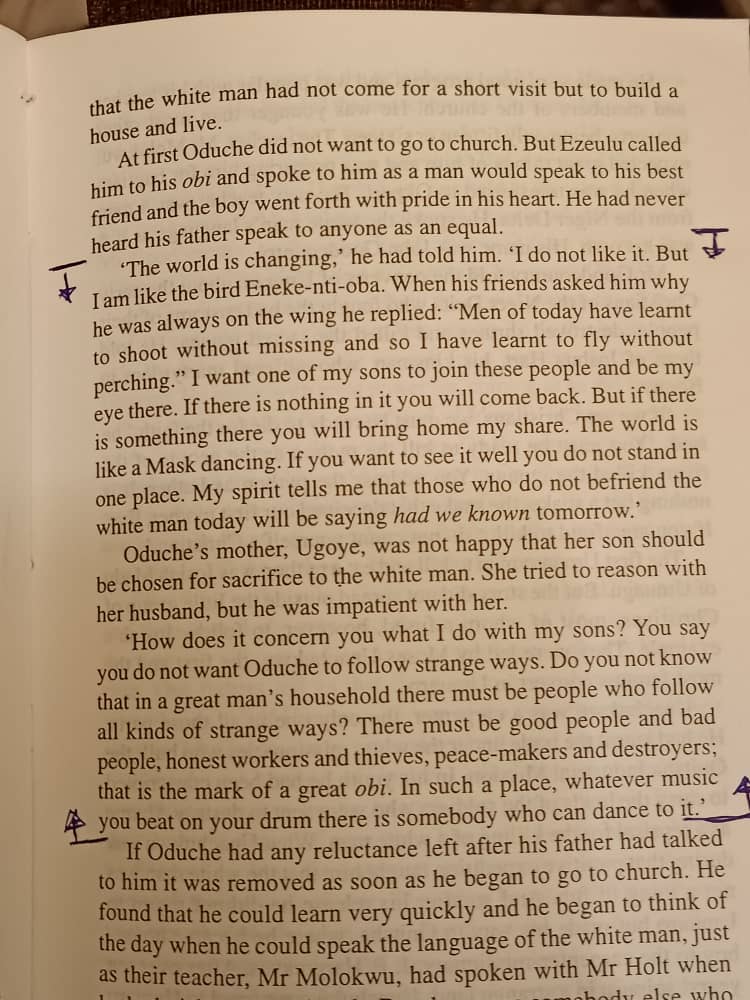
Achebe, the master story teller – a short glimpse of his skills by Noel Ihebuzor

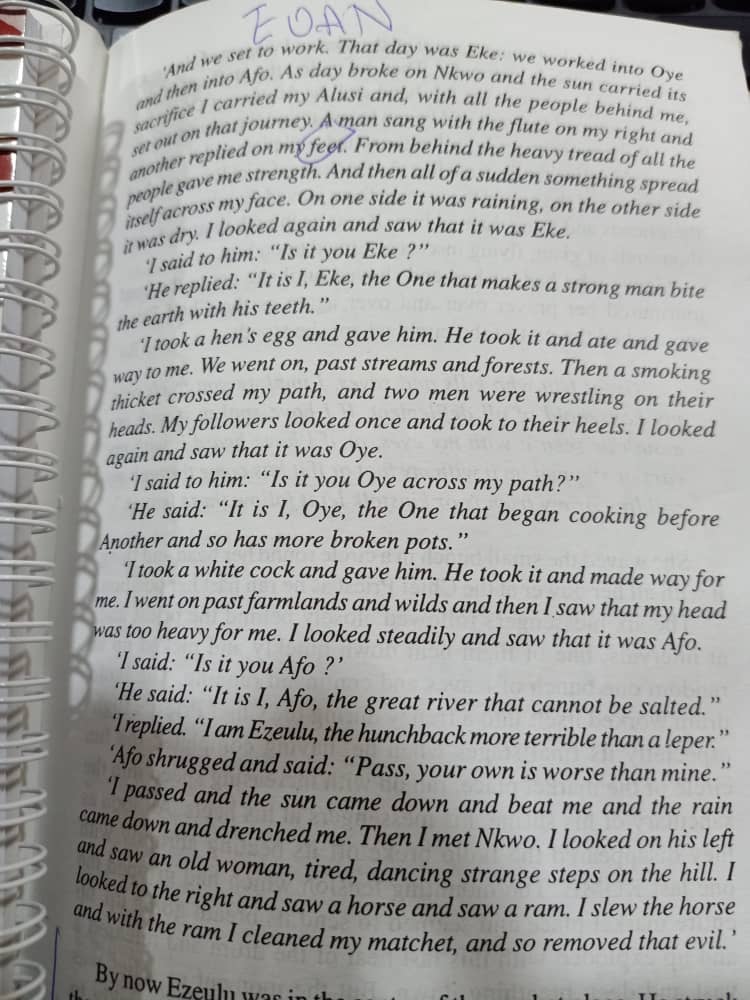
The beauty of Achebe’s prose. He has appropriated the English language and breathed Igbo into its core. He speaks Igbo in English. Ezeulu’s pragmatism shines forth as does the patriarchal mindset that defines and shapes him. Simple yet deep, ordinary yet majestic are the best ways to define this artistic tour de force which this master word and “storysmith” achieves in these lines.

Posted in Uncategorized

JGS 11:29-39A

The Spirit of the LORD came upon Jephthah.
He passed through Gilead and Manasseh,
and through Mizpah-Gilead as well,
and from there he went on to the Ammonites.
Jephthah made a vow to the LORD.
“If you deliver the Ammonites into my power,” he said,
“whoever comes out of the doors of my house
to meet me when I return in triumph from the Ammonites
shall belong to the LORD.
I shall offer him up as a burnt offering.”

Jephthah then went on to the Ammonites to fight against them,
and the LORD delivered them into his power,
so that he inflicted a severe defeat on them,
from Aroer to the approach of Minnith (twenty cities in all)
and as far as Abel-keramim.
Thus were the Ammonites brought into subjection
by the children of Israel.
When Jephthah returned to his house in Mizpah,
it was his daughter who came forth,
playing the tambourines and dancing.
She was an only child: he had neither son nor daughter besides her.
When he saw her, he rent his garments and said,
“Alas, daughter, you have struck me down
and brought calamity upon me.
For I have made a vow to the LORD and I cannot retract.”
She replied, “Father, you have made a vow to the LORD.
Do with me as you have vowed,
because the LORD has wrought vengeance for you
on your enemies the Ammonites.”
Then she said to her father, “Let me have this favor.
Spare me for two months, that I may go off down the mountains
to mourn my virginity with my companions.”
“Go,” he replied, and sent her away for two months.
So she departed with her companions
and mourned her virginity on the mountains.
At the end of the two months she returned to her father,
who did to her as he had vowed. http://bit.ly/1j6IVSe

Posted in Uncategorized

Wrestling with one’s chi – a duet

Noel Ihebuzor's avatarReflections

By Noel Ihebuzor and Susan Daniels

my chi is a muse, impish
invisible fellow lurking
behind my ears and my tongue
whispering when I am not ready
sauntering away when I am

mine whispers words in woven gold flights
spiraling from blood to my ears
as my eyes open; dream-writing, I call it
and the words melt in daylight like mist
before I have reached for my pen

quicksilver, erratic
unpredictable, nagging like a stubborn dream
on those days when fresh minty words stream
down my running fingers
and then only to turn off the faucet
when incipient joy in showering in the deluge
of singing is huge

they gift us in fragments, suggestions.
if they gave us the keyed music
of the harp strung underneath particles
always vibrating, could our ears
hold the whole song?

then those days when in mischief
it fills me with words in riot
words…

View original post 515 more words

Posted in Uncategorized

Features of Researches that influence policy

Talking points for the CABE/C4D/GEP 3 workshop by Noel A, Ihebuzor

Some researches are better than others in influencing policy. Such researches have certain qualities. Such researches usually possess the following qualities

  • Replicable
  • Have good sampling base
  • Respond to social needs
  • Easily applicable
  • Easy to read
  • Not marred by complex statistics 
  • Address pressing problems
  • Propose plausible and credible solutions 
  • Solutions are drawn from the research 
  • Their findings have a broad appeal
  • Their findings appeal to agenda setters and social influencers
  • Their finding appeal to important constituencies and influencers
  • Their findings appeal to the press

The 7 curses that cause research to policy failures  

  • irrelevance 
  • defective methodology 
  • limited sample size
  • atypical sample
  • unwarranted conclusions and extrapolations 
  • outdated-ness of topic
  • limited adaptability 

Why policies fail

  • No sponsor
  • No champion
  • Limited policy appeal
  • Limited scope for policy adaption or adaptation
  • Attempting too much
  • Attempting too little
  • Tissue rejection
  • Cultural unsuitability
  • No evidence base or skimpy evidence
  • Hostile environment
  • No effort to prepare the ground
Posted in Basic Education, governance, Uncategorized

The role of LGAs in delivering Quality in Basic education – Talk by Noel Ihebuzor at the training organized for LGAE officials as part of UNICEF’s support to Systems strengthening in Basic Education

Three terms are vital for an effective coverage of the topic – these are – Local Government Authorities, Quality and Basic education. Let us look at each in turn, starting from Quality

Quality

  • Quality involves standards
  • It means fit for purpose
  • It implies relevance and functionality
  • It means meeting some basic criteria and norms,
  • It carries the implication of good and possessing attributes that align with national goals and development
  • It suggests effectiveness and efficiency
  • It means desirable and something of value

Quality does not simply happen, it does not fall from the sky  – it is the result of human action.

  • Quality requires planning, it requires work, it
    requires sweat, but that sweat produces sweet results
  • Quality comes around when good and relevant
    processes, policies, strategies are combined with the tactics and activities

Basic Education – education in the first nine years of formal schooling,

  • Foundation for all further education
  • Covers primary, pre-primary, ECD, NFE,
    Alternative education such as IQE
  • It is the base on which all other education
    efforts are built on.
  • It is the foundation of all other education
  • Important are for national development.
  • It is also important for personal development –
    benefits include learning new things – (literacy and numeracy + emotional and
    social literacies), preparing the mind to learn new things and socializing.
  • Completion of basic offers a whole array social
    benefits, these benefits including social, health, Nutrition, workforce
    development.

LGAE- this the level of administration closest the people. We have 774 of thee in Nigeria

In Nigeria, Basic education is the responsibility of the state and local government levels of administration.

Responsibility for the day to day management of Basic education rests however with Local governments.

Such responsibility includes the responsibility for quality in basic education Planning, Research, Implementation, Monitoring and Evaluation – PRIME.

Plans are essential to move Basic Education forward, especially good operational plans. Good operational plans are realistic, participatory and inclusive in their design. They are equity and disparity reduction in their intentions, processes and strategies. Their indicative budgets are realistic, competitive and are built on established industry benchmarks. They are evidence-based, context-sensitive and implementable. They have reliable baselines and have monitoring & evaluation frameworks with valid indicators for measuring progress

Quality in Basic Education results from the interaction of four factors. They also have reliable and relevant midlines and end lines.

Quality in BASIC EDUCATION

In any educational system quality results from the interaction of four variables – these are learner, instructional, socio-cultural and administrative variables – LISA. We can also call these factors. These factors interact and influence one another.

Each of these factors is turn made up of several factors –

Learner factors are made up of the age, sex, socio-economic status, family background, achievement orientation, interest, intelligence, aptitude, attitude, character of the learners, etc.

Some of these are beyond the capacity of LGAE authorities to determine. Some, they can influence, some they can control. Which ones from the listing above are within the control and influence of the LGAE?

Instructional factors include teacher qualification, teacher certification, teacher conditions of employment, sex of teacher, age, experience, degree of motivation of teachers, curriculum, syllabus, books, school materials, school toilets, classroom size, desks, chairs, writing materials, lesson notes, length of lesson, type of shift in school – single or double shift? Can you list some more? 

Which of these are within the control and influence of the LGAE?

Socio-cultural factors include cultural and social norms, gender norms, attitudes to life. Attitude to education, cultural orientation, cultural beliefs etc. Are any of these under the direct influence of the LGEA?

Administrative factors include school buildings, school resources, blackboards, storage facilities, toilet facilities, school policies, regulations, procurement policies, Procurement practices, maintenance policies, employment and HR policies,  teachers’ salaries, training policies, financing, school budgets, fund allocation,  school census, school mapping, school plant size management, school design, classroom  design, ventilation, lighting, school Inspection and support services, etc.

For an educational system to effective, efficient and successful, all the four factors of LISA must be in harmony. They must all agree. They must also support one another.

Let me give an example – if you provide enough budgets and use them transparently and in keeping with procurement policies, you will build more classroom; if you build more classrooms, your pupil-classroom ratio will improve, if this improves, learners will be more comfortable, if learners are more comfortable, then more learning will likely take place

Another example – if teachers’ salaries are paid regularly, teachers will be more motivated, if teachers are more motivated, they will teach more effectively, if they teach more effectively, many more learners will learn.

Try your hands now with working out such relationships between instructional factors and learner factors. Do the same for learner factors and administrative factors. Ditto for socio-cultural factors and administrative factors.

You will soon begin to see the links between these different elements. You will soon begin to appreciate that what you as LGAE can influence the quality of Basic Education in your LGA.

Ask yourself this question – what is it that we want to see as accountable, professional and effective LGEA workers? I believe these would be the following

  • More children are going through our basic
    education system and passing well
  • Less and less repetition and wastage are noted in
    our schools
  • More and more children move from one year to another
    and pass each grade
  • More teachers are employed in our basic
    education system and are teaching well and inculcating positive values
  • More teachers in our LGA are being supported
    through regular and supportive inspection, monitoring and mentoring visits
  • More and more teachers in our LGAE are supported
    through value adding In-Service Teacher training and continuous Professional
    Development
  • More relevant teaching-learning materials are
    availed to all learners in our school schools and the pupils are using these to
    learn, survive, and thrive in and out of school
  • More resources are being spent in schools and
    our spending and funds use are rational, transparent, procedures compliant and
    achieve high returns on our investment
  • More school buildings and school facilities are
    availed
  • More gender equity is achieved in our schools
    because of good planning
  • More girls are in school, completing school and
    passing well because our teachers have been taught to be gender friendly and
    responsive in their pedagogic practices
  • More and more schools are gender friendly with
    toilet facilities and water and sanitation access
  • Schools are more efficient because school
    planning is based on correct evidence and very up-to-date statistics
  • Resources are in schools and are optimally being used and the LGA is achieving value for money through realistic spending and costing

Some of the above are the benefits of good planning. The listing also contains some of the indicators of quality in Basic education. Your state needs quality in Basic Education. And you can make it happen.

Be the change! Remember the power of one!

Good luck.

Noel Ihebuzor, LC, FoL