
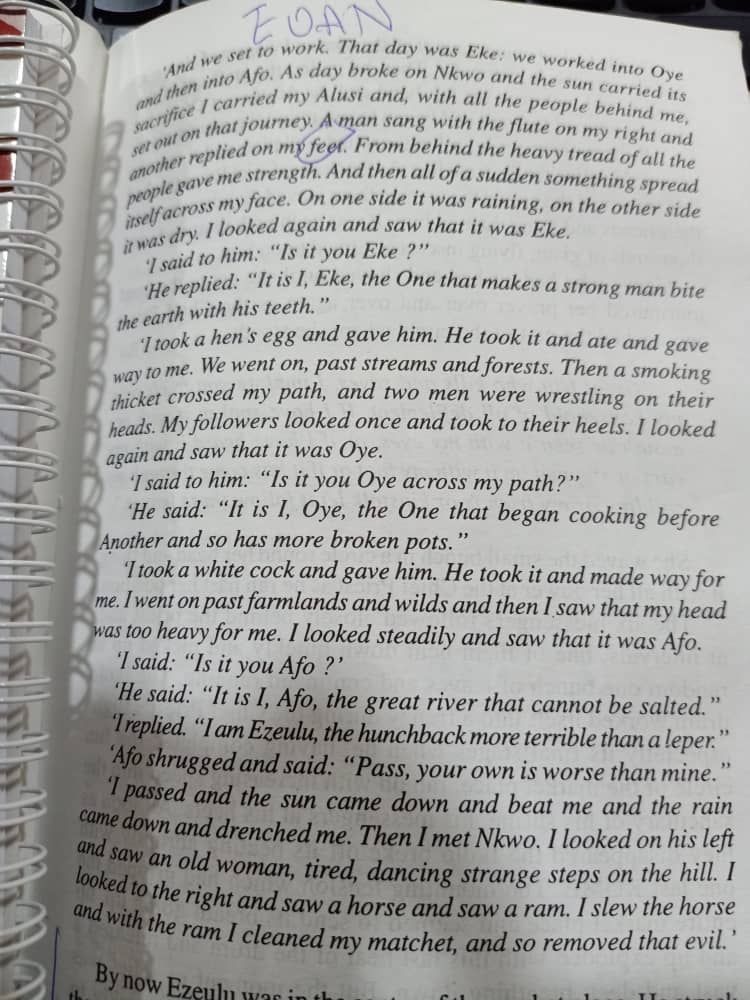
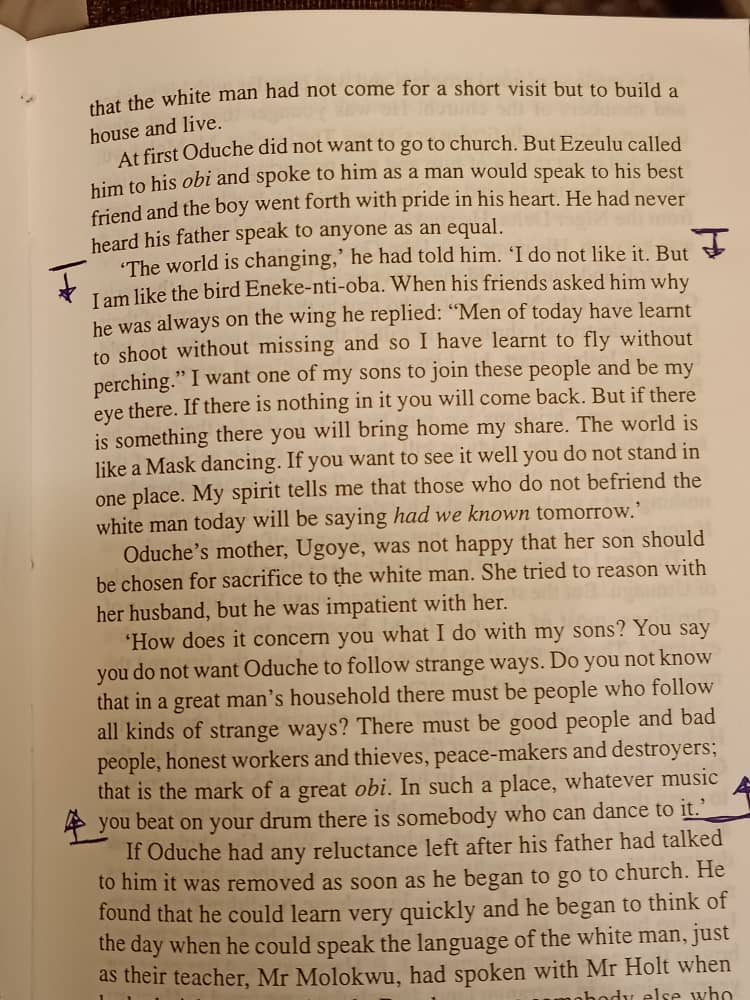
Was Achebe fair to Ezeulu? Could he not have gone into his creative and artistic forge and found another denouement, just as powerful and intense and gripping which would have allowed the chief priest of Ulu to walk away from the enveloping unravelling of culture and tradition, from this creeping and almost irreversible dissolution and destruction of authority and institutions in Igbo land with his head high instead of knocking him down and covering him in the mud of disgrace associated with dementia? In the end, it would appear that Achebe surrenders his protagonist, a man of wit and intellect, a clear thinker, a pragmatist, pater familias, and chief of Ulu to his enemies and there are quite a few…. Winterbottom, Clarke, Nwaka etc! Is this a good price to pay for a tragic ending and did Ezeulu truly deserve this treatment? My whole being screams No! Is the death of Obika fair? No! Was it necessary? What happens to his new bride? Was this tragic end sufficiently justified? Was the reader sufficiently prepared for it?
The Webster dictionary defines tragedy thus – Tragedy is a serious play or drama typically dealing with the problems of a central character, leading to an unhappy or disastrous ending brought on, as in ancient drama, by fate and a tragic flaw in this character, or, in modern drama, usually by moral weakness, psychological maladjustment, or social pressures.” Tragedy however is typically associated with a flaw in the main character, some hubris, described as hamartia which leads this character to making wrong choices and faulty decisions. Okonkwo in TFA had that hamartia, his intense fear of being seen to be afraid, Jim in Conrad’s Lord Jim also suffered from a fundamental hubris which brought his ruin in the end, the principal characters in Adichie’s purple hibiscus were also flawed and one could go on and on. But where was the flaw in Ezeulu’s character? True, Achebe had hinted at the possibility of some flaw in the opening chapter, precisely in the paragraph that starts
“Whenever Ezeulu considered the immensity of his power over the year and the crops and, therefore over the people, he wondered if it was real” How good was power if it could never be used? In physics, there is this distinction between potential and kinetic energy. Potential energy exists only in the realm of possibilities and probability. Real energy is kinetics. Was this temptation to test to what extent he could impose his awesome power of choosing the season of harvesting that Ezeulu yields to at the end of the tale what ruins him? I do not find this ending, the way Achebe attempts to sketch it out to be very convincing but perhaps, this is because I am a unsophisticated reader. But even allowing for this aesthetic immaturity on my part, why was it necessary to bring in the sudden death of Obika in this final denouement of this gripping tale and allowing it so a powerful role in the ensuing destruction of Ezeulu and by implication of the god Ulu? Is this this sudden fall of Ezeulu justified? Should Ulu have suffered this irreversible demise? Has Ulu been godly? Does Ulu deserve our pity? For a god that looks on when its chief priest is being destroyed should not complain if its followers abandon its shrine for the altars of a new religion.
 Reflections