Posted in Uncategorized

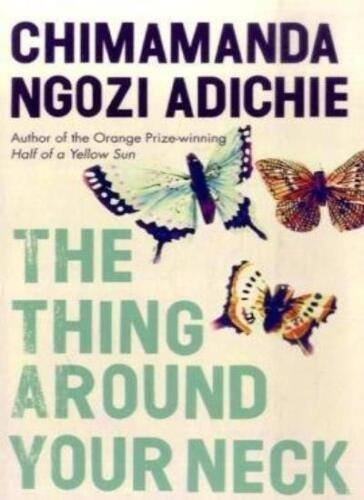
The Thing around your Neck – a review

By Noel Ihebuzor

“The thing around your neck”, TTAYN for short, is a collection of 12 short stories told by a writer with an eye for relevant detail, a good understanding of the human mind, and an admirable sensitivity to the sociological context in which her characters operate. The writer, Chimamanda Ngozi Adichie, is also capable of plenty of empathy for a majority of the characters in the twelve stories in her book as they struggle to respond to the challenges that life throws at them and make meaning of their varied existence, caught up as they are in specific moments of history as persons with some forms of agency. For a few other characters, she displays a very poorly concealed contempt for their actions and the false lives they lead trying to be what they cannot be. For such characters, she deploys her rich arsenal of sarcasm and irony to ridicule their fake lives underscoring in the process her commitment to people being true to themselves and to their identities. 

The stories cover a broad range of topics and issues from the Nigerian-Biafra war, to post-civil war challenges, to life in Nigerian universities and the plague of cultism in them, to wrong practices in academia and to the lives of Nigerians livingin the USA. A few of the stories touch on the lives of married couples whilst some others touch on relationships involving persons with sexual orientations that deviate from the norm and the pains and frustrations that do accompany such. Some other stories touch on themes of violence such as the killings in the north of Nigeria – killings caused by a blend of ethnicity and religious extremism, whilst others explore a broad array of themes spanning the early encounter of Igbo society with white colonization and its agents, especially the Christian missions, agents of evangelization and colonization, to the rigors involved in applying for an American visa in Nigeria, to repressive regimes in Nigeria, to gender and race based inequities and injustices, to sibling rivalry in an environment tainted by patriarchy and contestations of such social structures and strictures, such contestations often giving rise to very bizarre consequences.

Through these short stories, Chimamanda explores a number of themes ranging from political violence and repression, sexual orientation, ethnic killings, marital infidelity, migration and its stresses, coping with loss, racial biases, unequal and unrequited love  and its pains, the physical challenges and humiliation that often accompany visa applications, the stresses of marriage in a foreign land and finally to the inadequacies in colonial historiography. She also uses her story to point out ethical and moral failures in the banking sector, where banks use young girls in their marketing divisions to bait rich randy men and potential depositors. Here we note the subtle and not too subtle critique of the abuse of financial power by rich men who exploit power asymmetries in their favor often to take advantage of young female bank workers in age-inappropriate sexual engagements. Chimamanda thus uses her short stories to criticize these and other vices in society. Specifically, she comes against the use of financial power to secure sexual favors. The same criticism of the abuse of power, masking as cultural imperialism, would again show up in her treatment of the manner in which Edward, a white man, tries to exploit his role as workshop convener to impose his views on aesthetics on a creative writers’  workshop, and even to making obtuse sexual advances to some of the female participants at the workshop, again bringing up in the process the intersection of power and gender. 

These stories are not single stories, with one story line and a predictable ending.   Most of them are richer than comprising a number of interlaced themes and reflecting in many instances a number of  intersectionalities, such as those between gender and power, between social class and choices in marriages, between traditional institutions and modern day living and many more. It is this intersectionality that makes her tales very plausible and real. It also makes her characters to come across as people of flesh and blood that the reader can relate to. The stories are so engaging that the reader finds it difficult to put down the book until one has read the last chapter. The beauty of her writing comes alive when we start examining each of the twelve short stories that make up the collection.

Cell One is a presentation of cultism in Nigeria’s tertiary education establishment. The story is built around Nnamabia, the son of a lecturer at Nsukka who progresses from small time pilfering at home to full time criminality and to violence soaked in chilling cultism. The story is told by his sister, who resents the disproportionate attention and privileges that are accorded Nnamabia by their parents. What is sad is the way and manner that Nnamabia’s mother prefers to live in denial and to protect her son even when all the facts before her are pointing to one conclusion. There is an implied criticism of male child preference by parents as this is what partially explains for Nnamabia’s mum turning her eyes away from his criminal activities. The story also broadens to include a strong critique of our policing system, the incarceration of persons in cramped unhealthy cells, the practice of the arrest of a person whose son or relation has committed an offense and the holding of that person until the actual offender shows up.

There is also a level of covert didacticism running throughout the story and it is this. Cultism is bad news for the young one who joins as well as for the families of persons who get drawn into its crippling embrace. The message that comes across is that whereas being a cult member can bring the person a sense of power and connectedness in the short term, in the long term, it brings misery and suffering, apart from its deleterious effects on one’s morals and one’s consciousness which cultism deadens.

Imitation, the next story is a story of love, deception and cheating. It examines the pains and difficulties of long-distance marriages where one of the partners lives in one continent and the other partner lives in another. The story is built around the lives of Nkem, who lives in America, and her husband Obiora who lives in Lagos. The person who gives away Obiora’s infidelity is Nkem’s friend, Ijeamaka – (is she really a friend or simply an “amebo” who derives some pleasure by telling another woman of that woman’s husband infidelity?) The reader should also note that there is a certain deliberate irony in the name of this character which could means in some contexts – It is good to travel/travel is a good thing. Nkem’s pains arise principally from the fact of her separation from her husband caused by her sojourn in the States!

Engaging with this short story brings the reader to experience all the pains of wives of absentee husbands, especially the loneliness and the jealousy of such wives stranded, as it were, in a foreign land. Nkem’s situation is made worse by the fact that she is in an unequal relationship where she relies on her husband to lift her and her family out of poverty. She is torn by jealousy and this jealousy even drives her to her trying to imagine how her rival in Lagos looks like. She even cuts her hair to make it look like Ijeamaka had described the hair style of her husband’s lover looked like. Not that Nkem is an angel as the author makes us realize that she too had had affairs with married men before Obiora came her way. The story of jealousy is told from the point of view of a sympathetic insider including even when pain and jealousy make Nkem discuss her husband’s infidelity with her house girl, Amaechi. Was this necessary, one may ask? Envy can create stress which can then drive us to do crazy things. In the end she takes the bold step of informing Obiora that she intends to relocate to Lagos with the kids to stay with him, an act that requires the recognition and exercise of her agency.

A private experience is the next tale and this story is anything but a private experience. It is the story of two women caught up in the spiral of ethno-religious violence in Kano. Such violence is not unusual in Nigeria where religious zealots hide behind the cloak of religion to unleash senseless violence on their fellow citizens. Some sentences cleverly bring out the economic and political motives behind the mayhem. As the lady tells Chika, the rioters are not going to the small shops but are rather focusing their aggression on the big shops. As the author says, religion and ethnicity are often politicized by the political class to wreak havoc on society. One of the woman caught up in this maelstrom of violence is a lactating mother now separated from her daughter Halima by this sudden eruption of mayhem and carnage. The victims of this violence therefore go beyond our two characters – they include a child deprived of her mother’s milk and Chika who is praying and hoping that her sister Nnedi is not killed in the violence The story is told in the present from a third person perspective but with constant look into the future made possible by the use of “later, she would” or “later this would happen”

Ghosts is a story of loss and coping with loss, but Chimamanda manages to weave a number of related social topics and issues into the story. These include delays in the payment of pensions to retired university staff, the Nigeria-Biafra civil war, a blistering criticism of indecent practices in Nigerian universities starting from abuse of power by university vice chancellors, the unsavoury practices of university lecturers, the scourge of fake drugs to the endemicity of bribery before one can access public services. Running in the background of all of these is the story of a professor who hallucinates and who believes that his late wife Ebere comes to him at night. One conclusion that we can safely draw from this is that the professor is yet to achieve closure on the death of his wife!

On Monday of last week is a story that explores a number of themes – child minding patterns in the USA, the challenges of identity in biracial unions, Immigration challenges and how living apart because of difficulties with obtaining visas to the USA can slowly but surely eat away at the bonds of relationships. It is a story of the troubling issue of a marriage in a drift and where partners are becoming more like strangers to one another and the tragedy in a union where affection gradually dies out. It also hints at the taboo topic of lesbianism as Kamara discovers that she is gradually being sexually attracted to Tracy.. Kamara is the main character, and the story is told from her point of view. She makes powerful statements about parenting in the USA describing it on one occasion as a “juggling of anxieties” that came about from “having too much food”!

Kamara is also capable of very powerful descriptions of people and emotions – one’s “eyes shining with watery dreams”, describing her emotions on her first encounter Tracy, the mother of Josh, the boy she is hired to look after as a “flowering of extravagant hope” and describing Neil (Josh’s father) as a “collection of anxieties”. The relationship between Kamara and Tobechi as undergraduates at Nsukka is described as “filled with an effortless ease”. This contrasts with the emptiness and the “desperate sadness” she now feels because the emotions she wanted to hold in her hands were no longer there. A sad tale indeed.

Jumping Monkey Hill is another story that explores racism and gender and a number of other themes using a writers’ retreat as the canvas on which these are painted. The story explores and challenges white supremacist views on literariness and aesthetics, abuse of power, moral decay and sexual exploitation of females in the banking sector in Nigeria and finally the differences between West Africans and their brothers/sisters from Eastern and Southern Africa in their relationship with persons from the seats of power of their former colonial masters. The story is told from the point of view of Ujunwa, a former bank worker now turned budding creative writer.

Through Ujunwa’s eyes, we witness the corruption and use of female staff of banks as baits to catch clients and secure deposits from these. Her experience with Alhaji is most distressing and the practice as described was a common feature of client sourcing in banks in Nigeria some few years ago. She decides to make this experience the core of her creative writing assignment at the writers’ workshop in jumping monkey hill and is distressed at the dismissive appraisal her effort receives from Edward, the workshop organizer. Edward comes across as someone with a strong colonial hangover as his attitude to the participants at the workshop betrays major strains of patronizing condescension. He also has poorly concealed sexual intentions towards Ujunwa and in this he cuts the figure of an exploitative sexual predator. Other themes touched upon in this powerful story are those of lesbianism and marital infidelity. The former centers on the life of the workshop participant from Senegal  who has come out to declare her lesbianism, whilst the latter, marital infidelity, affects Ujunwa’s mum who is abandoned by Ujunwa’s father for a fair complexioned lady, the yellow woman. Peer commentaries at the workshop also afford us a peep into what one could call the rudiments of guides to people attending a creative writing workshop as well as the criteria for aesthetic judgements and evaluations of works of art in prose. Is the writing full of flourishes? Does it have too much energy? Is the narrative plausible? Is the story realistic or is it an instance of agenda writing? Is the style of writing a bit recherché, that is, does it make too much effort to be literary? Jumping Monkey Hill is a great story and the setting in Cape Town makes one wonder the utility of some creative writing workshops, especially those that are nothing else but poorly disguised efforts at cultural imperialism.

The Thing Around Your Neck is another love story involving a biracial couple – Akunna and her white lover. But this love tale is also used to package some of the challenges of immigration, such as Akunna’s sponsor for her visa who tries to take sexual advantage of her, the difficulties Akunna had when she left the house of her sponsor, the challenges of  working to earn a living and the exploitation of immigrants by their employers, her efforts to resist the love advances, the prejudice that greeted their relationship when it eventually took off and her decision to travel home on news of her father’s death. Another theme introduced quite early in the story is the huge burden of over-expectation placed on persons who travel abroad by relations and friends. Such over-expectation founded on a too rosy assessment of life in the USA ends up placing huge stresses and strains on the immigrant and could even become like a choking grip on the neck of an immigrant. The story is compelling and is told in an easy-to-read manner from the point of a detached but engaged narrator looking inwards from outside. The thing around one’s neck is an Igbo expression that conveys a deep source of worry which is always there, disturbing and choking and which causes silent but persistent discomfort. As has been pointed out earlier, it could be the cross of having to work in difficult circumstances to be able to meet one’s obligations or it could be an ever-present concern that refuses to go. The collection of stories take the title from this story and the style of writing is so endearing.

The American Embassy is set against the background of one of Nigeria’s most inhuman and cruel military dictatorships. The period was a dark one for Nigeria as individual and press freedoms were trampled upon. The resistance was championed by a loose association of journalists and academics, most of whom sought refuge abroad. The escape route was usually through the Nigeria-Benin border. The security services were most efficient in carrying out acts of repression and suppression and persons who wrote articles critical of this cruel and unimaginative regime did so at the risk of arrest and possible permanent disappearance. It is against this background that this story is set. The security services have come to arrest a journalist who has written something critical of the administration. However, by the time they got home, he had “flown”. In their frustration and in keeping with their modus operandi, they start to harass his family and one of them even goes as far as attempting to sexually harass his wife. In the ensuing tension and confusion, one of the security men shoots and kills the son of the journalist. The description is so real and intense, and the visual imagery is so gripping.

The wife then applies for an American visa and this section of this story is done with so much attention to detail that all the frustrations, psychological traumas and humiliations that persons seeking an American visa in Nigeria come across so forcefully. Can the Americans claim that they are unaware of the humiliations and inhumanity that people go through in their quest for visas? Flogging and beatings of applicants by over active soldiers with obvious streaks of sadism? Can they claim that they are not aware of the difficulties in their interview processes and of some of its opacity?

The story is full of examples of Adichie’s narrative powers. Her description of the area around the American Embassy – the beggars, the petty businesses, plastic chair rentals, the instant photographers etc., bring the place alive as does her description of the blood stain on Ugonna’s shirt as palm oil splash. Adichie also jolts us a little when speaking through the main character in this tale, she suggests that what is described as courage or bravery of the journalists who spoke up the military dictatorships could be a case of exaggerated selfishness. Is this fair? Or was she trying to draw the reader and get him or her to reflect on the basis and full driver of courage when one is confronted by an oppressive regime? The main character’s application for an asylum visa to the USA Is unsuccessful due to important miscommunications between the visa interview officer and the applicant – how fair is it to request a woman who has witnessed her son shot dead  by a red eyed security man with alcohol infested breath, a woman who had had to jump out of an upstairs window to escape possible death and rape to provide proof that the assailants/assassins were agents of a repressive government? In the end, the applicant walks away from the interview.

The Shivering is a story of unrequited love set against the context of one of the most disastrous aircraft accidents in Nigeria. The story is set at a time when air travel in Nigeria was so poorly regulated that accidents were very frequent and air travelers travelled with their “hearts in their hands” each time they boarded a flight.

The setting for the story, however, is the USA allowing Adichie to bring up issues that touch on immigration as a side theme in this sad story. Three different love stories unfold as we read along. The ill-fated love between Ukamaka and Udenna is the main course but an important side course is the homosexual rapport between Chinedu and Abidemi. The third love story is the incipient love between Chinedu and Ukamaka, two souls who had been poorly treated in their previous liaisons and who were now united by the common experiences of suffering from unrequited love. Chinedu’s case is worsened by his irregular visa status. Why does Ukamaka persist in her love for Udenna when it is clear that he does not harbor any thoughts of any serious relationship with her? Why does Chinedu cling to his love for Bidemi when it is clear that he is using him and using his economic power to hold him hostage?

The theme of homosexuality is one which Adichie often comes back to and one wonders why. Another theme explored in this short is that of God, religion and religiosity. Why does God allow bad things to happen? When bad things happen, what explanations can we advance for them? Can humans understand the mind and ways of God? Is faith rational? Is faith uncritical in its manifestation? Adichie raises these questions and leaves us to ponder them in our hearts.

The Arrangers of Marriage is another sad story involving a Nigerian resident in America – Ofodile who comes home to pick a bride, Chinaza. It is a criticism of arranged marriages.  Adichie is at her best here in her deployment of biting sarcasm, dark humour and ridicule in her portrayal of Ofodile. He comes across as insensitive, uncouth and raw as she slowly allows his personality to unfurl. In a description of a sexual encounter between Ofodile and Chinaza, Ofodile jumps on his new wife allowing her very little or no time to get into the mood. He then gratifies his sexual urge without a thought for her pleasure from the encounter. Sexual engagements of this type can actually be described as rape, even when this is done in a marriage. Chimamanda can be very earthy too in her writing here. An example of such is when she describes the itchy feeling Chinaza has between her legs once Ofodile has satisfied his sexual urge and rolls off without giving a thought to helping his wife to clean up. The author is unsparing in her slow but progressive description, call it characterisation if you will but somewhere along the line, the characterisation begins to read as some slow  destruction and dismantling of Ofodile through the strategies of ridicule and portrayals of the inaccuracies in some his claims. And the examples are legion. Ofodile speaks a phony type of American English especially in the presence of whites. And the oddities in his profile and behavior are legion  – he rejects his Igbo name, he has been involved in a green card marriage and he is very shallow when it comes to showing proof of emotional intelligence. To imagine that there are Igbo doctors who are this uncouth in the USA makes one shudder.  I am even inclined to see Ofodile as a flat character and not a rounded one. His marriage to Chinaza is certainly headed for the rocks and the reader is not surprised when she walks out of her maternal home but is unable to sustain the decision to quit the marriage because of economic reasons suggesting the intersection of female dependence and the perpetration of patriarchy. Is this story an example of feminist writing? I am not sure. Clearly, Chinaza finds herself in a relationship characterized by power asymmetry between  and Ofodile. But she had her choices. Should we not hold her accountable for the decisions she takes? She is the story teller and wins our sympathies and she  engages in one long unrelenting male bashing. Is male bashing the distinguishing feature of feminist writing? I think not.

Tomorrow is Too Far is about sibling rivalry carried too far and also a critique of male child preference in Igbo society. Nonso is the brother of the main character, a girl whose name is not disclosed. She has taken a childhood fancy to her cousin Dozie. She is very envious of the attention that her brother, Nonso, receives from their grandmother, and in one moment of senseless stupidity, she manages to distract Nonso who has climbed up a tree to harvest some fruits by shouting that a dreaded snake, Echi eteka, was on the tree. Nonso, is frightened and in that moment of fright lets go of his grip, falls to the earth, cracks his skull and dies. The story also touches on mother-in-law and daughter-in-law relationship and tensions, the tensions in this case made even more complex and intense by the fact of cultural differences and distance. Things are also worsened by the fact that Nonso’s parents are separated.

The Headstrong Historian, the last story in the collection  treats a number of themes ranging from a condemnation of practice of inheritance in precolonial times, to critique of the way women are treated in traditional Igbo society,  to the early contacts between Igbo society and the Christian missions and the unhealthy rivalries between the Catholic and the Anglican missions in their struggle to win converts, to a subtle affirmation of feminism and to a challenge to colonial historiography. The last theme in this story in TTAYN is important as colonialist historiography had done its best to present its military excursions and destructive missions into the territory of the colonized as evidences of events carried out with the noble intention of pacifying the “tribes” inhabiting those areas and thus bring them under the civilizing and beneficial influence of the colonial administration. But this narrative is seriously challenged and debunked by the research work of Anikwena’s daughter, the headstrong historian. To the extent that the historian who does this debunking is a female could be said to be Adichie’s celebration of the triumph of feminism. A combined assault on colonial historiography and aspects of feminism are therefore unleashed in this short story, from the time we are told that Nwamgba threw her brother in a wrestling match to the final unfolding when Nwamgba’s grandchild, a female historian redresses the inequalities and inaccuracies in historiography that the great Chinua Achebe had alluded to in the closing chapter of Things Falls Apart. 

Equally engaging is the rich way, the narrator exposes to us the early beginning of Christianity in Eastern Nigeria. Through the eyes of the narrator, we also get to see the tensions that neophytes to the new religion go through, including challenging and even attempting to look down on and even ridicule some of the practices in their own societies which they describe as primitive, thereby showing an uncritical acceptance of the language and judgments of the evangelizers. We get also to catch glimpses of some of the excesses of these new converts, especially those who use their developing linguistic competence in English to even try to pervert the cause of justice. Finally the motivations of converts to the new religions as well as the differences in the approaches to evangelization and the use of Nigerian languages is also brought up and examined, even though the examination is not conducted at the right level. Adichie does not spare her main characters from the lash of her wit, humor and sarcasm. Thus Nwamgba though a convert to Christianity does not hesitate to go and consult the traditional deity in her moment of need, nor does Nwamgba herself spare the agent of the oracle she consults when that oracle asks for a bottle of Gin, among other gifts as a condition for the god to grant Nwamgba her request – and it is this candid portrayal of religious hybridity that adds to the beauty of this particular story. Nwamgba can also be seen as a forerunner of the Igbo feminist in her display of physical strength and her demonstration of agency in her bid to solve problems that impinge on her including the efforts she made to recover her land which the relatives of her husband impound when he passes on. Such harmful traditional practices were rife in the Igbo society where this gripping tale is set.

These twelve stories achieve their purpose with great artistic economy and impact and do not suffer any of the defects of the short story. As is well known, a major challenge with the short story as a genre is achieving adequate characterization for the personae in such stories for their utterances and actions to achieve plausibility. Most short stories therefore suffer from some form of lack of depth in their main characters. However, the characters in these twelve stories have none of those defects as they come across as fully fledged, rounded and plausible characters of the type you could come across in real life. TTAYN is thus a great book and an important contribution to our stock of short stories in Nigeria and indeed in Africa. It is even made richer by the use of linguistic devices to present the stories and the characters in them. The use of the second and third person narrative approach enriches the story as does the way, Adichie, a consummate story teller starts a story some times from the middle and then keeps shuttling between time past and present to make the story come fully alive.

TTAYN is a collection of great short stories that examine a number of real issues and challenges – love, infidelity, envy, race, corruption, coping with loss, political violence, religion, colonialism, domestic violence, harmful traditional practices, exploitation, sexual orientation and power asymmetries in relationships etc.  It is a book that I would certainly encourage anyone anxious to experience some of these themes as seen and presented by a story teller with plenty of empathy and wit to read.
Posted in Uncategorized

Good intentions and bad outcomes in Chinua Achebe’s Arrow of God. By Noel Ihebuzor

Arrow of God contains a central crisis from which other crisis and tensions in the novel arise. This crisis is the arrival of the white man with his guns and his religion. If one were carrying out a causality analysis of the crisis in this novel, one would then be right to call this crisis the underlying cause of the tragedy that enfolds the novel. But when the causality analysis is carried one step further, one then comes upon the immediate cause of the tragedy. This immediate cause is the botched invitation by Captain Winterbottom to Ezeulu sent through Mr. Clarke. The invitation was for Ezeulu to become the traditional ruler of Umuaro. This botched invitation is central to the rest of the tragedy that engulfs Umuaro, that is when one makes allowances for the flaws in some of the characters in the novel such as Nwaka – (Ezeidemili), Ezeulu and Obika.
This immediate cause has its origins in the knowledge gaps and faulty assumptions that informed the choices and decisions made by the principal actors in the unfolding tragedy. Tools and concepts from sociology can help us understand these gaps and assumptions. The first of these concepts from sociology is that of stereotyping. Colonial administration was rife with a number of assumptions about the colonized. The colonized is simplified, presented as childlike and a creature lacking in depth but drawn to flamboyance and the easy life. This tendency to simplify the colonized has been noted to be almost universal in its manifestation and has been described by Said as “Orientalism”. It is this type of mindset by the agents of colonial administration which makes both Clarke and Wiñterbottom to assume that Ezeulu would be excited to learn that he had been nominated as the Eze, the chief of Umuaro. Their assumption proved to be wrong. Stung by Ezeulu’s refusal to accept their offer, the colonial administration decides to detain Ezeulu thereby making it impossible for him to carry out certain priestly functions around which the farming calender of the community revolves. His inability to do these contributes to the gradually enlarging crisis.
Another concept from sociology which has some explanatory power in this crisis is that of “Otherness”.

Otherness is important for any deep understanding of discrimination in relations between groups of people in which one group, usually the dominant, attempts to simplify and stigmatise the other as being unworthy, deficient and lacking in certain core capacities, affects, sensibilities and competencies. Otherness finds expression in such phrases as “those people”, “those natives” and in the marked use of N words to refer to people of the discriminated races. Hand in hand with this discrimination was an orchestration of negative stereotypes of the group deemed inferior. A close examination of the middle sections of Arrow of God reveals that it is littered with words and phrases that betray such damaging and unhelpful stereotyping, otherness and discrimination. They poison relationships, prevent proper communication between protagonists each caught within the prison of the prism of their narrow world views. In the end, failures of communication ultimately lead to a crisis whose end point is the emotional destruction of the chief priest of Ulu and the further penetration of the Christian faith in Igbo land.

Posted in Creative writing, Literature, Aesthetics, Uncategorized

Poverty Porn or Pity Porn

By

Noel Ihebuzor

Critics often react differently to a work of art. Some react to the theme, others to the content and yet others react to the considerations that may have guided the selection of content whilst others react to the narrative style, the way selected content and themes are presented. Put such reactions against the backdrop of authors’ claims to some creative independence and some would immediately argue that the author has a right to certain autonomy in selecting what to write on! In situations such as these, the conditions are set for conflicts between an author’s claim to independence and autonomy and the assumed rights of a critic to make judgments on artistic production.

In the field of African literary aesthetics, the issue of poverty porn is on that has divided author and critic most forcefully and sharply drawn the battle lines. There are essentially those who argue for author autonomy and those ranged against them in battles; who preach moderation and balance in content and how it is presented. Such conflicts are not new. In the 19th century, Stendhal had commented through one of the characters in his book “The Red and the Black” as follows:

“Ah, Sir, a novel is a mirror carried along a high road. At one moment it reflects to your vision the azure skies, at another the mire of the puddles at your feet. And the man who carries this mirror in his pack will be accused by you of being immoral! His mirror shews the mire, and you blame the mirror! Rather blame that high road upon which the puddle lies, still more the inspector of roads who allows the water to gather and the puddle to form.”

Similar strains have been heard in defense of stories that have been rated highly in the Caine Prize for Literature. Habila, a Nigerian writer and critic, uses Poverty Porn to refer to a “certain kind of literary work that represents Africa as a space of suffering, wretchedness, and despair.” Habila expands on this view in a scorching commentary:

“I was at a Caine prize seminar a few years back and the discussion was on the state of the new fiction coming out of Africa. One of the panelists, in passing, accused the new writers of “performing Africa” for the world. To perform Africa, the distinguished panelist explained, is to inundate one’s writing with images and symbols and allusions that evoke, to borrow a phrase from Aristotle, pity and fear, but not in a real tragic sense, more in a CNN, western-media-coverage-of-Africa, poverty-porn sense. We are talking child soldiers, genocide, child prostitution, female genital mutilation, political violence, police brutality, dictatorships, predatory preachers, dead bodies on the roadside. The result, for the reader, isn’t always catharsis, as Aristotle suggested, but its direct opposite: a sort of creeping horror that leads to a desensitization to the reality being represented”

In defense of the creative writer, one can ask bluntly – what is wrong with writing what you see, what you think you have seen so long as you are sure that what you write is what you see and not what someone has cleverly whispered into your ears or subtly manipulated you into thinking is what you see or what you must see? In the unfortunate case that what you write is what someone has cleverly planted in your psyche, perception is flawed and your scribbles are nothing but the echoes of another. Your narrative style is also likely to be vitiated. And that would be really sad. Similar sadness would also result if you were writing what you saw or see but presenting in a frame that conforms to or confirms another person’s judgment of your reality or his/her preferred image of your reality. In this second case, whereas perception could be objective, the presentation and narration of what is perceived is influenced by a desire to pander to the preferences of a target readership. Most stories written on African and about Africa have two target readership audiences in mind. There is the African readership and then there is the Western readership. The West has its own preferred images of Africa and the developing world. It is a world overrunning with images of poorly fed children, emaciated mothers and kids with running noses, singed copper-colored hair, shriveled limbs and bloated tummies vegetating in an environment filled with buzzing flies and overrun with dirt and signs of squalor. Other variants of the preferred images include images of cruelty, wars, famine, and machete-wielding red-eyed adolescents. These are marketed as metonyms for Africa and find outlets in programmes on TV and in publications by well-meaning but patronizingly condescending international NGOs who try to use such images in their fund mobilization efforts for Africa and the third world. Similar presentations of Africa and the third world have crept into the arts and creative writing where African realities are often presented as a series of unremitting tragedies, savagery, immorality and wretchedness.

Poverty porn is a term used by critics to describe works of art that attempt to depict a reality in such bold and extreme strokes that the reader’s response often becomes one of pity followed by an overwhelming sense of powerless. Like porn, the style is seen to be direct and with no efforts at diversion or depth. Sadness is layered upon sadness, bad situations fall on top of one another and a canvas of crushing negativity is imposed on the reader’s perceptual field as a result of the exhaustive description of sorrow and destruction which are projected ad nauseam as substitutes for critical distance, balanced narration, analysis and creativity.

Choice is one basic and foundational feature of every work of art. Every piece of writing involves a series of choices – at the phonological, lexical and syntactical levels. And a writer makes choices on what to present and the extent to which he/she goes presenting them. One feature of a good presentation is balance, and a presentation that lacks balance is deficient in many ways. Yet some writers, presenters and narrators carry on as if the concept of balance does not exist in their portrayal of realities. And this begs the question why this is so. Are some realities so strong that they overwhelm and force the descriptor or narrator to extremes in a bid to express the same shock that such painful realities imposed on his or her? One could well be reading the work notes of a morbid anatomist, enamored of his/her art and treating us to full screen presentations of malignant cells and dying and decaying tissues. Every line is so soaked in a suffocating dampness that depresses the reader, and this is true whether the writer’s prose is beautiful, elegant, cadenced and effortless, something which could give rise to the oxymoron “beautiful ugliness”. Whether written in beautiful prose or in deliberate destructive and discordant prose, the effect is the same – the layer upon layer description of poverty, of cruelty, of rot, of helpless souls trapped in it floods every bit of the reader with pity. It bathes you in a slow unending stream of negative images and imagery which ultimately wear you down. The unremitting negativity overwhelms and sucks you under. Sorrow triumphs at the expense of solution, surrender trumps any survival urge. Pity porn would appear to me to also be a good label for works in this genre.

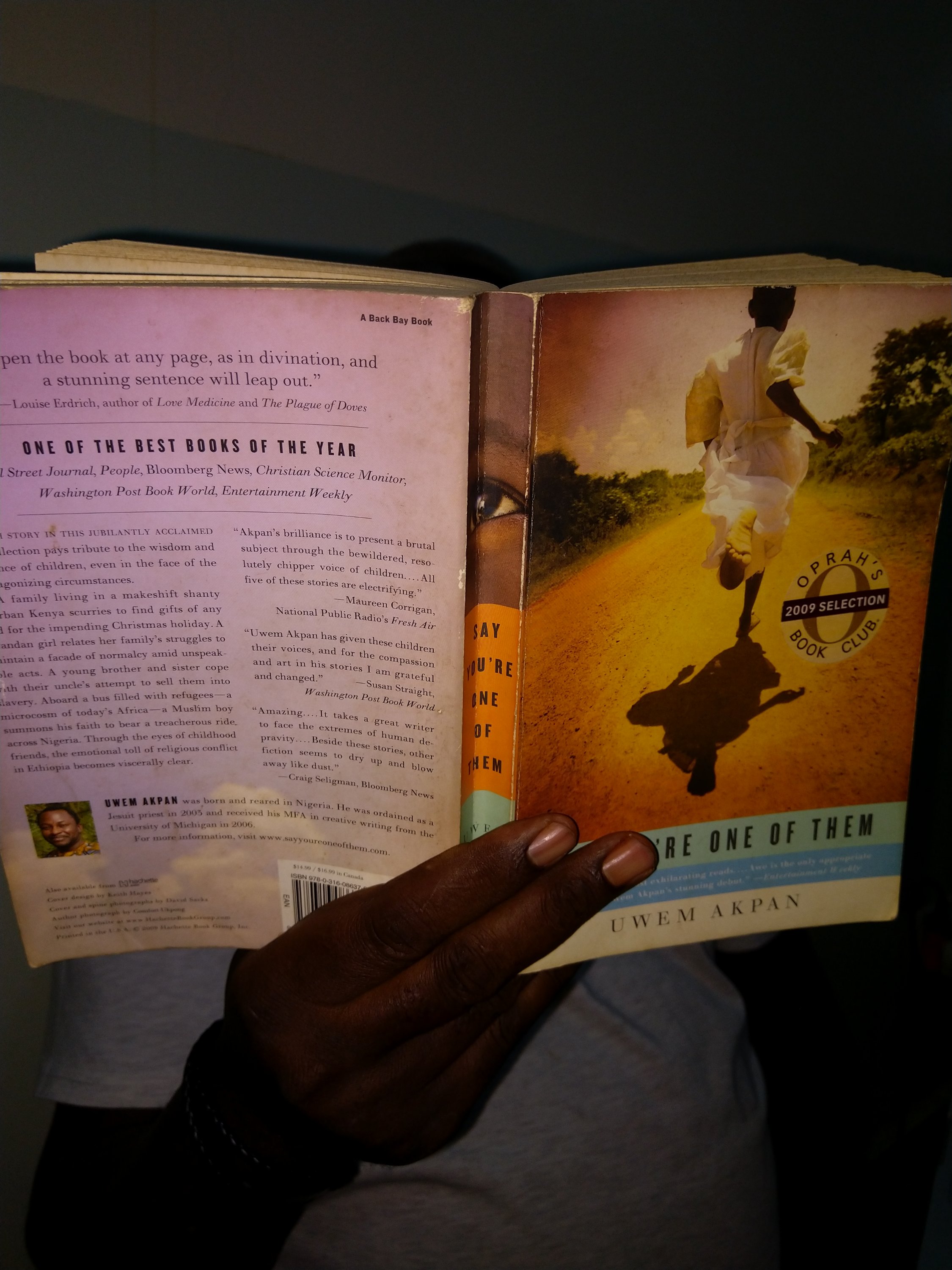
Father Uwem Akpan’s book – Say you‘re one of them has been criticized as an example of this dangerous literary genre of poverty porn or pity porn. Published by Back Bay Books, it is a collection of five stories, all tragic and all overflowing with negative images. “An Ex-mas feast” is set in Nairobi and is a description of life, deprivation and survival in one of its largest slumps, “Fattening for Gabon” is set somewhere in the fuzzy land between Seme border and Nigeria and deals with child trafficking, “What language is that” is set somewhere around Ethiopia and is about tensions caused by linguistic differences. “Luxurious Hearses” is set in the north of Nigeria and is a tale of religious inspired violence and killings, and the last story “My parents’ bedroom” is a story around the genocide in Rwanda.

Apart from a few geographical and time inaccuracies in some of the stories, the stories and the research that informed them are pithy and informed by a commitment to realism. Yet one is overcome by a sense of sadness as one completes reading each story. There is no escape from the enveloping sadness, from the negativity that nibbles at the core of your being as you read about Africa.

One of the sharpest minds for now in African literary aesthetics is Ikhide Ikheloa. I am yet to meet him in person but judging from his many contributions, he is a man of great erudition, astounding intellectual depth, amazing energy, great wit and someone with a discernable social vision and commitment. He also has a strong aversion for poverty porn/pity porn and has deployed his massive intellectual energy, wit and sarcasm to come against any African writer he thinks is producing such. His views on Poverty Porn in the articles with link lines below are highly critical of Poverty Porn and its purveyors.

The comment below is sweltering:

“The mostly lazy, predictable stories that made the 2011 shortlist celebrate orthodoxy and mediocrity. They are a riot of exhausted clichés even as ancient conflicts and anxieties fade into the past tense: Huts, moons, rapes, wars, and poverty. The monotony of misery simply overwhelms the reader. …..The stories are uniquely wretched”.

Listen to Ikhide speak again:

“I am still fuming over the wretchedness of almost all the offerings on the shortlist of the 2011 Caine Prize for African Writing. Aided by some needy “African” writers, Africa is being portrayed as an issues-laden continent that is best viewed on a fly-infested canvas. Memo to the Caine Prize folks: It doesn’t have to be all about issues. Just tell me a story, any story”.

I have read somewhere where he blasts Father Uwem’s book as another example of poverty porn. Is this fair, I mean this effort to classify to classify Father Uwem Akpan’s book as belonging to this genre of poverty porn? Is Father Akpan wrong in describing what he sees or is his vision biased or his depiction exaggerated? Is the critic right in castigating a writer for choosing a point of view? And in response to the critic’s lambast, could the writer simply not respond by saying: You may not like it but that is what I saw and what I felt when I confronted the reality that prompted and released my creative impulse? Before such expostulation, can the critic not simply ask the creative writer to go check his/her eyes? Would such exchanges not raise key philosophical and epistemological issues about the objectivity and subjectivity of reality and perception?

We all know that life and reality are a blend of the good and the bad, of hope and despair, of wickedness and kindness or nobility and knavery. A good storyteller must then seek to capture this dual face of life and reality and not just focus only on the ugly or the good. Focusing only on the positive and optimistic can be as damaging as focusing on the negative and pessimistic. Voltaire’s “Candide”, for example, is a riotous routing of the dangers in unbridled and unchecked optimism! Voltaire Candide checked that unhealthy tendency and in many ways prepared the ground for the emergence of realism. Is the rage against poverty porn driven by a similar impulse to call out and check the sprouting of effusive negativity and pessimism in artistic depictions of the African reality?

If the answer is yes, the question then becomes how to distinguish works we can define as poverty porn. How is it different from other works of art? Could its distinguishing feature then be a deliberate choice by the author to exaggerate negativity without making an effort to balance such negative images with strategic injections of rays of positivity? For in life, there is sadness but within sad situations, a narrator who looks hard enough could find something that ennobles and which contains the seeds for the defeat of despair. Is one guilty of prescriptivism if one then suggests that the duty of an author could be to seek such balanced presentation even when one allows the author a right to betray a preference for giving the upper hand to the tragic?

I have lived experiences with backgrounds similar to those of two or three of Fr Uwem’s stories. I can say that these experiences can be presented in manners that do not create a numbing stasis and inability to respond creatively to life’s challenges?

The first one was sometime around 2002/2003. It was one of those slow mornings in a typical UN office I was heading. I was going through implementation reports line by line and also checking up to see which of the partners that we had advanced funds to had satisfactorily accounted for those funds. Then all of a sudden, all hell broke loose. The police had intercepted a vehicle loaded with children headed for the Idi-Iroko border. The stories the children told were not too satisfactory. They all claimed that the lady they were traveling with was their aunty but on close examination, the story turned out not be true. The lady was the wife of a highly placed person and was clearly well connected and the children were from Kaduna. She claimed she was taking the children to the Republic of Benin for a vacation project but again it was difficult to believe that as schools were still in session. This was beginning to look like a case of cross-border smuggling gone wrong and in the end, the children had to be returned to their parents with the assistance of the Ogun State department of Child welfare to Kaduna state. So child border smuggling is real. Uwem has a story that deals with such a situation – the difference is on the layered incidences of unremitting sadness in his story. It is such unremitting sadness, the pounding presentation of a sad reality that dwells extensively on negative episodes that in a way threaten to reduce the literary value of Uwem’s storytelling and to paralyze our ability to respond to it. In the case under review, I refused to be discouraged, always assuring the children that they would soon be united to their parents and doing my best to see that they were fed whilst they remained in the protective custody of the Ogun state government. Sad event, but positivity results in a happy ending.

My second experience was in 2004. I had just arrived Nairobi and after a few weeks living there, I decided to visit Kibera. I had two reasons to do this. The first was to satisfy my curiosity. The second was more professional. In 1996, I had directed a UNESCO funded project to produce a module capable of teaching urbanization in secondary schools in a manner that would reflect the innovative strands from the Rio, Cairo and Beijing conferences on the environment, population and gender respectively. Tall order! But I managed to assemble a very strong team made of demographers, sociologists, educationists, environmental experts and curriculum developers and we came out with an output that we were very proud of. A book of readings titled “An EPD approach to teaching Urbanization in secondary schools” edited by Professor UMO Ivowi and myself was also published. A lot of our background stuff on urban settings were gleaned from Ajegunle, the jungle.

Kibera, another slum, was thus my opportunity to test whether the “truths” we told about one slum had universal application. The visit to Kibera shook me to the roots. It brought tears to my ears. The poverty I saw there tormented me. It offended every sense of decency. Kibera’s inhabitants were more like animals trapped in a place with no exit. Later to achieve some catharsis, I wrote a long, rambling, poorly structured poem – A song for Kibera.

Later in 2005, I chanced upon “Say you’re one of them” and I was amazed to notice how despite the differences in genres, Father Uwem’s images and mine of Kibera had very strong resemblances. Was I doing poverty porn or writing down what I saw in this poem? Yes, I now recognize that I deliberately ended the poem on a note of rebellion, a note that affirmed my hope and prayer that the Kiberas of this world must no longer be allowed to exist and that social policy could put an end to Kiberas and wipe them off the face of Africa. Hence, my poem ends with a choice of positivity over negativity and optimism over pessimism.

What is my point? Two authors may confront and be inspired by almost identical realities but choices made all along the narrative trajectory could produce a difference in effect and could determine whether one is doing poverty porn or simply engaging in an exercise in realism.

Posted in Uncategorized

Views and comments on Chimamanda Adichie’s “Americanah”

By Noel Ihebuzor

Image

This is not a review in the formal sense of the word. Rather it is a collection of comments and scribbles I made as I read through the book – a book made of seven unequal parts.

Part 1 opens in Princeton USA and already introduces the reader to Ifemelu’s longing for home, her imminent home coming, her lovers – Blaine, Obinze and Curt. It also introduces us to Obinze’s wife, Kosisochukwu. The story then shuttles between Nigeria and the USA depending on whether the narrator is Obinze or Ifemelu. These two chapters in part 1, beyond the initial introduction to the principal characters and beyond their stage setting functions, are also very biting criticisms of the nouveaux riches in Nigeria and their fawning and fake lifestyles! Adichie’s dissection of the manners of the Nigerian elite in this section is rich in both sarcasm and pity. Some lines in this part do indeed float like butterflies but sting like bees. Here are two to illustrate – “mundane observations delivered as grand discoveries”; “middle-aged Lagos woman, dried up by disappointments, blighted by bitterness…” Great powers of description! This is certainly a writer with a very keen sense observation and a way with words. Consider again this very damning but apt observation of Nigerians “Everybody is hungry in this country, even the rich men are hungry but nobody is honest” And this piece of self-recognition and assessment by Obinze – “It was honesty that he valued; he had always wished himself to be truly honest, and always feared that he was not”. Adichie also indicts the nouveaux riches for their complicity with military regimes that raided, raped and ruined Nigeria.

The preliminary examination of hair, color and culture are also commenced in part 1. The encounter with Aisha in the braiding salon is used to explore the theme of hair and bleaching further and Adichie leaves the reader in no doubt as to her position on these two matters. “Aisha was almost whispering…and in the mirror the discoloration of her arms and neck became ghastly sores” Fela coined the expression “yellow fever” to describe such skin variegations that arise in the African’s quest for skin lightening.

Part 2 (chapters 3-22) shuttles between America and Nigeria and narrates in part the early beginnings of the love between Ifemelu and Obinze. But it is more, as part 2 is a huge canvas on which Adichie paints a number of things – race, religion, relationships and relocation. The part also deals with enculturation/acculturation, situation driven associations, settling down to life abroad, the privations of life in America as well as coping strategies immigrants adopt. Also, featuring prominently in this part 2 is Adichie’s depiction of the early love between Ifemelu & Obinze which is done with a combination of simplicity, depth and some plausibility – though I found plausibility stretched a bit in one or two instances. The section also contains a criticism of the new Christianity in Nigeria. This criticism of the “new Christian theologies” (poverty or prosperity) overflows with sarcasm, bathos and pathos! The sudden and abrupt changes and somersaults in the image and model of God in Ifemelu’s mother’s imagination – from the benign easy going God, then to an austere one and then to one that deals in prosperity are presented with a lot of deliberate mischief by Adichie. As we read, we find that the lady roves and roams from one church to another in search of God and an assured route to Him and these unending spiritual peregrinations are described in a manner that evokes a mixture of pity and some contempt from the reader. The feeling of contempt arises because Adichie cleverly manages to make us sense the absence of consistency in her faith and her actions, especially towards Uju and her affair with the General. But still, the reader is steered into sympathising with this troubled woman who is such an easy prey for fakes and false men of God. And all of this because Ifemelu’s dad had lost his job for failing to display the right level of obsequiousness! – We are told that “He was fired for refusing to call his new boss Mummy”.

The relationship between Uju and the General, in all its immorality and necessity, is also presented to the reader and we are led through Ifemelu’s eyes to judge it since she, Ifemelu, judges it harshly. However in doing this, Ifemelu herself is guilty of some “bad faith” since she benefits from a relationship she looks down on. Incidentally, relationships such as those flourished in Nigeria during the military dispensation and still thrive in our new democratic structure. These are relationship driven by need and greed – the need by young ladies for life styles their salaries can ill afford and the need by aging males for younger female flesh. The men exploit the wants of the young women and the young women in turn exploit the cravings and libidos of the aging males. Morality becomes a luxury and parents, uncles and aunties find it convenient to look away and pretend that they do not see what is happening. Most times, they accept the gifts which flow from such commerce-driven relationships and pretend that these are simply a reflection of the benevolence of an overgenerous male. Adichie manages the narrative here well and achieves a large degree of plausibility in many parts of it. However, I think that Chapters 6 and 7 contain the narrative flaw of plausibility in both dialogue and characterisation. In an effort to portray Uju’s moral bankruptcy in her role as the General’s mistress, Adichie occasionally over does things. Uju, a medical doctor, often lapses and speaks like a cheap “Mgbeke” and worse still asks Ifemelu to help her shave her pubic hair in readiness for a weekend of delight with the General, conveniently overlooking the moral danger she is exposing her younger cousin to. Also, it is very unusual for an Igbo lady to openly speak of such things as sex and extra marital escapades to her younger ones or to elders and yet Uju does this regularly in chapters 6 and 7. The General’s death in a plane crash appears to be too hastily contrived and tends to create the impression that the character had played role sketched out for him and needed to be quickly exited from the scene. Apart from these tiny narrative challenges, Adichie’s language still flows effortlessly with astounding effects even though here and there in this part one comes away feeling that the story line as well the principal characters have lost some depth and some essential “vraisemblance”. The reaction by Obinze’s mum to the pregnancy false alarm is one case in point and her remarks to Obinze and Ifemelu on the management of their relationship and sexuality read like a straight lifting from the speech of characters in a play written to promote responsible sexuality for young people! Not too convincing, even if earlier characterisation had sought to cast her as a liberal educated mother!

Chapters 8-11 focus on the unending strikes in Nigeria tertiary education and Ifemelu’s eventual relocation to America. Adichie succeeds very well in conveying to the reader Ifemelu’s initial disappointment with Brooklyn and the harsh existence that life is for Nigerian students there. The frost in her relationship with Aunty Uju, who is struggling to pass her qualifying examinations and living a life marked by privations, frightens and disturbs her. These chapters bristle with flashes of inspired prose, beautiful yet crisp and sometimes cutting – Bartholomew who comes courting Aunty Uju is described as an “exaggerated caricature” who actively pursued “airless arguments”. A line like “the strange naivety with which Aunty Uju had covered herself like a blanket” is simply beautiful and powerful as prose. “Bartholomew…spoke with an American accent filled with holes, mangling words until they were impossible to understand” is another one – biting and hard hitting. Chapter 12-16 take us further into Ifemelu’s journey into America. Her reunion with Ginika, her struggles to find some employment, her numerous disappointments, her growing frustration and desperation are all presented in a manner that has both sociological depth and sympathy. The presentation of Ifemelu’s humiliating encounter with the tennis coach is understandable as is the sense of guilt and uncleanness that chokes her afterwards but the prolonged grief and depression appear overdone.

The exploration of race, culture, enculturation, resistance and identity is done with mature sensitivity such that we feel the tensions, the patronizing condescension of the persons like Laura, the poorly concealed uncertainty of a Kimberley who employs Ifemelu as baby sitter, as well as the well-meaning paternalism of American NGOs working in Africa. Ifemelu’s gradual “Americanisation” in her speech is also convincingly narrated

We are also introduced to the tensions that exists between African Americans and African students in the lively exchanges that followed the viewing of the film Roots in one of Ifemelu’s classes. An interesting distinction is the one of “African American” and “American African” we meet in one of the chapters. Some winning lines crop up here and there “Professor Moore, a tiny tentative woman with the emotionally malnourished look of someone who did not have friends”. And of our unfailing relapse into self-criticism and castigation of our countries once we are abroad, Adichie observed with great insight – “And they themselves mocked Africa, trading stories of absurdity, of stupidity, and they felt safe to mock because it was a mockery born of longing, and of a heartbroken desire to see a place made whole again”. Wow!

In some chapters in part 2, especially the parts that deal with Ifemelu’s baby-sitting role and her relationship with Morgan and Taylor (Kimberley’s children) and her amazement at the American child rearing practices, the flow and energy stall, the story becoming insipid, and then in another, vitality, elegant prose and depth return. I found the relationship with Curt as a bit unnecessary, a bit contrived, a bit forced and one which contributes very little to the structure of the novel and to the characterization. Perhaps it is useful in the sense that it affords Adichie an opportunity to explore mixed race relationships and the tensions and adjustments that come with them.

After a lull towards the end of part 2, the novel comes alive again in part 3 with the treatment of life, race and immigration in the UK – after Obinze fails to get a visa to the USA. This part is done with sensitivity, commendable awareness of the inner working of the minds of characters, their fears and their pretensions and their coping strategies. The murky realities of the life of the illegal immigrant – working with fake papers, the extortion of shylocks who loan their identity cards to desperate immigrants, the humiliation of menial work, the pretended superiority of natives, the frustrations, the fake visa driven marriages, all of these are painted with a healthy dose of realism and sympathy. This section also bristles with superb prose. “He was, by turns, inflamed by anger, twisted by confusion, withered by sadness”. Of Emenike, Obinze’s school mate, Adichie says – “His was the coiled, urgent restlessness of a person who believed that fate had mistakenly allotted him a place below his true destiny”. Of Emenike’s attitude towards his wife she talks of “a mockery coloured by respect” and describes his dinner manners as reflecting “a careful but calibrated charm”. Immigrants and asylum seekers are described as people with a “need to escape from the oppressive lethargy of choicelessness” – Beautiful! Things end badly for Obinze and he is deported in the end.

Part 4 – examines race and how race conditions most interactions in the USA. Whereas the relationship with Curt enabled the author to examine the challenges and stresses of mixed race relationships, the relationship with Blaine is used to examine the various shades of race and blackness – an examination that is helped in many ways through the instrumentality of Ifemelu’s blog. It also allows her to take a stroll through history and present from the eyes a witness the tensions and joys that were the Obama march to the White House. Dike’s suicide attempt at the end of this chapter is a bit jarring and does not fit very neatly into the core of the narrative. Is this a technical fault? I am inclined to think so.

Part 5 is brief and the story shifts to Obinze and to the destabilizing potential a relink with Ifemelu is bound to have on his stable family life. As Kosi says and very perceptively – Obinze’s mind “is not here”

Part 6 – is shortest part of the novel and deliberately so to prepare the reader for ifemelu’s imminent return to Nigeria.

Part 7 – Narrates Ifemelu’s settling back to life in Nigeria and the reunion with Obinze. Nigeria is presented first through the eyes of Ifemelu and later through Dike’s innocent eyes. The X-ray is piercing, and alternates between empathic commentary and biting sarcasm. The claim of universality of corruption in Nigeria, the rent seeking behaviour of officials – all these come out in the conversation between Okwudiba, Olu and Obinze. Eventually the lovers come together, their physicality still as intense (“their bodies remembered and did not remember…but lying next to him afterwards…her body suffused with peace”) but the consequences are sad for third parties. The pains of love, the jealousy, the irritability of the mistress, the pettiness of women in love – all of these are depicted with great sensitivity in this last part.

Part 7 also allows the author to explore and expose some of the development and urban anomalies in Lagos – power outages, crater filled roads, expensive housing, the disguised prostitution of the working lady who is clearly living beyond her salary and who is being maintained by a lover or lovers, the growing culture of marital infidelity, the tartness and irritating competition amongst urbanised middle class Lagos women, the invasion of the gloss gossip magazine full of pictures, over brimming with titillating gossip but containing nothing of real value (existing mainly to pander to the vanities of the rich in my opinion), the meetings of returnees and been-tos from the UK and USA, doubly annoying by their empty pretentiousness, the growing intolerance in churches where bridesmaid are kept out of the church for skimpy dressing, the obsession with marriage by the likes of Ranyianyindu – these are all there and very expertly described. Indeed on a good day, these could actually provide material for another novel. The author demonstrates her ability to touch at the heart of one the drivers of Nigeria’s malaise when she comments through her characters of the mentality of scarcity that pervades Nigerian society and the Nigerian psyche, a mentality which makes rush and scramble for things even when there is no scarcity!

In all of these chapters, Chimamanda finds time to criticise most of the characters she creates – for their pettiness, for their ambitions, for the sale” of their persons and souls in their pursuits of life and living, for their cockiness, their failings, their foibles, their vanity – Blaine, Curt, Ginika, Ranyianyindu, Shan, Uju, Emenike – no one escapes.

The only persons who escape her mild tongue lashings, surprisingly or not surprisingly, are Dike, Ifemelu and Obinze. She is so benign in her treatment of their inadequacies, in their failings and in their betrayals and one wonders why. Ifemelu’s “self-sabotager” fling (Ginika’s expression) that ended the relationship with Curt is presented as irrational but is really not judged. She is mild in presenting the very damaging consequences of the relink between Ifemelu and Obinze and how the pursuit of pleasures from their pasts is going to destroy the delicate life that Kosisochukwu has built for herself and her young family

The whole story is told from the eyes of Obinze and Ifemelu and the fact that Ifemelu’s portion of the story telling has more space would also betray not just the sex of the writer but also her gender and her romance with feminism. But it is an unequal narrative. The flash back technique and non-linear disrupted sequence are maximally exploited to bind the story and also to glue the reader’s interest to the unfolding narrative and events. The blog inserts allow her to comment on a number of key issues, especially race and here, Adichie walks a fine line and walks it finely, talking about race as a black without being racist in the process.

Let me end by sharing my opinion on the main characters- Ifemelu and Obinze. They are human but not very moral characters. It could be said of them that “when they are good, they are very very good” and when they are bad, they are horrid! And do not ask me why! Which character am I most drawn to in Americanah? Kosi!. a beauty queen who loves her husband, dotes on him but who was never really loved by him and who gets such a raw deal in the end! The plight of this poor girl, this poor victim of two selfish lovers in an imperfect world makes me sad – but perhaps, I am over-reacting – but in life as in this book, my sympathies always go the unfairly treated.

Americanah is great book – great in the quantity of themes it treats and also great in the depth and quality with which it treats them. It weaves a story of love, lust and romance and uses it to examine issues of race, relations and the feeling of exile that one feels in a foreign land. It is also a critique of the Nigeria’s developmental challenges – a country where basic social services have long gone extinct and the story and the critique and handled by a writer with a great sensitivity to details and feelings.