Development and policy analyst with a strong interest in the arts and inclusive social change.
Dabbles occasionally into poetry and literary criticism!
The 2025 Corruption Perceptions Index (CPI) paints a sobering picture of global governance. Transparency International measured perceived public-sector corruption in 182 countries, and the global average fell to 42/100, the lowest in more than a decade. Most countries are struggling: 122 out of 180 scored below 50, showing widespread corruption challenges. Only five countries scored above 80, compared to 12 a decade ago. Denmark leads again with 89, while Somalia and South Sudan sit at the bottom with 9 each.
Key Highlights
Top performers: Denmark (89), Finland (88), Singapore (84), New Zealand (81), Norway (81).
Major democracies slipping: United States (64), Canada (75), United Kingdom (70), France (66), Sweden (80), New Zealand (81).
Lowest scorers: Venezuela (10), Somalia (9), South Sudan (9).
Global Trends
Democracy matters: Full democracies average 71, flawed democracies 47, authoritarian regimes 32.
Civic space is critical: Countries with open civic space average 68, while those with closed civic space average just 30.
Declines since 2012: 50 countries worsened, including Venezuela, Syria, Hungary, and South Sudan, where corruption has become systemic.
Consequences
The report links corruption to weakened institutions, poor public services, and rising inequality. It notes that restrictions on civic freedoms often coincide with declining CPI scores. For example, Georgia (50), Indonesia (34), Peru (30), and Tunisia (39) have seen governments limit NGO activity and intimidate journalists, worsening corruption risks.
Recommendations
Transparency International urges governments to:
Protect independent justice systems.
Ensure transparency in political finance and lobbying.
Safeguard civic space and media freedom.
Strengthen oversight of public spending.
Cooperate internationally to combat illicit financial flows.
One striking line from the report captures the urgency: “At a time of climate crisis, instability and polarisation, the world needs accountable leaders and independent institutions to protect the public interest more than ever – yet, too often, they are falling short.”
Would you like me to create a regional comparison table (e.g., Americas vs. Europe vs. Africa) so you can see how different parts of the world stack up against each other?
One of the most fascinating lessons I’ve learnt about women in this my short life, and this is based on the women I’ve met, is that a man can never truly claim to know a woman, except perhaps his mum. Because essentially, women are basically unknowable.
Women are mysteries, and the moment they lose their mystery, they lose an essential trait, a trait that makes them women. I am inclined to concluding on the basis of my limited experience (error of limited sample size) that this state of things just has to do with what I believe is at the core of what being a woman, that quality of their “unknowability” to a man. Let us suppose that this applies to the relationships between most women and men and is invariant in time and place. In that case, a man approaching trying to “know” a woman in fiction, and this woman herself being a creation by another woman (would “understand” be a better verb to use in this context?), faces a serious uphill task. Such a man could be said to be embarking on a task which even the bravest of souls would approach with a lot of caution and timorousness.
Yes, it is thus with a spirit of “quaking and trembling” that I embark on this assignment, or this self-imposed task that will not let me rest, of sharing a few thoughts about what I believe I’ve learnt or known or suspect to have known about one of the many female characters that populate Chimamanda Ngozi Adichie’s many books. I’ve picked on one of her female characters that is perhaps the most complex, the most unknowable, and indeed, the most difficult to trap. And this you must agree, is a difficult task for a specie (sincere apologies for any crude biologism here – it is totally unintended) that, at the outset, I’ve said is basically unknowable to most men.
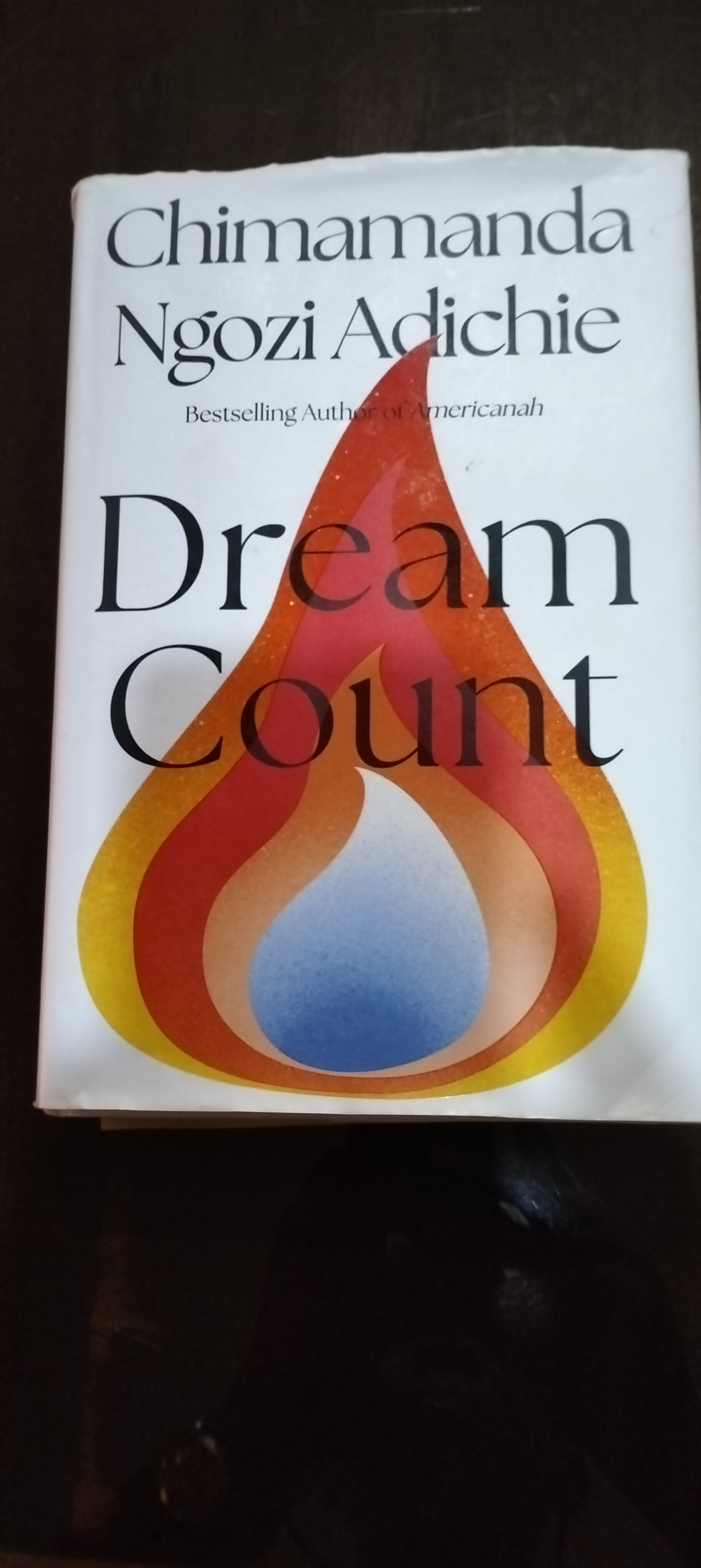
The character in question here is Omelogor, Chiamaka’s cousin in Ngozi Chimamanda Adichie’s newest and most engaging novel – Dream Count. Omelogor is the person I’m trying to wrap my head around to try to see if I can present a description of her that makes sense to me before it can make sense to other people. Omelogor is very complex, but then, trying to decipher a complex character is a project that appeals to us as humans, even when we intuitively feel that failure could be the fate of such an exercise in the long run. But I’ll try. As the French say, “The difficulty of succeeding only makes it more imperative for us to try.” By the way, that’s a very bad translation indeed, because the original expression in Beaumarchais’ play = Le Barbier de Seville goes thus, “La difficulté de réussir ne fait qu’ajouter à la nécessité d’entreprendre.”.
Yes, the subject of my reflection is Omelogor, her actions and her thoughts as reflected in the story in the section of the book that bears her name. I am asking whether Omelogor is the world’s modern female Robin Hood, (And it should not surprise anyone that the name of the NGO she established and devoted to supporting female empowerment is known as Robyn Hood – how cheeky!). I am also wondering aloud whether Omelogor is a social iconoclast, a deliberate disruptor of social norms and conventions, a social avenger, a woman who is willing to stand up to the rich and powerful, a career banker who does not think twice about using a mop to poke at comfortable glass ceilings of society, a very composed male-eater or a bit of all of these. Who thus, is this engaging and unusual character, this bold character, who sets out to speak with frankness on several issues that most women would approach with a lot of caution, you may ask? Omelogor is someone who can throw caution to the wind and who speaks her mind on very difficult issues, can make up her mind on very complex social issues, and who can go ahead to do things that run counter to the dominant trends and the dominant models of sex roles in society. Once her mind is made up, she just goes ahead and does these things, without as much as batting an eyelid about what the consequences could be.
Omelogor is a banker who returns to Nigeria from the USA, after a successful degree, and joins a bank, rises to the very top of the career and becomes a very close associate and confidant of a character in the book simply described as CEO. The appellation CEO is the only one we have of him. Could this be a technique that Chimamanda Adichie uses to suggest that the CEO could refer to anyone, to any of the many individuals who crowd and corrupt the numerous commercial establishments in Nigeria’s financial sector? Through the CEO and his antics, the reader gains an insight into the carryings-on and the putrefaction that has become a distinguishing feature of the dealings in our banking sector. These include money laundering, aiding and abetting financial heists, stealing from clients’ funds, armed with the knowledge that persons who operate accounts made up of stolen funds cannot speak up when those very same funds are expropriated from them by the persons they entrust them to. CEO is just as criminal as those who steal government funds, as he steals from his very customers in the Bank. Omelogor soon finds out that the CEO is stealing from his own bank but shows no moral outrage. This is a reflection of how badly her values have altered that rather than upbraid the CEO for larceny, she actually tells him that she can teach him better ways to cover his tracks and criminal acts, CEO takes the bait, and once he does this, he becomes Omelogor’s accomplice and partner in crime. By thus choosing to cover up the CEO, Omelogor has effectively pocketed him and silenced him forever. To keep him under her thumb, she says – “I never failed to perform respect” because she has come to realize that men like CEO “had shockingly thin skins”. Notice that the expression “to perform respect” serves to convey the superficiality and fakeness of her actions since she actually feels nothing but contempt for these big men in society – “these same men who paraded wealth that they knew to be mere hull and all hollowness beneath.” Omelogor continues to thus “play” this society for her own gains and ends. Is it hypocrisy that she can still decry the collapse of morality in Nigeria or is it the silenced voice of her morality still struggling to speak out amidst all the financial rot and decadence? Her observation that “It is not that Nigeria is poor, it is that it is virulently materialistic…….Money is at the of center of everything, absolutely everything. We don’t admire principle or purpose” is most apt but what gives the moral high ground to speak thus when we know that her behavior in managing funds entrusted to her financial house betrays this same trait?
She makes a number of statements that condemn corruption in society and its consequences. And I find myself agreeing with her when she talks of the “fragile security of stolen wealth”. When she comments thus of a politician – “He was surrounded by many people but he trusted so few because his power had robbed him of the ability to trust”, I find myself feeling very sorry for the politician because he is experiencing the effects of what I describe as a bad tradeoff. The story contains other instances of the damaging results of a life of criminality –aptly expressed in the reflection “who do you go to complain when someone steals the money you stole from you”? This situation is well illustrated in the case of the politician whose money is stolen and who did nothing “because what can you do when a person has stolen what you stole”?
Omelogor crosses the stealing and cheating line and her excursion into philanthropy with stolen funds could be dismissed as the efforts of someone looking for ways to buy back her soul by using of some of the stolen money to financially empower needy women! But I could be wrong as some other reader could simply see Omelogor as our brand new 21st century Robin Hood. She takes the money she shas stolen and sets up a foundation that embarks on an empowerment programme for women in rural communities. Redemption through restitution to non-expropriated? Does this clean up the act of stealing? Her model is that of a thief who steals money with the intention is using it to empower the poor. But do intentions wipe out criminality? Because stealing is criminal. Taking what is not yours is criminal, even if what you’re taking is stolen. And it is important to say this and draw clear boundaries around these issues, for if not we could get trapped in a quagmire of philosophical ramblings, emotional tainted disputations and theological disagreements. A man/woman who steals from the rich to give to the poor, is he/she doing the right thing? And if the intention is to do the right thing, do intentions redeem an act from what it was in the first instance? Now, those are the type of questions that Omelogor’s acts in the story throw our way. The case of stealing from a stealer raises important ethical and moral issues! Whilst Robin Hood is an appealing model for this type of moral conduct, one wonders what the world would become if we all became modern Robin Hoods, acting like EQUALIZERS in the Denzel Washington and Queen Latifa molds.
What would Immanuel Kant say about such a world in the light of his categorical imperatives? Ethics and Morality can often be slippery where acts are judged by the intentions of the perpetrator and not by its outcomes and consequences; The moral and ethical question of “stealing from a thief”—sometimes phrased as “Can it be right to take back what was stolen?” – is a nuanced issue in philosophy. It has attracted and continues to attract volumes and tomes in ethics and theology and Miss Adichie, in her presentation of Omelogor, walks dangerous and slippery grounds here as the actions of her character raise the important question, is it right to steal from someone who has stolen? When Omelogor says “Look, you have to understand that lying and deceiving are not moral issues in everyday life here – they are just survival tools.”
Should we extend the same claim to stealing and “pen robbery”? And she goes on to seal her position and indicate the protective seal one must apply on one’s mind to carry on the way she does – “Compunction is not even an option because you would need to think of these issues first as moral”. Our heroine has provided us with the moral code by which she wants to be judged. Is she rationalizing her dishonesty by thus creating a code by which her acts should be judged? Honestly, I do not know. How did her mind which condemned the sleaze and corruption in the banking sector, her mind which had so much contempt for the corrupt characters in the sector suddenly get twisted? How and why did she allow her soul to be seduced to cross over the line that separates the innocent from the damned?
Maybe the seeds for the conversion could be traced to her unusual sexual ethos. Here is a female character who picks men to sleep with and dispenses with them after the event without any trace of emotional connection. Is she real? Is she acting? Doesn’t she feel anything? Is she well? Is her characterization simply to convey, by role reversal, the frustration that women, like Zikora and Kadiatou, feel on being used and dumped by men. In one episode, she walks over and invites a man who she has spotted ogling her at a party to her flat. In another, she picks a young man in act devoid of emotional connection. She picks the men. She is not picked.
Listen to Omelogor speak about one of such pickups. – “I sensed his fascination with and mild repulsion for women older than him”. Yet she goes on and ends up “bedding” him and this decision is the rational one of a female tigress. About this younger lover, Omelogor observes – “He was to me simply a younger man, an experiment because he was sweet”. Who else but a man-eater could speak thus – Men run for your lives! There is a man eater on the prowl! And she can be so detached during the act of coitus that she is able to provide a neutral and clinical description of the engagement taking place, taking time to talk of the practiced movement of fingers and tongue and accusing the young man trying to please her of simply going through a well-rehearsed performance whilst being completely enraptured with himself over his performance. Reads more like a description of male masturbation with a female accomplice.
There’s a role reversal here in terms of our stereotypes. In standard narratives, men use women and dump them and move on. In the cases of the encounters between Omelogor and men, the tables are turned. Here is a bold female character, an enterprising and upwardly mobile one at that too, a new manifestation of Jagua Nana if you want, who picks up men, chews them and spits them out without any emotional connection. Picking men and sleeping with them without due attention due to considerations such as shared values, social class and adequate background checks of one’s intended sleep mate carries certain risks as Omelogor discovers when one of her “captives” brutalizes her during coitus by pinching her breasts – and he confuses effective and pleasurable coitus with the act of riding her as if he were riding a horse. She is so turned off that she tells him to get off and get going.
I have a nagging feeling that the character Omelogor perhaps offers the author a good platform for speaking out against a number of male inadequacies in relationships with women, be they wives or mistresses. Take the case of Hauwa whose husband is described as a reason and not a person. Or take the case of Mmiliaku and her husband, Emmanuel. Mmiliaku complains that her husband “just climbs on top of her whilst she is sleeping! “I just want us to have enjoyable sex and connect as man and wife. It is terrible, always the same thing: he forces himself into my body when I am asleep”. When Mmiliaku complains to Emmanuel about his approach to sexual relationships in a marriage, he resorts to the strategy of shaming, instead of agreeing to identify his shortcomings – accusing her of talking like a prostitute and advising her to change her ways! My fellow men are we such insensitive and sexually incompetent clods?
The story “Omelogor” is replete with her and the way she treats men. In a few episodes, she makes comments on masculinity and the size of the male organ, which is something you don’t usually find women talking about – but I could be wrong here. Does Adichie use Omelogor to have a laugh at men, and the type of insecurities they feel because of size. One episode during a sexual encounter illustrates this well. When one of her “sex captives” asks whether he was hurting her during the sex act, she reflects and comments to herself – ”hurting me when the man had an object of insufficient size further encumbered by a significant belly, and yet he had the nerve, as he was huffing and puffing to keep asking “am I hurting you”. “Huffing and puffing”, like the ineffective Fox in the three pigs story! Huffing and puffing indeed – this is what a man’s action during coitus is now reduced to.
And the introduction of four of her lovers by the phrase – “There was a man” – is very unusual and subversive. “There was a man”, so we read, “there was a man with long elegant fingers”. “There was a man I could have loved, a man I wanted to love” – all of these read more like the disinterested entries in the social diary of a female qualitative researcher working on the relationship between the sexes, – conducting initial frequency counts, tallying numbers and then making bland entries. There was this man with elegant long fingers she describes as erudite, self-possessed, and not crushingly handsome but he is disqualified by one flaw – self-love because nothing bores Omelogor more than the self-love of men who have their whole lives been praised for their looks. In another relationship, she gets really upset when the fellow keeps repeating “I love you” to her during the act of lovemaking and ends the relationship. Her longest relationship lasts 11 months! Yet this tigress is not immune from emotions that come from the type of autopsies we usually carry out at the end of relationships – “How could I have opened my door to this man who I did not want at all and could not possibly have wanted” = So what happened ? Did Omelogor open her door to him in a moment of irrationality? Please do not ask me.
Like most men, I feel uncomfortable when females discuss male sizes. Why? It is simple – I’m tempted to believe that the saying size matters actually is a derivative, an offshoot from male obsessions with their inadequacies. And that indeed, if you look at the current obsession in pornography, which incidentally Omelogor wanted to do a master’s degree in, and its consistent interest in exaggerations, exaggerated phalluses, exaggerated busts, exaggerated moans and visual exaggerations enhanced by different styles and angles of photography and close ups, you will understand why men feel uncomfortable when size is mentioned. In pornography where one sees such mechanistic and demeaning images, one is right to start to wonder whether sex is really an expression of affection or is it more a physical expression of power and asymmetries? Is the sexual act an expression of power symbolized by size; of force and invasions symbolized by entry for the man; power symbolized by capture for the female; and power symbolized by subjugation for the female? I say subjugation very responsibly and I do so because at the end of most sexual encounters, the man leaves the battlefront a reduced form of himself, feeling very, very insecure at the end of it.
It is these taboos that Omelogor exercises little reluctance in giving expression to. And this is what makes her fascinating as a character in this book. Because she talks freely about these inadequacies, and funny enough, she’s also so aware of male inadequacies that she even sets up a blog to talk to men about issues about sex and relationships that men tend to fret about and are unwilling and afraid to discuss with third parties. Reading the contents of her blog, one cannot but get the feeling that Omelogor is mocking men and having a good laugh at their expense. It is also interesting to note, as I’ve said earlier, that Omelogor decides to abandon her banking career to go to the States to do a master’s degree in all things…in all things on an unholy subject like pornography. Anyway, in the end, she abandons the degree, but that does not mean she has abandoned her restless mind. Her mind is full of energy and brimming with rebellion.
So, what we have here now is a picture of a new female. I’m careful not to say new feminist. Is this a new female that’s assertive, that’s independent, that knows what she wants to do, and that doesn’t really appear to give a hoot about what social conventions say, Is this the model for the new female? Is she the model for the new feminist in Nigeria? I don’t think that’s the author’s intention. The author’s intention is rather to tell us that it is also possible for females to choose paths that do not conform to the conventional. Females can choose paths that set them apart and that are not necessarily tied to obeying the strictures of social conventions.
In the end, looking at Omelogor, you realize that we are dealing with a female who can say what she wants, and does what she wants, and doesn’t allow herself or her horizon to be limited by social norms and conventions. Is this the definition of a feminist? Perhaps so.
Now, if this is the definition of a feminist, then Omelogor is one, a social iconoclast smashing away at all the barriers of morality, whittling down on all expectations of females in normal society, attacking preciously held notions about motherhood. In her discussion with her auntie, she’s very clear about it – attacking and showing very strong moral outrage about attempts to make her conform to the norms of a society. In that case, social iconoclasm for her becomes a route to self-expression. But when you look at her closely, you discover a woman who’s also very anxious to be loved, anxious to be possessed, anxious to possess, but who is not that lucky, because the men she meets don’t meet her criteria. Could it be that she set her criteria too high? Could the source of the problem be in the way she conceives of love as sudden panic syndrome, an emotion described by another writer Mario PUZO in the Godfather as the bolt of lightening effect? Must all love be of this highly romanticized nature?
Omelogor is a woman who has triumphed over a number of socio-cultural obstacles that stand between women and upward social mobility, who has overcome social constraints and barriers that stand between women and success, broken through the glass window and is there in our faces asserting herself, being herself, even at the risk of being labeled a social iconoclast, a man-eater who picks up the men she wants, a lady who trivializes pornography, and who is able to even take risks of sleeping with men she poorly understands. So perhaps our female Robin Hood, our female social iconoclast, our social avenger, our male-eater, is a woman who wants to be what she wants to be and who demands to be understood for what she is and wants to be. But then I’m not sure that men would understand her and accept her in that position.
But there’s a point at which she actually goes beyond this searching for identification and definition and goes into what one could call a subversive role. The typical relationship in society, the typical male-female relationship in society is one that is governed by, in many ways, in many relationships, by power asymmetry where the man either physically or financially or socially enjoys a more privileged status than the woman. That is our standard, paradigm for the relationship between a man and the woman. The man is either richer, stronger, older, more experienced or taller or whatever you want to name it. But there’s always that asymmetry which is a critical part of male-female relationship. Now, in Omelogor’s case that asymmetry is changed, is reversed, is subverted because whereas the rich man uses his money and social position to hire women to come and please him, Omelogor uses her power, her privilege, her connections to hire men to come and please her. Now, that’s subversion because it subverts our normal expectations.
It is also worth noting that in our culturally defined norms, it is the man who makes the move, who chooses, who decides where the playground will be. But then suddenly a woman emerges and she’s the one doing the choosing, choosing when it will start, choosing when it will end, choosing who she will play with, choosing on which terrain she will play with the person. And for me, that’s been very deliberately subversive because like I’ve said earlier, the typical male-female relationship is one that’s characterized by intersection of power, privilege, culture and patriarchy, and all end up favoring men. Omelogor, in one fell swoop, subverts all that. And it is that deliberate attempt to subvert and successfully subverting that qualifies her well as social iconoclast.
There is also a play on the name Omelogor by the author. The name Omelogor in Igbo suggests social philanthropy, and most social philanthropists are men. There are a few women. It is also assumed that money used for such noble exercises was cleanly made. Was the money that Omelogor deploys to social philanthropy made through honest means? No because we know that in Omelogor’s case, the money was made by robbing the rich who had robbed society. Philanthropy made possible with stolen funds is flawed right at the outset! Why then would Chimamanda Ngozi Adichie, her creator “bless” her with a name as Omelogor knowing that her social philanthropy which reflects her name is made possible by illegal-gotten wealth, even if this illegally gotten wealth is obtained by robbing the rich who have robbed society? I find to be another interesting dimension to this story.
Omelogor is socially aware and she has agency. But her behavior shows traces of what can be called a socially amoral strain with a very pronounced pragmatist bent. Her unfolding persona clearly illustrates the difference between the immoral and the amoral person. I hope that I am not being unfair to her if I say that she can be indifferent to conventional morality and may indeed have created her own moral laws. I’m not sure I’ve understood Omelogor, but like I said, I don’t think I understand women and I don’t pretend I do and perhaps I never will.
But the story is well written by a very skilled word and phrase smith and powerful storyteller and the verses and lines flow so beautifully – Just a few examples will suffice to demonstrate this –
“a part of Zikora decayed into a bitterness which she imagines is wisdom”
“if I needed further proof that this was no emotion happening, it was the painful hailstorm of cascading regret that hit me each time I remembered him”
“Friendship should have prefixes, suffixes, gradations”.
“….and leave my skin unmarked by the stigmata of eternal gratitude”
“Jide thinks of his hopes as thwarted even before he hopes”
There is beauty in these lines, even if some of these lines are hauntingly so . Read the book and you will discover more.
Truth is twisted, lies fall in to assorted lines, by hook and crook, mimicking straight lines, tangled lines tangle lives, tangled lives tangle minds, in vain we seek to untwist a tangled wreck,
the broom, overrun by yesteryear’s cobwebs has lost its power to sweep,
only witches and wild wizards, unable to find rest or sleep now hop around, crossing carpets to and fro, hopeless and hapless on its jagged ends!
Notes scatter, flung high above the heads of the celebrant, come falling down like boozed butterflies in disordered clusters to the unclean floor, gradually being overrun by notes in disarray. The more affluent hurl bundles at willing shoulders, some other bundles are thrust into welcoming arms by photo-savvy gifters
The long arm of the law looks on, powerless, the law has been long settled, sorted, and so now is broken, breakable
The space knows no balance, this place knows no balance, peopled by hollow souls with no restraint, who know no restraints, know and respect no limits, the leash on the impunity of the rich has no limits, so we ball on, big ballers kicking restraint, morality, conscience, common sense further down the slippery road of riot, ruin, and rot.
May the flour jars and jars of oil in our lives never run dry but may they be always replenished like fountains of eternal gift from God because we have given in support of the truly needy. The lady who gave two cents in the NT Reading represents someone who gives with deep faith, confident in the munificence of God. Her gift and its real value effectively teach us the economic concepts of marginal significance and opportunity cost. Christ’s remarks on her giving teach us that a gift is not measured by its absolute value but by the real effort and sacrifice that giving involves. So even before the principles enunciated in “The Wealth of Nations”, Jesus, our Lord and Savior, was already well versed in economics. If the giving to a worthy receiver does not cause some pain, then there is no gain in it. The gifts of the two women take on enhanced significance when we realize that the two women are widows. We must remind ourselves that these narratives are set in a social context where widows were the lowest of the low, the bottom of bottom of the social pyramid, victims of societal discrimination given the harmful widowhood practices that were so rampant at that time. It would thus appear that the Harmful Traditional Practices we notice in society today have a long history! Yet these victims of discrimination stepped out and made their marks in acts overflowing with faith and genuine care of others. May we have the faith to give like these two women, Amen.
Today’s readings touch on choices, decisions and wisdom. In the first reading, the apostle Paul does what he does best – drawing from his familiarity with greek philosophy to use opposites to contrast God’s wisdom with human wisdom. The whole exercise enables Paul to show the profound superficiality of much of what we humans see as indicators of our wisdom. Much of that pretended wisdom is indeed nothing else but vanity upon vanity, just plain shakara! In the Gospel reading, Jesus resorts to a parable to bring out the limited rationality of much of human decisions, especially in the example of the servant who buries his talent and therefore and thereby forecloses its possibility of growth and development. We are, most times, like this third servant in our decision making and in our choices. We arrive at decisions and choices by prioritising faulty and flawed parameters and assigning weights to these. We then reach a position based on the defective considerations that follow from our earlier prioritisation process. This position we have now taken must be the right one, must always be the right one we delude ourselves into believing. We tell ourselves that every other person’s views are inadequate, not well thought out and lacking in social depth, contextual sensitivity and intellectual rigour. We resist every effort to make us see otherwise and we resort to a broad range of strategies including doubling down, trivializing and ridiculing alternative views and voices. Hubris would already have kicked in at this time making us effectively victims and prisoners of our pride, our imperfect analysis and our unconscious biases. We become “Amarachalam ihe uwa jere je kuola nda Onyemachi nwa”. The readings today invite us to reflect and make real wise choices and take sound and rounded decisions which are based on a full consideration of the total circumstance involved – the actors and persons in the constellation of that decision making as well as the long, medium and short term consequences of our choices, decisions and actions. They also challenge us to examine the ethical and moral implications of our choices and what Kantian categorical imperatives would suggest as the best line of action in the situation we find ourselves in.
May divine wisdom invade us, possess us, flood us, overtake and overpower us and thus equip us with the necessary wisdom and balanced emotional intelligence that we need to engage with the world and those around us.
Ka Chineke mezie ukwu, isee!
Noel Ihebuzor
(written in the departure lounge of Nnamdi Azikiwe International Airport, Abuja, whilst waiting for a rescheduled flight)
“The thing around your neck”, TTAYN for short, is a collection of 12 short stories told by a writer with an eye for relevant detail, a good understanding of the human mind, and an admirable sensitivity to the sociological context in which her characters operate. The writer, Chimamanda Ngozi Adichie, is also capable of plenty of empathy for a majority of the characters in the twelve stories in her book as they struggle to respond to the challenges that life throws at them and make meaning of their varied existence, caught up as they are in specific moments of history as persons with some forms of agency. For a few other characters, she displays a very poorly concealed contempt for their actions and the false lives they lead trying to be what they cannot be. For such characters, she deploys her rich arsenal of sarcasm and irony to ridicule their fake lives underscoring in the process her commitment to people being true to themselves and to their identities.
The stories cover a broad range of topics and issues from the Nigerian-Biafra war, to post-civil war challenges, to life in Nigerian universities and the plague of cultism in them, to wrong practices in academia and to the lives of Nigerians livingin the USA. A few of the stories touch on the lives of married couples whilst some others touch on relationships involving persons with sexual orientations that deviate from the norm and the pains and frustrations that do accompany such. Some other stories touch on themes of violence such as the killings in the north of Nigeria – killings caused by a blend of ethnicity and religious extremism, whilst others explore a broad array of themes spanning the early encounter of Igbo society with white colonization and its agents, especially the Christian missions, agents of evangelization and colonization, to the rigors involved in applying for an American visa in Nigeria, to repressive regimes in Nigeria, to gender and race based inequities and injustices, to sibling rivalry in an environment tainted by patriarchy and contestations of such social structures and strictures, such contestations often giving rise to very bizarre consequences.
Through these short stories, Chimamanda explores a number of themes ranging from political violence and repression, sexual orientation, ethnic killings, marital infidelity, migration and its stresses, coping with loss, racial biases, unequal and unrequited love and its pains, the physical challenges and humiliation that often accompany visa applications, the stresses of marriage in a foreign land and finally to the inadequacies in colonial historiography. She also uses her story to point out ethical and moral failures in the banking sector, where banks use young girls in their marketing divisions to bait rich randy men and potential depositors. Here we note the subtle and not too subtle critique of the abuse of financial power by rich men who exploit power asymmetries in their favor often to take advantage of young female bank workers in age-inappropriate sexual engagements. Chimamanda thus uses her short stories to criticize these and other vices in society. Specifically, she comes against the use of financial power to secure sexual favors. The same criticism of the abuse of power, masking as cultural imperialism, would again show up in her treatment of the manner in which Edward, a white man, tries to exploit his role as workshop convener to impose his views on aesthetics on a creative writers’ workshop, and even to making obtuse sexual advances to some of the female participants at the workshop, again bringing up in the process the intersection of power and gender.
These stories are not single stories, with one story line and a predictable ending. Most of them are richer than comprising a number of interlaced themes and reflecting in many instances a number of intersectionalities, such as those between gender and power, between social class and choices in marriages, between traditional institutions and modern day living and many more. It is this intersectionality that makes her tales very plausible and real. It also makes her characters to come across as people of flesh and blood that the reader can relate to. The stories are so engaging that the reader finds it difficult to put down the book until one has read the last chapter. The beauty of her writing comes alive when we start examining each of the twelve short stories that make up the collection.
Cell One is a presentation of cultism in Nigeria’s tertiary education establishment. The story is built around Nnamabia, the son of a lecturer at Nsukka who progresses from small time pilfering at home to full time criminality and to violence soaked in chilling cultism. The story is told by his sister, who resents the disproportionate attention and privileges that are accorded Nnamabia by their parents. What is sad is the way and manner that Nnamabia’s mother prefers to live in denial and to protect her son even when all the facts before her are pointing to one conclusion. There is an implied criticism of male child preference by parents as this is what partially explains for Nnamabia’s mum turning her eyes away from his criminal activities. The story also broadens to include a strong critique of our policing system, the incarceration of persons in cramped unhealthy cells, the practice of the arrest of a person whose son or relation has committed an offense and the holding of that person until the actual offender shows up.
There is also a level of covert didacticism running throughout the story and it is this. Cultism is bad news for the young one who joins as well as for the families of persons who get drawn into its crippling embrace. The message that comes across is that whereas being a cult member can bring the person a sense of power and connectedness in the short term, in the long term, it brings misery and suffering, apart from its deleterious effects on one’s morals and one’s consciousness which cultism deadens.
Imitation, the next story is a story of love, deception and cheating. It examines the pains and difficulties of long-distance marriages where one of the partners lives in one continent and the other partner lives in another. The story is built around the lives of Nkem, who lives in America, and her husband Obiora who lives in Lagos. The person who gives away Obiora’s infidelity is Nkem’s friend, Ijeamaka – (is she really a friend or simply an “amebo” who derives some pleasure by telling another woman of that woman’s husband infidelity?) The reader should also note that there is a certain deliberate irony in the name of this character which could means in some contexts – It is good to travel/travel is a good thing. Nkem’s pains arise principally from the fact of her separation from her husband caused by her sojourn in the States!
Engaging with this short story brings the reader to experience all the pains of wives of absentee husbands, especially the loneliness and the jealousy of such wives stranded, as it were, in a foreign land. Nkem’s situation is made worse by the fact that she is in an unequal relationship where she relies on her husband to lift her and her family out of poverty. She is torn by jealousy and this jealousy even drives her to her trying to imagine how her rival in Lagos looks like. She even cuts her hair to make it look like Ijeamaka had described the hair style of her husband’s lover looked like. Not that Nkem is an angel as the author makes us realize that she too had had affairs with married men before Obiora came her way. The story of jealousy is told from the point of view of a sympathetic insider including even when pain and jealousy make Nkem discuss her husband’s infidelity with her house girl, Amaechi. Was this necessary, one may ask? Envy can create stress which can then drive us to do crazy things. In the end she takes the bold step of informing Obiora that she intends to relocate to Lagos with the kids to stay with him, an act that requires the recognition and exercise of her agency.
A private experience is the next tale and this story is anything but a private experience. It is the story of two women caught up in the spiral of ethno-religious violence in Kano. Such violence is not unusual in Nigeria where religious zealots hide behind the cloak of religion to unleash senseless violence on their fellow citizens. Some sentences cleverly bring out the economic and political motives behind the mayhem. As the lady tells Chika, the rioters are not going to the small shops but are rather focusing their aggression on the big shops. As the author says, religion and ethnicity are often politicized by the political class to wreak havoc on society. One of the woman caught up in this maelstrom of violence is a lactating mother now separated from her daughter Halima by this sudden eruption of mayhem and carnage. The victims of this violence therefore go beyond our two characters – they include a child deprived of her mother’s milk and Chika who is praying and hoping that her sister Nnedi is not killed in the violence The story is told in the present from a third person perspective but with constant look into the future made possible by the use of “later, she would” or “later this would happen”
Ghosts is a story of loss and coping with loss, but Chimamanda manages to weave a number of related social topics and issues into the story. These include delays in the payment of pensions to retired university staff, the Nigeria-Biafra civil war, a blistering criticism of indecent practices in Nigerian universities starting from abuse of power by university vice chancellors, the unsavoury practices of university lecturers, the scourge of fake drugs to the endemicity of bribery before one can access public services. Running in the background of all of these is the story of a professor who hallucinates and who believes that his late wife Ebere comes to him at night. One conclusion that we can safely draw from this is that the professor is yet to achieve closure on the death of his wife!
On Monday of last week is a story that explores a number of themes – child minding patterns in the USA, the challenges of identity in biracial unions, Immigration challenges and how living apart because of difficulties with obtaining visas to the USA can slowly but surely eat away at the bonds of relationships. It is a story of the troubling issue of a marriage in a drift and where partners are becoming more like strangers to one another and the tragedy in a union where affection gradually dies out. It also hints at the taboo topic of lesbianism as Kamara discovers that she is gradually being sexually attracted to Tracy.. Kamara is the main character, and the story is told from her point of view. She makes powerful statements about parenting in the USA describing it on one occasion as a “juggling of anxieties” that came about from “having too much food”!
Kamara is also capable of very powerful descriptions of people and emotions – one’s “eyes shining with watery dreams”, describing her emotions on her first encounter Tracy, the mother of Josh, the boy she is hired to look after as a “flowering of extravagant hope” and describing Neil (Josh’s father) as a “collection of anxieties”. The relationship between Kamara and Tobechi as undergraduates at Nsukka is described as “filled with an effortless ease”. This contrasts with the emptiness and the “desperate sadness” she now feels because the emotions she wanted to hold in her hands were no longer there. A sad tale indeed.
Jumping Monkey Hill is another story that explores racism and gender and a number of other themes using a writers’ retreat as the canvas on which these are painted. The story explores and challenges white supremacist views on literariness and aesthetics, abuse of power, moral decay and sexual exploitation of females in the banking sector in Nigeria and finally the differences between West Africans and their brothers/sisters from Eastern and Southern Africa in their relationship with persons from the seats of power of their former colonial masters. The story is told from the point of view of Ujunwa, a former bank worker now turned budding creative writer.
Through Ujunwa’s eyes, we witness the corruption and use of female staff of banks as baits to catch clients and secure deposits from these. Her experience with Alhaji is most distressing and the practice as described was a common feature of client sourcing in banks in Nigeria some few years ago. She decides to make this experience the core of her creative writing assignment at the writers’ workshop in jumping monkey hill and is distressed at the dismissive appraisal her effort receives from Edward, the workshop organizer. Edward comes across as someone with a strong colonial hangover as his attitude to the participants at the workshop betrays major strains of patronizing condescension. He also has poorly concealed sexual intentions towards Ujunwa and in this he cuts the figure of an exploitative sexual predator. Other themes touched upon in this powerful story are those of lesbianism and marital infidelity. The former centers on the life of the workshop participant from Senegal who has come out to declare her lesbianism, whilst the latter, marital infidelity, affects Ujunwa’s mum who is abandoned by Ujunwa’s father for a fair complexioned lady, the yellow woman. Peer commentaries at the workshop also afford us a peep into what one could call the rudiments of guides to people attending a creative writing workshop as well as the criteria for aesthetic judgements and evaluations of works of art in prose. Is the writing full of flourishes? Does it have too much energy? Is the narrative plausible? Is the story realistic or is it an instance of agenda writing? Is the style of writing a bit recherché, that is, does it make too much effort to be literary? Jumping Monkey Hill is a great story and the setting in Cape Town makes one wonder the utility of some creative writing workshops, especially those that are nothing else but poorly disguised efforts at cultural imperialism.
The Thing Around Your Neck is another love story involving a biracial couple – Akunna and her white lover. But this love tale is also used to package some of the challenges of immigration, such as Akunna’s sponsor for her visa who tries to take sexual advantage of her, the difficulties Akunna had when she left the house of her sponsor, the challenges of working to earn a living and the exploitation of immigrants by their employers, her efforts to resist the love advances, the prejudice that greeted their relationship when it eventually took off and her decision to travel home on news of her father’s death. Another theme introduced quite early in the story is the huge burden of over-expectation placed on persons who travel abroad by relations and friends. Such over-expectation founded on a too rosy assessment of life in the USA ends up placing huge stresses and strains on the immigrant and could even become like a choking grip on the neck of an immigrant. The story is compelling and is told in an easy-to-read manner from the point of a detached but engaged narrator looking inwards from outside. The thing around one’s neck is an Igbo expression that conveys a deep source of worry which is always there, disturbing and choking and which causes silent but persistent discomfort. As has been pointed out earlier, it could be the cross of having to work in difficult circumstances to be able to meet one’s obligations or it could be an ever-present concern that refuses to go. The collection of stories take the title from this story and the style of writing is so endearing.
The American Embassy is set against the background of one of Nigeria’s most inhuman and cruel military dictatorships. The period was a dark one for Nigeria as individual and press freedoms were trampled upon. The resistance was championed by a loose association of journalists and academics, most of whom sought refuge abroad. The escape route was usually through the Nigeria-Benin border. The security services were most efficient in carrying out acts of repression and suppression and persons who wrote articles critical of this cruel and unimaginative regime did so at the risk of arrest and possible permanent disappearance. It is against this background that this story is set. The security services have come to arrest a journalist who has written something critical of the administration. However, by the time they got home, he had “flown”. In their frustration and in keeping with their modus operandi, they start to harass his family and one of them even goes as far as attempting to sexually harass his wife. In the ensuing tension and confusion, one of the security men shoots and kills the son of the journalist. The description is so real and intense, and the visual imagery is so gripping.
The wife then applies for an American visa and this section of this story is done with so much attention to detail that all the frustrations, psychological traumas and humiliations that persons seeking an American visa in Nigeria come across so forcefully. Can the Americans claim that they are unaware of the humiliations and inhumanity that people go through in their quest for visas? Flogging and beatings of applicants by over active soldiers with obvious streaks of sadism? Can they claim that they are not aware of the difficulties in their interview processes and of some of its opacity?
The story is full of examples of Adichie’s narrative powers. Her description of the area around the American Embassy – the beggars, the petty businesses, plastic chair rentals, the instant photographers etc., bring the place alive as does her description of the blood stain on Ugonna’s shirt as palm oil splash. Adichie also jolts us a little when speaking through the main character in this tale, she suggests that what is described as courage or bravery of the journalists who spoke up the military dictatorships could be a case of exaggerated selfishness. Is this fair? Or was she trying to draw the reader and get him or her to reflect on the basis and full driver of courage when one is confronted by an oppressive regime? The main character’s application for an asylum visa to the USA Is unsuccessful due to important miscommunications between the visa interview officer and the applicant – how fair is it to request a woman who has witnessed her son shot dead by a red eyed security man with alcohol infested breath, a woman who had had to jump out of an upstairs window to escape possible death and rape to provide proof that the assailants/assassins were agents of a repressive government? In the end, the applicant walks away from the interview.
The Shivering is a story of unrequited love set against the context of one of the most disastrous aircraft accidents in Nigeria. The story is set at a time when air travel in Nigeria was so poorly regulated that accidents were very frequent and air travelers travelled with their “hearts in their hands” each time they boarded a flight.
The setting for the story, however, is the USA allowing Adichie to bring up issues that touch on immigration as a side theme in this sad story. Three different love stories unfold as we read along. The ill-fated love between Ukamaka and Udenna is the main course but an important side course is the homosexual rapport between Chinedu and Abidemi. The third love story is the incipient love between Chinedu and Ukamaka, two souls who had been poorly treated in their previous liaisons and who were now united by the common experiences of suffering from unrequited love. Chinedu’s case is worsened by his irregular visa status. Why does Ukamaka persist in her love for Udenna when it is clear that he does not harbor any thoughts of any serious relationship with her? Why does Chinedu cling to his love for Bidemi when it is clear that he is using him and using his economic power to hold him hostage?
The theme of homosexuality is one which Adichie often comes back to and one wonders why. Another theme explored in this short is that of God, religion and religiosity. Why does God allow bad things to happen? When bad things happen, what explanations can we advance for them? Can humans understand the mind and ways of God? Is faith rational? Is faith uncritical in its manifestation? Adichie raises these questions and leaves us to ponder them in our hearts.
The Arrangers of Marriage is another sad story involving a Nigerian resident in America – Ofodile who comes home to pick a bride, Chinaza. It is a criticism of arranged marriages. Adichie is at her best here in her deployment of biting sarcasm, dark humour and ridicule in her portrayal of Ofodile. He comes across as insensitive, uncouth and raw as she slowly allows his personality to unfurl. In a description of a sexual encounter between Ofodile and Chinaza, Ofodile jumps on his new wife allowing her very little or no time to get into the mood. He then gratifies his sexual urge without a thought for her pleasure from the encounter. Sexual engagements of this type can actually be described as rape, even when this is done in a marriage. Chimamanda can be very earthy too in her writing here. An example of such is when she describes the itchy feeling Chinaza has between her legs once Ofodile has satisfied his sexual urge and rolls off without giving a thought to helping his wife to clean up. The author is unsparing in her slow but progressive description, call it characterisation if you will but somewhere along the line, the characterisation begins to read as some slow destruction and dismantling of Ofodile through the strategies of ridicule and portrayals of the inaccuracies in some his claims. And the examples are legion. Ofodile speaks a phony type of American English especially in the presence of whites. And the oddities in his profile and behavior are legion – he rejects his Igbo name, he has been involved in a green card marriage and he is very shallow when it comes to showing proof of emotional intelligence. To imagine that there are Igbo doctors who are this uncouth in the USA makes one shudder. I am even inclined to see Ofodile as a flat character and not a rounded one. His marriage to Chinaza is certainly headed for the rocks and the reader is not surprised when she walks out of her maternal home but is unable to sustain the decision to quit the marriage because of economic reasons suggesting the intersection of female dependence and the perpetration of patriarchy. Is this story an example of feminist writing? I am not sure. Clearly, Chinaza finds herself in a relationship characterized by power asymmetry between and Ofodile. But she had her choices. Should we not hold her accountable for the decisions she takes? She is the story teller and wins our sympathies and she engages in one long unrelenting male bashing. Is male bashing the distinguishing feature of feminist writing? I think not.
Tomorrow is Too Far is about sibling rivalry carried too far and also a critique of male child preference in Igbo society. Nonso is the brother of the main character, a girl whose name is not disclosed. She has taken a childhood fancy to her cousin Dozie. She is very envious of the attention that her brother, Nonso, receives from their grandmother, and in one moment of senseless stupidity, she manages to distract Nonso who has climbed up a tree to harvest some fruits by shouting that a dreaded snake, Echi eteka, was on the tree. Nonso, is frightened and in that moment of fright lets go of his grip, falls to the earth, cracks his skull and dies. The story also touches on mother-in-law and daughter-in-law relationship and tensions, the tensions in this case made even more complex and intense by the fact of cultural differences and distance. Things are also worsened by the fact that Nonso’s parents are separated.
The Headstrong Historian, the last story in the collection treats a number of themes ranging from a condemnation of practice of inheritance in precolonial times, to critique of the way women are treated in traditional Igbo society, to the early contacts between Igbo society and the Christian missions and the unhealthy rivalries between the Catholic and the Anglican missions in their struggle to win converts, to a subtle affirmation of feminism and to a challenge to colonial historiography. The last theme in this story in TTAYN is important as colonialist historiography had done its best to present its military excursions and destructive missions into the territory of the colonized as evidences of events carried out with the noble intention of pacifying the “tribes” inhabiting those areas and thus bring them under the civilizing and beneficial influence of the colonial administration. But this narrative is seriously challenged and debunked by the research work of Anikwena’s daughter, the headstrong historian. To the extent that the historian who does this debunking is a female could be said to be Adichie’s celebration of the triumph of feminism. A combined assault on colonial historiography and aspects of feminism are therefore unleashed in this short story, from the time we are told that Nwamgba threw her brother in a wrestling match to the final unfolding when Nwamgba’s grandchild, a female historian redresses the inequalities and inaccuracies in historiography that the great Chinua Achebe had alluded to in the closing chapter of Things Falls Apart.
Equally engaging is the rich way, the narrator exposes to us the early beginning of Christianity in Eastern Nigeria. Through the eyes of the narrator, we also get to see the tensions that neophytes to the new religion go through, including challenging and even attempting to look down on and even ridicule some of the practices in their own societies which they describe as primitive, thereby showing an uncritical acceptance of the language and judgments of the evangelizers. We get also to catch glimpses of some of the excesses of these new converts, especially those who use their developing linguistic competence in English to even try to pervert the cause of justice. Finally the motivations of converts to the new religions as well as the differences in the approaches to evangelization and the use of Nigerian languages is also brought up and examined, even though the examination is not conducted at the right level. Adichie does not spare her main characters from the lash of her wit, humor and sarcasm. Thus Nwamgba though a convert to Christianity does not hesitate to go and consult the traditional deity in her moment of need, nor does Nwamgba herself spare the agent of the oracle she consults when that oracle asks for a bottle of Gin, among other gifts as a condition for the god to grant Nwamgba her request – and it is this candid portrayal of religious hybridity that adds to the beauty of this particular story. Nwamgba can also be seen as a forerunner of the Igbo feminist in her display of physical strength and her demonstration of agency in her bid to solve problems that impinge on her including the efforts she made to recover her land which the relatives of her husband impound when he passes on. Such harmful traditional practices were rife in the Igbo society where this gripping tale is set.
These twelve stories achieve their purpose with great artistic economy and impact and do not suffer any of the defects of the short story. As is well known, a major challenge with the short story as a genre is achieving adequate characterization for the personae in such stories for their utterances and actions to achieve plausibility. Most short stories therefore suffer from some form of lack of depth in their main characters. However, the characters in these twelve stories have none of those defects as they come across as fully fledged, rounded and plausible characters of the type you could come across in real life. TTAYN is thus a great book and an important contribution to our stock of short stories in Nigeria and indeed in Africa. It is even made richer by the use of linguistic devices to present the stories and the characters in them. The use of the second and third person narrative approach enriches the story as does the way, Adichie, a consummate story teller starts a story some times from the middle and then keeps shuttling between time past and present to make the story come fully alive.
TTAYN is a collection of great short stories that examine a number of real issues and challenges – love, infidelity, envy, race, corruption, coping with loss, political violence, religion, colonialism, domestic violence, harmful traditional practices, exploitation, sexual orientation and power asymmetries in relationships etc. It is a book that I would certainly encourage anyone anxious to experience some of these themes as seen and presented by a story teller with plenty of empathy and wit to read.


 Reflections